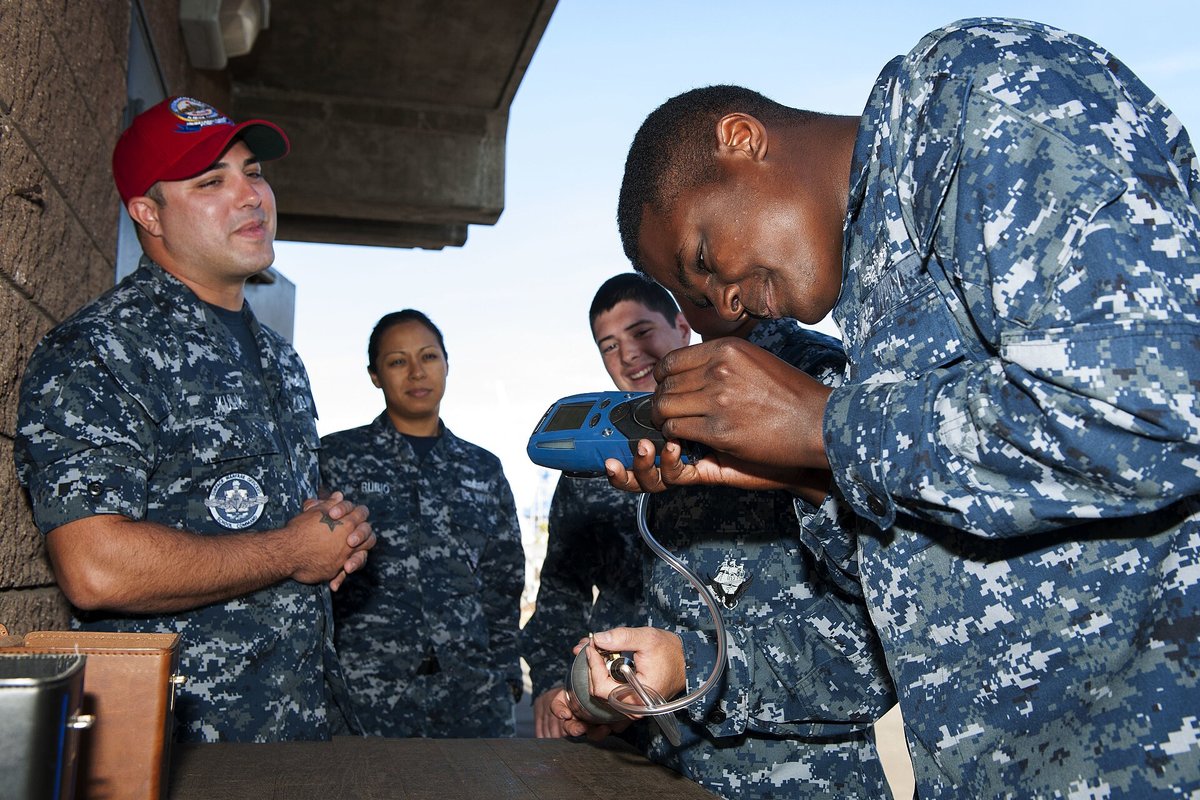
A portable gas detector can power on, display normal oxygen, and still fail to detect a hazardous gas. Its sensor inlet may be blocked; a sensor may have lost sensitivity; the wrong gas channel may be installed; or its alarm may not activate. A gas challenge is how an operator establishes that the monitor responds before relying on it.
Three procedures are regularly confused:
- A bump test proves basic response to an applied challenge gas and alarm function. It does not establish measurement accuracy.
- A calibration check compares the displayed gas reading with a known test concentration against the manufacturer's specified acceptance criteria, without adjusting the span response. Some manufacturers and OSHA guidance call for a preliminary zero; any zero adjustment should be identified in the record.
- A full calibration uses appropriate zero and span references to adjust the instrument's response; a calibration failure means the instrument cannot be relied upon until repaired or replaced and successfully retested.
These distinctions follow OSHA's Calibrating and Testing Direct-Reading Portable Gas Monitors Safety and Health Information Bulletin (SHIB), issued November 26, 2024. The bulletin conveys technical recommendations; it does not create a freestanding federal daily bump-test requirement. OSHA SHIB
The operational boundary: A detector passing its bump test is evidence about the detector at that moment, with those challenge gases. It is not evidence that the air in a tank, pit, vault, or sewer is acceptable for entry. The space still needs a hazard assessment, appropriate pre-entry sampling, monitoring during work, and all other applicable entry controls (1910.146(d) and 1926.1204).
Downloadable resources
The workbook flags incomplete device-check records.
Bump test vs. calibration check vs. full calibration
| Question | Bump test / function check | Calibration check / accuracy check | Full calibration |
|---|---|---|---|
| Purpose | Confirm that gas reaches sensors and the expected response and alarms occur | Verify reading against a certified known concentration within the model's allowed error | Adjust zero and/or span to establish a correct response to references |
| Test gas | Manufacturer-approved challenge gas(es) at sufficient concentration/time for the programmed test | Manufacturer-approved, known concentration(s) and specific pass tolerance | Approved zero reference and span gas(es), using specified setup |
| Numerical accuracy established? | No | Checked at the applied point(s), not every concentration or interferent | Adjusted at designated points, subject to sensor and system limits |
| Settings changed? | No calibration adjustment | No span adjustment; a manufacturer-directed preliminary zero may reset the reference and should be recorded | Yes, where the process permits and demands adjustment |
| Typical result | Pass/fail, often by sensor and alarm | Measured value, reference value, deviation, pass/fail | As-found/as-left data and calibration status |
| What a failure means | Do not rely on the monitor; follow the manufacturer's calibration/service sequence | Reading outside tolerance; perform prescribed full calibration | Remove from service pending qualified service or replacement |
| Does it authorize confined-space entry? | No | No | No |
Some automated docking stations use terminology such as quick bump, extended bump, or calibration test. Those names do not establish which operation the unit performed. Verify the configured program, sensor channels, gas delivery, alarm checks, acceptance tolerances, and saved test results. A station's green status light is not proof that an omitted or disabled channel was challenged.
What a bump test actually verifies
The monitor is exposed to gas that should produce the expected sensor and alarm response. In OSHA's SHIB description, the challenge is sufficient to activate the instrument's alarms. Depending on model and test program, an automatic system may assess a threshold response and time-to-response. The manufacturer's designated method controls the actual pass criteria. Simply hearing the buzzer during a startup self-test is not an applied-gas bump test: it may verify the alarm actuator but cannot prove gas reaches the sensor. OSHA SHIB; Industrial Scientific guidance
A qualitative bump can pass even when the sensor reads materially high or low. Conversely, a failure can result from empty or expired gas, wrong gas, incorrect regulator, disconnected adapter, obstructed inlet, a faulty pump, insufficient challenge time, sensor deterioration, or an alarm problem. Document the cause and the correction; do not turn a failed result into a pass by repeatedly resetting the detector.
Calibration check: accuracy without span adjustment
Follow the manufacturer's zero instructions before the check. OSHA's SHIB recommends zeroing first; however, zeroing can reset the instrument's reference. A post-zero span reading is not an untouched pre-adjustment (“as-found”) reading. Where failure investigation or drift trending needs as-found evidence, preserve the pre-zero indication and identify any intervening zero adjustment rather than mislabeling later data. Apply the specified reference gas, wait for the prescribed stabilization, and compare the observed reading against the stated concentration. Record the actual value, reference value, units, and the model/channel's tolerance. OSHA describes acceptance bands typically around 10–20% of the applied concentration, but explicitly directs users to the manufacturer's tolerance. Neither 10% nor 20% is a universal instrument pass criterion. A check near one concentration does not establish linearity throughout a sensor's range. OSHA SHIB
Field workflow: keep zero adjustments and span checks traceable
This is an administrative sequence, not a substitute for the manufacturer's exact operating procedure:
-
Confirm the asset ID, serial, installed channels, current configuration, calibration status, operator authorization and applicable manual revision. Review prior failures and service warnings. Do not start a test on a detector already designated out of service without following its service procedure.
-
Match each installed channel to the correct certified gas, concentration and compatible test equipment. Check the cylinder certificate of analysis, identification, expiration, regulator type/flow, test cap, filter and tubing specified for the model. Mixed cylinders do not necessarily exercise every installed sensor; an oxygen channel may need a different challenge.
-
Allow the manufacturer-specified warm-up and environmental stabilization. Confirm a verified clean-air location or approved zero-air cylinder and perform any zero procedure the manual specifies. If the instrument's reference is reset, document the adjustment and distinguish subsequent post-zero readings from original as-found values. Record whether zero was performed, skipped under the manual or failed.
-
Apply the test gas through the designated adapter and sampling path for the specified duration. Note actual gas flow and any pump/fault status where the manual calls for them. Wait for a stable reading using the model's stabilization criterion; do not stop simply because the first alarm sounds.
-
Record the span reading before any span adjustment. Identify whether it was obtained after an initial zero adjustment. Compare it with the cylinder's certified concentration in the same units. Where the manufacturer expresses the tolerance as a percentage of the reference-gas concentration, the descriptive calculation is:
Percent deviation = 100 × (observed reading - certified concentration)
                         / certified concentration
Use this formula only where the manufacturer defines the acceptance band that way. Some specifications use absolute units, asymmetric limits, sensor-specific conditions or a different evaluation. A nominal ±10–20% example in OSHA guidance is not an automatic pass threshold for a particular detector.
-
Verify the audible, visual and vibration alarm operation and any automatic test-station output. Record each sensor's result separately. If a channel or alarm fails, designate the unit unavailable and follow the manufacturer's failed-check/full-calibration pathway; do not reclassify an inaccurate reading as a pass.
-
Remove the gas, ensure the instrument returns to a valid monitoring state, preserve the original observations and identify any post-zero readings separately, and record the next action, technician, date/time and return-to-service authorization where applicable.
For controlled fleets, a second person should confirm restored service status after a failure, even where OSHA does not separately mandate a second signature. That is an employer quality-control choice, not an additional federal requirement.
Full calibration: zero and span correction
Calibration establishes or adjusts the instrument's relationship between sensor signal and known references. A typical two-point procedure uses a verified zero and a certified span concentration, but methods differ by sensor and monitor: some channels need different sequences or multiple points, and some oxygen channels handle ambient air specially. Use the correct device-specific instructions, not a generic combination of button presses. Verify success and complete any post-calibration functional test the manual specifies before returning the unit to use.
Do not overwrite the as-found measurement with the corrected value. Keep both. A detector that needs a large adjustment after a period in service may warrant review of earlier measurements, environmental exposure or sensor replacement. Successful display of a calibration icon also does not establish that every gas relevant to the job is detectable.
Does OSHA mandate a daily bump test?
Not as a blanket rule across all U.S. workplaces and portable detector models. OSHA's SHIB endorses the International Safety Equipment Association recommendation of a bump test or calibration check before each day's use, according to manufacturer instructions. A SHIB is technical guidance, not a regulation. A manufacturer may prescribe daily tests for a named model; a site procedure, customer contract, permit system, or another specifically applicable requirement may impose additional obligations. None of those sources is a universal OSHA mandate. OSHA SHIB
Which OSHA confined-space rule applies?
General industry: 29 CFR 1910.146 covers permit-required confined-space entry within that standard's scope. It explicitly excludes construction, agriculture and shipyard employment. A space that is not permit-required does not become subject to the full permit program merely because a portable gas detector is used. Employers still must comply with other applicable requirements. 1910.146(a)
Construction: 29 CFR 1926 Subpart AA applies to covered construction confined-space work, with exclusions in 1926.1201(b) for construction regulated under Subpart P (Excavations), Subpart S (Underground Construction, Caissons, Cofferdams and Compressed Air), and Subpart Y (Diving). An excavation may pose an atmospheric hazard while remaining outside Subpart AA. Evaluate the rule that actually governs that operation; do not transplant the Subpart AA permit provisions into an excluded excavation. Where Subpart AA does apply and another OSHA rule addresses a confined-space hazard, 1926.1201(c) calls for compliance with both applicable provisions. 1926.1201
Other hazardous-atmosphere work: A gas detector can also be called for or used under other standards, such as hazardous-waste operations or grain handling. The rules below compare the specified permit-space pathways; they are not a complete map of every federal, state-plan, maritime, mining or fire-code obligation. OSHA SHIB
What the federal confined-space provisions actually establish includes:
| Setting and entry pathway | Actual atmospheric-testing obligation | During-entry monitoring |
|---|---|---|
| General industry, full permit program, 29 CFR 1910.146(d)(5) | Test for acceptable entry conditions before authorization, with an exception for infeasible full pre-entry isolation; test oxygen, then combustibles, then toxics | Test or monitor as necessary; continuously monitor areas where entrants work if the large/continuous-system pre-entry exception applies |
| General industry, ventilation-only alternate entry, 1910.146(c)(5) | Test before entry using a calibrated direct-reading instrument for oxygen, flammables, and potential toxic contaminants, in that order | Periodic tests as necessary to confirm ventilation prevents a hazardous atmosphere |
| Construction, full permit program, 1926.1204(e) | Test before changing natural ventilation and before entry authorization, subject to the specified infeasibility exception; oxygen → combustibles → toxics | Continuous atmospheric monitoring unless permitted demonstrations support unavailable equipment or sufficiently frequent periodic monitoring |
| Construction, ventilation-only alternate procedures, 1926.1203(e) | A calibrated direct-reading instrument must be used for the pre-entry sequence | Continuous unless continuous equipment is unavailable or periodic monitoring is sufficient, with the prescribed alarm/check frequency safeguards |
The alternate procedures have strict eligibility conditions and are not a shortcut for any space with additional uncontrolled hazards. An employer may also need requirements from a different applicable OSHA standard, a state-plan rule, or a site-specific hazard determination. 1910.146; 1926.1203; 1926.1204
Calibration and daily function checks are complementary. The fact that a cited entry provision, such as 1910.146(c)(5)(ii)(C), says “calibrated” does not itself create a fixed national 24-hour bump interval. Equally, following a recommended daily bump schedule does not excuse using an out-of-calibration or unsuitable monitor.
How often should you bump test or calibrate a gas detector?
There is no single interval for every sensor or detector. Use the applicable regulation, the exact manufacturer instructions and the site's documented risk-based schedule. The examples below are manufacturer-specific, not interchangeable rules.
| Instrument / program | Original source's recommendation | Important qualification |
|---|---|---|
| MSA ALTAIR 4XR | Bump before each day's use; periodically perform full calibration and immediately after a failed bump | MSA calls daily bump best practice; more frequent testing after shock or contaminant challenges. Current manual and sensor configuration govern. MSA user guide |
| Industrial Scientific non-DualSense configurations (including listed Ventis, MX6 and legacy instruments) | Calibrate before first use and monthly; bump before each day's use | The manufacturer's published policy allows risk-based adjustments when daily testing is impractical; model/firmware guidance and employer policy still matter. Industrial Scientific |
| Industrial Scientific devices actually operating in qualifying DualSense mode | Calibrate before first use and monthly; bump interval between calibrations set by policy; the published table also discusses pre-use self-testing for a continuously operated instrument | Only the qualifying redundant, functioning sensor configuration receives this distinction. The source specifically documents Tango TX1 self-test behavior; do not assume identical self-test procedures or capabilities on other models. Industrial Scientific |
| Honeywell BW Solo | Bump before each day's use; calibrate after failed bump and no less frequently than every six months under the manual's stated conditions | This is for BW Solo, not every Honeywell/BW monitor; impacts, immersion, over-limit events and other doubts prompt additional checks. BW Solo manual |
| Dräger X-am 2500 | Six-month recommended calibration/adjustment interval for Ex, O₂, H₂S, SO₂, NO₂ and CO channels; the manual separately states a CSA bump-before-use requirement in its approval-specific instructions | The manual documents separately configurable quick and extended bump-test modes. The six-month interval is not a six-month bump-test schedule, and the CSA condition is not a federal OSHA requirement. Check the unit's approval, installed sensors and current manual. X-am 2500 manual |
An employer's schedule should identify the make, exact model, firmware, channel/sensor type, manual revision and operating mode. A fleet-wide rule copied from a different monitor may be wrong.
Dräger example: quick versus extended bump testing
The X-am 2500 technical manual describes two modes configured through Dräger CC-Vision. Its quick bump test checks whether a defined alarm threshold is crossed (with a different oxygen-channel test condition). Its extended bump test checks whether the measured response reaches a configured challenge concentration within a tolerance window and time. The manual identifies the extended mode as the delivery setting for the described configuration. The selected mode, challenged channels, gas concentration and stored results therefore belong in the instrument record. These are X-am 2500 procedures, not definitions imposed on every portable detector by OSHA. Dräger technical manual
Why sensors drift, and what the display does not tell you
Sensors change with age and exposure. Electrochemical channels may lose sensitivity or exhibit offsets; catalytic combustible sensors can be inhibited or poisoned; optical or infrared systems have distinct gas detection limits; filters, diaphragms and inlets can become obstructed. Mechanical shock, temperature, humidity, pressure changes, corrosive vapors and severe gas overrange can also impair performance. A monitor can produce a plausible zero with a degraded span response. OSHA SHIB
Fresh-air zero is not a gas challenge
Zero sets the detector's reference in air known to be free of the gases of concern, or using the manufacturer's approved zero-air supply. “Outside the space” does not prove air is uncontaminated. Nearby vehicle exhaust, solvents, discharge points or another process can corrupt a zero. For the MSA ALTAIR 4XR, Fresh Air Setup is expressly limited; MSA warns against performing it without confidence that the air is clean, and states that it does not replace gas-response checking. The manual's oxygen-channel treatment is model-specific. MSA Fresh Air Setup
Zeroing in contaminated air can suppress subsequent readings. If the location is uncertain, use approved zero gas or move to a verified location and follow the manual. Do not force zero to remove an unexplained positive or negative reading.
Gas-specific zero example, Honeywell BW Solo CO₂: Its user manual states that some CO₂ configurations display an “Apply N₂?” prompt and need nitrogen for zeroing. The same instructions note that newer CO₂ units with updated firmware may not need nitrogen. This is not a general instruction to apply nitrogen to other sensors or meters: confirm the exact BW Solo sensor, firmware and current procedure before changing the zero reference. Honeywell BW Solo manual
Alarm setpoints, response time, and uncertainty
Before use, verify that low/high instantaneous alarms, oxygen alarms, and any STEL/TWA alarms have the appropriate configuration for the space and substances actually present. Some units permit changes to alarm setpoints; others ship with defaults that may not meet an employer's entry conditions. OSHA atmospheric hazard definitions, entry permit acceptance values, manufacturer alarm defaults, and occupational exposure limits are not interchangeable. A short-duration indication cannot by itself demonstrate compliance with an 8-hour PEL or another averaging-period limit.
Legal atmospheric criteria versus a detector's programmed alarms
| Parameter | Relevant federal confined-space rule | Correct operational interpretation |
|---|---|---|
| Oxygen deficiency | Below 19.5% by volume in 1910.146(b) and 1926.1202 | An alarm threshold must protect the actual entry plan; a reading at a single point is not evidence that oxygen is acceptable elsewhere. |
| Oxygen enrichment | Above 23.5% by volume in both definitions | Oxygen enrichment increases fire risk. It is not a harmless reading simply because a breathing-asphyxiation alarm is quiet. |
| Combustible gas or vapor | The definitions describe in excess of 10% of the LFL; the alternate-entry procedures also prohibit a hazardous atmosphere during occupancy | A common conservative entry/alarm criterion is below 10% LFL, reflected in OSHA's sample permit. Do not treat the definition's phrase “in excess of” as permission to ignore a reading at exactly 10%. Determine the actual permitted conditions and controls. |
| Toxic gases or vapors | Hazardous-atmosphere definitions reference applicable dose/PEL or another immediately dangerous condition; the hazardous substance depends on the space | There is no universal OSHA confined-space alarm number for every CO, H₂S, chlorine, solvent, ammonia or CO₂ application. Identify the hazard and the actual applicable short-term, ceiling, IDLH and/or time-weighted criteria. |
Sources: 1910.146(b), 1926.1202, and OSHA's sample pre-entry checklist, 1910.146 Appendix D. The language in 1910.146(b) must also be read with the applicable permit obligations and procedures; Appendix E's nonmandatory sewer-entry example recommends an alarm at 10% LFL or more. In construction, 1926.1204(c)(4) specifies restrictive conditions involving inerting when the atmosphere cannot be reduced below 10% LFL. None of these statements authorizes routinely entering an uncontrolled flammable atmosphere. 1910.146 Appendix E; 1926.1204
Alarm configuration decision, before a confined-space job:
- List hazards that can actually be present, including substances not measured by the monitor.
- Record the instrument's actual configured low/high, oxygen, STEL/TWA and fault alarms, not assumed factory defaults.
- Compare those settings with the site-specific acceptable entry criteria and response plan, taking sensing range, bias, resolution, sample delay and uncertainty into account.
- Assign who needs to be alerted and what action follows a warning, high alarm, sensor fault, lost sample flow, low battery or lost communications.
- Where the monitor cannot provide an adequate warning for a hazard, change the monitoring method or controls before authorizing entry. Do not simply raise an alarm threshold to make it quiet.
An 8-hour exposure limit is not automatically an instantaneous toxic-gas alarm setting. Conversely, an instantaneous alarm below a PEL does not prove compliance with that PEL's averaging period. Preserve the alarm configuration associated with each entry permit, especially if settings are changed later.
For quantitative decisions, consider the certified test gas's uncertainty, sensor bias and precision, calibration reference, sensor response time, pump and tubing delay, environmental effects, resolution, and interferents. NIOSH's Components for Evaluation of Direct-Reading Monitors for Gases and Vapors (2012-162) treats those as separate performance characteristics. It does not provide one correction factor applicable to every field instrument. Where readings approach a critical entry or exposure criterion, evaluate the uncertainty conservatively and consult the technical specification or qualified industrial hygiene support. NIOSH 2012-162
What to do near an entry limit: Suppose a reading is close to the employer's permitted concentration for a particular gas. Even if the display is below the limit, the assessor needs to consider the instrument's specified accuracy at that concentration, the actual calibration reference, sample lag and potential interferences. The correct response may be to stop entry, repeat representative measurements with a more appropriate or more accurate method, and improve controls before resuming. Do not subtract a generic percentage from the display, round downward, or raise the alarm threshold to obtain a passing result. No universal uncertainty margin can be derived from OSHA's typical calibration-check tolerance.
Cross-sensitivity and blind spots
- Electrochemical sensors: other gases may cause a positive or negative response. For example, NIOSH mining research documents hydrogen interference with some carbon-monoxide sensors; the degree and direction should be taken from the installed sensor's manufacturer chart. NIOSH research
- Catalytic-bead %LEL sensors: response depends on oxygen and the gas used for calibration. The reading for methane-calibrated equipment may differ for a solvent vapor or propane; some chemical exposures can desensitize the element. The ALTAIR 4XR manual specifically cautions about oxygen-deficient conditions, poisoning exposures, and certain high-flash-point vapors. MSA precautions
- Infrared combustible channels: the gas species detected differ from catalytic sensors. Do not assume an IR hydrocarbon sensor detects hydrogen; check the particular detector's gas list and technology.
- Four-gas configurations: O₂, %LEL, CO and H₂S do not mean that chlorine, ammonia, carbon dioxide, other solvent vapors, or all IDLH hazards are measured. Choose extra sensors or methods based on the actual process, SDSs, previous contents and potential reaction products. The absence of an alarm for an unmeasured chemical is not evidence of its absence.
Likewise, %LEL is not a universal measure of toxic risk. A solvent may be harmful well below a combustible alarm, while high concentrations beyond a combustible sensor's valid range can yield unreliable interpretations. OSHA Technical Manual
Match sensing technology to the question
| Sensor approach | What it can do | Specific blind spot / caveat | Verification needed |
|---|---|---|---|
| Electrochemical toxic channel | Measures the gas(es) for which the installed cell is designed | Cross-sensitive gases may cause higher or lower readings; cell aging and environmental conditions matter | Exact sensor's interference chart, range, response and calibration gas |
| Catalytic-bead combustible channel | Measures combustible-gas response relative to its calibration gas | Needs adequate oxygen for combustion; poisoning or inhibition can reduce response; different flammables have different response factors | Oxygen limitations, calibration gas, correction factors and poisoning warnings |
| Infrared hydrocarbon sensor | Measures appropriate infrared-active hydrocarbons; some designs function in low oxygen | Conventional hydrocarbon IR does not measure hydrogen; the gas list is technology/model specific | Manufacturer target-gas list and infrared sensor instructions |
| Oxygen channel | Detects oxygen deficiency/enrichment in its specified range | Cannot identify what displaced oxygen or detect toxic exposures at normal oxygen | O₂ calibration/response instructions plus separate gas hazard assessment |
| Photoionization detector (PID), where used | Screens many photoionizable volatile organics | Does not identify a mixture's components, nor detect every compound; response factors and lamp energy matter | Gas identity, correction factors, range and any complementary sampling method |
MSA's ALTAIR 4XR performance specification gives a particularly useful documented example, not a universal correction: in the table for its standard CO measuring channel, an applied 100 ppm hydrogen challenge is shown producing a 48 ppm CO indication. The same specification separately describes a hydrogen-resistant CO (CO-H₂-RES) sensor option. The 48 ppm illustration does not apply to that hydrogen-resistant channel or to another installed CO cell. MSA also warns that cross-sensitivity varies with conditions, sensor position and sensor age. Conventional IR hydrocarbon detection is not suitable for hydrogen gas detection. MSA hydrogen guidance
Pre-entry sampling and monitoring: The separate safety decision
- Characterize the space before choosing a detector. Review previous contents, adjacent lines and connected systems, cleaning chemicals, coatings, decomposition, hot work, engines, oxygen displacement, potential engulfment, and changeable inflows. Identify gases not covered by the installed channels.
- Check the instrument and sampling train outside the space. Verify acceptable calibration status and the function check; model/channel match; alarm setpoints; battery; inlet, filter and tubing; pump-flow fault/alarm and leak or blockage check where prescribed. Confirm the instrument's approval, protection rating and permitted accessories for the actual hazardous location, including potentially explosive atmospheres where relevant. Verify that the pump is moving air through the complete line, not merely running audibly. An accurate instrument with unsuitable hazardous-location approval is still unsuitable for the job.
- Test at multiple representative locations. From outside, sample the route and potential stratified zones: upper, middle, lower and dead zones as relevant. Account for instrument sensor response plus sample transport time and any gas loss in tubing. Appendix B to 1910.146 advises no less than the manufacturer-specified response time at each parameter and describes testing approximately four feet in the direction of descent and to each side where stratification is possible. That distance is guidance for a specific descent context, not a fixed one-point sampling rule. 1910.146 Appendix B
- Interpret in the prescribed order. Oxygen first; combustibles next; toxic gases and vapors afterward. A modern multigas unit can display channels together; that does not eliminate the need to evaluate them in the legal priority order. 1910.146(d)(5)(iii); 1926.1204(e)(3)
- Record the conditions, not just “pass.” The entry record should contain actual results, units, sampling times/locations, tester identity, permitted conditions, and any changes or controls. Under full permit procedures, 1910.146(f)(10) and 1926.1206(k) call for test results with tester names/initials and times. 1910.146; 1926.1206
- Continue appropriate monitoring during entry. Position monitors and sampling points to capture entrants' actual exposure and changing hazards, taking account of source location and airflow; keep alarms perceptible and communication/retrieval procedures functional. Construction's ordinary permit pathway starts with continuous monitoring subject to the exact exceptions in 1926.1204(e)(2); general industry's text is different. Reassess when work, ventilation, weather, chemicals, adjacent operations or readings change.
Remote sampling: the pump, tubing and sensor each add a limitation
A diffusion monitor samples at its inlet; it does not automatically measure atmosphere several feet away or down a manhole. For remote pre-entry checks, use a manufacturer-approved pump/probe and complete sampling assembly capable of drawing air from the actual location being evaluated. Check its flow-fault response and fittings using the correct model-specific test. A motor noise alone does not prove gas is moving through the full line. MSA describes a sampling-system blockage check for its pump-equipped ALTAIR 5X PID family; do not assume the buttons or diagnostic sequence are identical on other models. MSA pump verification
At each position, allow for both transport through the line and the sensor's own response/stabilization time. An alarm can trigger before the final concentration is displayed; an initial zero-looking display may simply reflect a sample that has not arrived. Industrial Scientific publishes a practical 2-second-per-foot plus 2-minute remote sampling rule of thumb for its examples, but the controlling rule for an actual job is the installed pump, tubing, gas, sensor and manufacturer's instructions, not a universal OSHA timing formula. 1910.146 Appendix B instead directs a measurement lasting no less than the manufacturer's minimum instrument response time, while recognizing probe sampling speed. Industrial Scientific remote sampling; 1910.146 Appendix B
Tubing compatibility is a measurement issue, not just a connection issue. Industrial Scientific warns that urethane tubing may absorb chlorine, chlorine dioxide, hydrogen chloride and certain VOCs; its guidance discusses appropriate fluoropolymer-lined alternatives for those applications. A tube that is acceptable for O₂ or CO may not be suitable for a reactive chemical at low concentration. The approved tube, filter, line length, sample time and gas-specific limitations should be checked as one system. Industrial Scientific pumped monitoring
Practical sequence from a safe location:
- Verify tubing compatibility, full-line integrity and the manufacturer-prescribed pump-flow or blockage test; keep the operator outside the space.
- Sample representative layers, compartments and the intended route, allowing transport plus sensor stabilization at each point. Record location, depth, time and measured concentrations; do not assume a simple gas-layer pattern in moving air.
- Communicate results and repeat sampling when conditions change. Use another appropriate method where the installed channels cannot detect a suspected substance.
Never use a detector, even a recently calibrated one, beyond its sensor range, environmental rating, approved sample path or known interference limitations. An overrange/fault indication is not a numerical exposure result.
Why a passed bump test never proves a confined space is safe
A successful bump says, for example, that the H₂S sensor and selected alarms responded to the H₂S challenge at the test station. It says nothing about the H₂S concentration inside a sewer an hour later, whether the oxygen at the bottom of a pit is adequate, whether a line is about to release nitrogen, or whether an uninstalled CO₂ sensor would have detected a high level. Entry authorization is a separate operational and regulatory decision (1910.146(f) and 1926.1206), requiring acceptable atmospheric results and controls for all non-atmospheric hazards such as engulfment, energy, falls, and rescue (1910.146(k) and 1926.1211).
Three jobsite scenarios: what the test proves and what it misses
Scenario A: underground utility vault, ventilation stops. The crew's multigas detector passed its morning bump test, and the supervisor has documented suitable pre-entry readings. While workers are inside, forced-air ventilation loses power. The earlier bump result cannot determine the developing vault atmosphere. The planned monitor/alarm and attendant response needs to detect loss of acceptable conditions in time for safe exit. Under construction's full permit program, continuous atmospheric monitoring is the default with narrow stated exceptions (1926.1204(e)(2)), and the permit needs to address how an increase in atmospheric hazards will be detected if the fan stops. Stop the affected entry, reassess and reauthorize only when the applicable conditions are restored. 1926.1204; 1926.1206
Scenario B: tank previously cleaned with solvent. O₂, CO and H₂S readings look normal, and the %LEL channel is below the employer's combustible trigger. A typical four-gas monitor may still be incapable of measuring a solvent's toxic concentration. The correct next step is to identify the actual solvent and process byproducts, evaluate whether its vapor can be measured by the existing sensors, select a validated additional method and determine the appropriate exposure criteria before entry. If a pumped line is used, verify that the solvent is not substantially lost to the tubing. Do not convert a non-alarm on a combustible channel into an assessment of toxic vapor exposure.
Scenario C: hydrogen-containing process. A CO-channel indication may be caused by hydrogen interference, while an IR hydrocarbon channel may not detect hydrogen. Check the installed sensors' interference charts and select an appropriate hydrogen measurement method. Use the interference data for the installed sensor; the MSA example above does not supply a correction for other models. MSA performance; MSA hydrogen guidance
For the corresponding entry procedure, see HazComFast's construction permit template, general/construction comparison, and permit-required confined-space guide. The permit-space guide covers the evaluation of 1910.146(c)(1).
Check the tool's built-in triggers: The linked permit generator uses a 25 ppm CO trigger and a 10 ppm H₂S trigger when screening atmospheric readings. Those values are tool-specific screening choices, not universal federal OSHA toxic-gas alarm setpoints or proof of safe entry. The entry employer needs to independently assess the hazards, determine appropriate site-specific acceptance criteria, and compare them with the monitor's actual programmed alarms. If the site calls for a different or more protective criterion, the generator's built-in threshold does not replace it.
Pre-use gas detector checklist
Use alongside the current manual. Put the instrument on HOLD / DO NOT USE if an item fails or cannot be verified.
- Correct instrument, installed sensor channels, measurement ranges and sensing technology for identified hazards.
- Instrument, batteries and accessories approved for the location's electrical/flammable-atmosphere classification, if applicable; manufacturer's environmental limits checked.
- Current manual, training, site procedure, maintenance status and calibration due date checked.
- Physical condition, inlets, membranes, seals, filters, case, battery and display acceptable.
- Pump, flow-failure function, probes and full sampling line checked where applicable; no leaks, kinks or blockages.
- Audible, visible and vibration alarm outputs checked as specified; necessary channels enabled; actual setpoints reviewed.
- Clean zero-reference location verified; zero/FAS performed only if and as specified.
- Correct, in-date certified challenge gas and concentration(s), regulator, adapter, flow and tubing used.
- Installed sensor roster compared with the dock/test configuration and job hazards; every needed channel actually challenged with the approved gas or method. An excluded, disabled or untested needed channel is not a pass.
- Any drop, immersion, overrange, suspected contaminant poisoning, prolonged storage, sensor change or unexplained reading evaluated; extra service performed as prescribed.
- Test station gas removed, monitor recovered/stabilized, readiness displayed; record associated with instrument ID and user.
- Independent permit-space assessment, pre-entry tests (1910.146(d)(5) or 1926.1204(e)) and ongoing monitoring plan arranged; the pre-use check is not entry authorization.
Failed bump test or calibration: Response procedure
- Stop relying on that instrument immediately. Label or electronically lock it OUT OF SERVICE. If it is the active monitor protecting entrants, notify the attendant and entry supervisor and terminate/suspend entry as the situation calls for; direct entrants to exit when safe monitoring cannot be assured or the alarm/hazard procedure calls for it. Do not send an unprotected person inside to retrieve a monitor.
- Preserve evidence. Record ID, channel, test type, time, challenge gas, cylinder ID/expiry, as-found reading or error, alarm behavior and operating conditions. Retain relevant event data if there may have been an exposure or incident.
- Rule out test-setup errors without bypassing the failure. A qualified operator can inspect gas compatibility, cylinder pressure and expiry, delivery connections, regulator flow, adapter fit, inlet/filters, and the specified warm-up time in a safe test location. Follow the manufacturer on whether to repeat a test.
- Perform the indicated full calibration, if allowed and competent to do so. OSHA's SHIB recommends full calibration after a failed bump/check. A failed calibration calls for withdrawal from service and manufacturer-qualified service, sensor replacement or replacement instrument. A successful adjustment does not erase the initial failure record. OSHA SHIB
- Verify and release. After corrective work, complete the manufacturer's return-to-service checks, including any gas challenge, alarm verification and performance check. Record as-left readings, repair details, tester and approver. Check whether prior measurements or entries need review because the instrument may have been inaccurate.
- Resample before resumed entry. A replacement or repaired detector needs to be suitable, function-verified, and used to re-establish acceptable conditions before any new authorization. Correct the hazard source and review permit/monitoring arrangements if conditions changed.
Gas detector test and calibration log template
Use two linked records. The first is short enough for a crew's pre-use check. The second preserves calibration and maintenance evidence. Maintain a unique event ID so a later calibration or repair can be linked to the original failed bump without replacing it. The companion Gas Detector Test & Calibration Log workbook has separate daily and service/calibration worksheets.
Daily bump-test log: one row per instrument and test event
| Date/time | Instrument ID / model | Operator | Test gas cylinder ID / expiry | Channels challenged / coverage verified | Sensor/alarms result | Pump/flow or N/A reason | Final status | Fault / next action | Event ID |
|---|---|---|---|---|---|---|---|---|---|
| ____ | ____ | ____ | ____ | ____ | PASS / FAIL / NOT TESTED | ____ | ____ | ____ | ____ |
The daily row is a summary. Retain the docking export or channel-level results where needed. Compare the installed sensor list with every channel actually challenged. A missing test is NOT TESTED, not a pass; N/A is appropriate only for a genuinely inapplicable item, with a recorded explanation. If a sensor, alarm or sampling-path check fails, the instrument remains HOLD or OUT OF SERVICE until corrected.
Calibration and repair log: one row per channel and event
| Date/time / event ID | Instrument, serial / channel | Certified gas / cylinder / expiry | As-found reading | Manufacturer acceptance criterion | Calibration or repair action | As-left result | Return-to-service check | Tester / approver | Final status |
|---|---|---|---|---|---|---|---|---|---|
| ____ | ____ | ____ | ____ | ____ | ____ | ____ | ____ | ____ | ____ |
Retain gas concentration and units, certificate/lot, regulator/flow, zero method, configured alarms, sensor type and relevant firmware or test settings in the detailed service record. The daily crew form is intentionally shorter.
Record design and use:
- Event ID: ties each sensor/channel row to one actual test occasion, docking-station run or calibration session.
- Reference traceability: cylinder ID, lot, expiry and certificate reference permit a later reviewer to verify the gas standard. A certificate should be available from the supplier; NIST traceability, gas stability and expiration matter. OSHA SHIB
- As found / as left: keep the initial observation before any adjustment and the subsequent reading when an adjustment is made. Never overwrite a failed first result with a later passing result.
- Pass criteria: write the actual manufacturer's channel-specific tolerance, not a generic percentage. Where the event is purely qualitative, the field may specify the manufacturer's alarm/response criterion instead.
- Final status: distinguish
AVAILABLE,HOLD,OUT OF SERVICEandRELEASED AFTER SERVICE, with the approving person's identity and date. These are suggested employer workflow values, not federally prescribed codes. RecordAVAILABLEonly when every test and release condition has been satisfied. - Missing versus not applicable: record
NOT TESTEDfor a needed channel that was not challenged; reserveN/Afor controls that genuinely do not apply, such as a pump test on a diffusion-only instrument. - Event linkage: keep the relevant entry permit/work order reference, but do not substitute this maintenance log for the atmospheric results an entry permit records.
Keep an equipment-master record as well: make/model/serial, sensor type and installation dates, firmware, configured alarms, certified gases and regulators, current manual, assigned site, service history and approved testing interval. A dock-generated result should retain individual sensor status, not only “unit passed.” Preserve the export of the original dock file and any fault/event history where it is available, rather than relying on a manually transcribed summary alone.
Example of linked failure and service records: An authorized technician documents a CO-channel accuracy check as FAIL, retains the original observation, records the calibration the manufacturer calls for, and changes the equipment status to HOLD. A later successful calibration and gas challenge are recorded as a new event, then an authorized reviewer may release the unit. Keep the original failure and subsequent release traceable as separate events.
Retention: a critical distinction
Under 1910.146(e)(6) and 1926.1205(f), each canceled entry permit must generally be retained for at least one year. Those permits include test results required under the full permit pathway. In a November 3, 2023 OSHA interpretation, the agency clarified that routine atmospheric data entered on a 1910.146 permit for acute entry-hazard control is subject to the permit's one-year minimum, not automatically a thirty-year exposure-record rule (1910.1020(d)(1)). The same letter warns that separately conducted monitoring to satisfy substance-specific exposure standards or 1910.1000 can be an employee exposure record with a different retention period. OSHA 2023 interpretation
Do not conflate (a) canceled entry permits, (b) separate instrument bump/calibration maintenance logs, and (c) occupational exposure sampling records. OSHA's gas-monitor SHIB recommends retaining calibration history for an instrument's life; it does not state a universal enforceable service-log period. Preserve longer where another specific OSHA standard, state law, employer record schedule or litigation hold applies. OSHA SHIB; 1910.1020
The 2023 interpretation also states that OSHA archived a more expansive November 1996 interpretation on this particular retention question. On this question, the 2023 clarification is the current OSHA position. OSHA 2023 interpretation
Sources and further reading
- OSHA, Calibrating and Testing Direct-Reading Portable Gas Monitors, SHIB 11-26-2024, definitions, gas quality, recommended checks and records.
- 29 CFR 1910.146 and Appendix B to 1910.146, general-industry entry, atmospheric testing order, test duration and stratification.
- 29 CFR 1926.1201, 1926.1203, 1926.1204, 1926.1205, and 1926.1206, construction scope exclusions, alternate and full permit procedures, monitoring, records.
- OSHA, Nov. 3, 2023 interpretation and 1910.1020, retention distinction between entry monitoring and employee exposure records.
- NIOSH, Components for Evaluation of Direct-Reading Monitors, Pub. 2012-162, bias, precision, uncertainty, response and interferences; NIOSH atmospheric monitoring research, a documented sensor-interference example.
- MSA ALTAIR 4XR bump test instructions, Fresh Air Setup, and safety limitations.
- Industrial Scientific calibration and bump-test procedure by instrument configuration.
- Honeywell BW Solo User Manual, specific daily bump and periodic calibration guidance.
- Dräger X-am 2500 Technical Manual, model/channel-specific calibration intervals and quick/extended bump modes.
- OSHA Technical Manual: direct-reading instrumentation, limitations in combustible and toxic gas monitoring.
- 1926.1202, 1910.146 Appendix D and Appendix E to 1910.146, defined hazards and illustrative acceptance/alarm guidance, with different legal statuses.
- MSA ALTAIR 4XR performance specification and hydrogen detection technical FAQ, model-specific cross-sensitivity and IR hydrogen limitations.
- MSA pump verification and Industrial Scientific pumped/remote sampling guidance, pump checks, gas transport delays and tubing compatibility.
Frequently Asked Questions
1. Does OSHA mandate daily bump testing of every gas detector?
No single federal OSHA confined-space provision, such as 1910.146 or 1926.1204, universally establishes that daily interval. OSHA's SHIB recommends a bump test or calibration check before daily use in accordance with manufacturer instructions. Check the actual model, applicable standard, employer policy, state plan and contract requirements.
2. Can a gas detector pass its bump test and still be inaccurate?
Yes. A qualitative bump demonstrates response and alarm function, not numerical measurement accuracy. A calibration check compares the displayed value against a known concentration within a specified tolerance. The entry rules in 1910.146(c)(5) and 1926.1203(e) call for a calibrated direct-reading instrument.
3. Is a fresh-air zero the same as a bump test?
No. Zero establishes a reference. It does not challenge a sensor with its target gas, test span sensitivity, or prove alarm response. Zeroing in contaminated air can create dangerously low subsequent readings for the pre-entry tests of 1910.146(d)(5) and 1926.1204(e).
4. Does a passing four-gas monitor authorize confined-space entry?
No. The employer needs to assess all atmospheric and physical hazards, conduct applicable pre-entry tests, verify acceptable conditions and controls, authorize the entry under the correct procedure (1910.146(d) or 1926.1204), and maintain the monitoring it calls for. Four channels do not detect every toxic or oxygen-displacing substance.
5. What should happen after a failed bump test?
Stop using the detector, document the failure and follow the manual's troubleshooting and full-calibration path. If full calibration fails, remove the instrument from service for qualified repair or replacement. Do not resume an entry on the strength of that failed monitor; the pre-entry tests of 1910.146(d)(5) and 1926.1204(e) start again with a suitable instrument.
6. How long should bump and calibration records be kept?
OSHA recommends keeping instrument calibration history for the instrument's life, but the SHIB is guidance. Canceled permit-entry records carry a distinct one-year federal minimum under 1910.146(e)(6) and 1926.1205(f). Exposure monitoring performed for another applicable standard may have longer retention; examine the type and purpose of each record.
Site-wide regulatory figures such as compliance dates and penalty amounts come from our regulatory source-of-truth modules, last checked against the eCFR, OSHA.gov, and the Federal Register on October 19, 2026. Last reviewed November 14, 2026.
About This Article
Published by: HazComFast
Published: November 14, 2026
Last Updated: November 14, 2026
- https://www.osha.gov/publications/shib093013
- https://www.osha.gov/laws-regs/regulations/standardnumber/1910/1910.146
- https://www.osha.gov/laws-regs/regulations/standardnumber/1926/1926.1201
- https://www.osha.gov/laws-regs/regulations/standardnumber/1910/1910.146AppB
- https://www.osha.gov/laws-regs/regulations/standardnumber/1926/1926.1203
- https://www.osha.gov/laws-regs/regulations/standardnumber/1926/1926.1204
- https://www.osha.gov/laws-regs/regulations/standardnumber/1926/1926.1205
- https://www.osha.gov/laws-regs/regulations/standardnumber/1926/1926.1206
This content is for informational purposes only and does not constitute legal advice.