Fire extinguisher training depends on the employee's assigned role. In general industry, 29 CFR 1910.157(g) distinguishes education for employees allowed to use portable extinguishers from equipment-use training for employees designated under an emergency action plan. Both have initial and annual requirements where they apply.
Establish the response policy first. Employees need to know whether they should evacuate or may perform a defined firefighting task. Construction employers also have specific duties under 1926.21 and 1926.150, described below.
Who needs education or training?
Read the training provisions with the scope and exemptions in 1910.157(a) and (b).
| Workplace arrangement | Effect under 1910.157 |
|---|---|
| Written policy for immediate total evacuation, no extinguishers available, and compliant emergency action and fire prevention plans | 1910.157(b)(1) provides an exemption, unless another Part 1910 standard specifically requires an extinguisher. |
| Extinguishers are present but intended for use by people other than employees, with compliant emergency action and fire prevention plans | Paragraph (a) leaves the inspection, maintenance and testing requirements in (e) and (f) applicable. |
| Portable extinguishers are provided for employee use | Paragraphs (g)(1) and (g)(2) require education on use principles and incipient-stage firefighting hazards. |
| The emergency action plan authorizes designated employees to use equipment and requires others in the fire area to evacuate | Paragraphs (g)(3) and (g)(4) require designated-employee equipment training. The (b)(2) exemption concerns distribution requirements in (d). |
Communicate the policy to supervisors and employees. An instruction to use an extinguisher needs to be consistent with the employee's assigned role and training.
Initial and annual requirements
| Instruction | Content | Timing |
|---|---|---|
| Education under 1910.157(g)(1) and (g)(2) | General principles of extinguisher use and hazards of incipient-stage firefighting. | Initial employment and at least annually thereafter. |
| Designated-employee training under (g)(3) and (g)(4) | Use of the appropriate firefighting equipment. | Initial assignment to the designated group and at least annually thereafter. |
OSHA's definition of training in 1910.155(c)(41) includes instruction and hands-on practice with the equipment and duties expected. Build that practice into designated-employee training.
Education can use different formats. OSHA's September 12, 1986 interpretation, corrected in 2004, discusses educational materials and distinguishes the employer's policy options.
What employees need to learn
Use the site's equipment, alarm system and response policy during the session.
| Subject | Practical instruction |
|---|---|
| Reporting a fire | Alarm method, emergency contact and information to give responders. |
| Assigned role | Who evacuates and who is designated to use equipment. |
| Fire limits | Which conditions are within the assigned response and when to withdraw. |
| Equipment selection | Fire hazards covered by the extinguisher's rating and manufacturer instructions. |
| Escape | Keeping a usable exit available and leaving when conditions change. |
| Equipment operation | Instruction and practice appropriate to the employee's assignment. |
| After use or a defect | Reporting, replacement and service arrangements. |
Under 1910.155(c)(26), an incipient-stage fire is an early-stage fire controllable with the listed portable or small-hose equipment without protective clothing or breathing apparatus. Employees need to recognize when smoke, heat, spread or another hazard exceeds their assigned response.
Does training need a live fire?
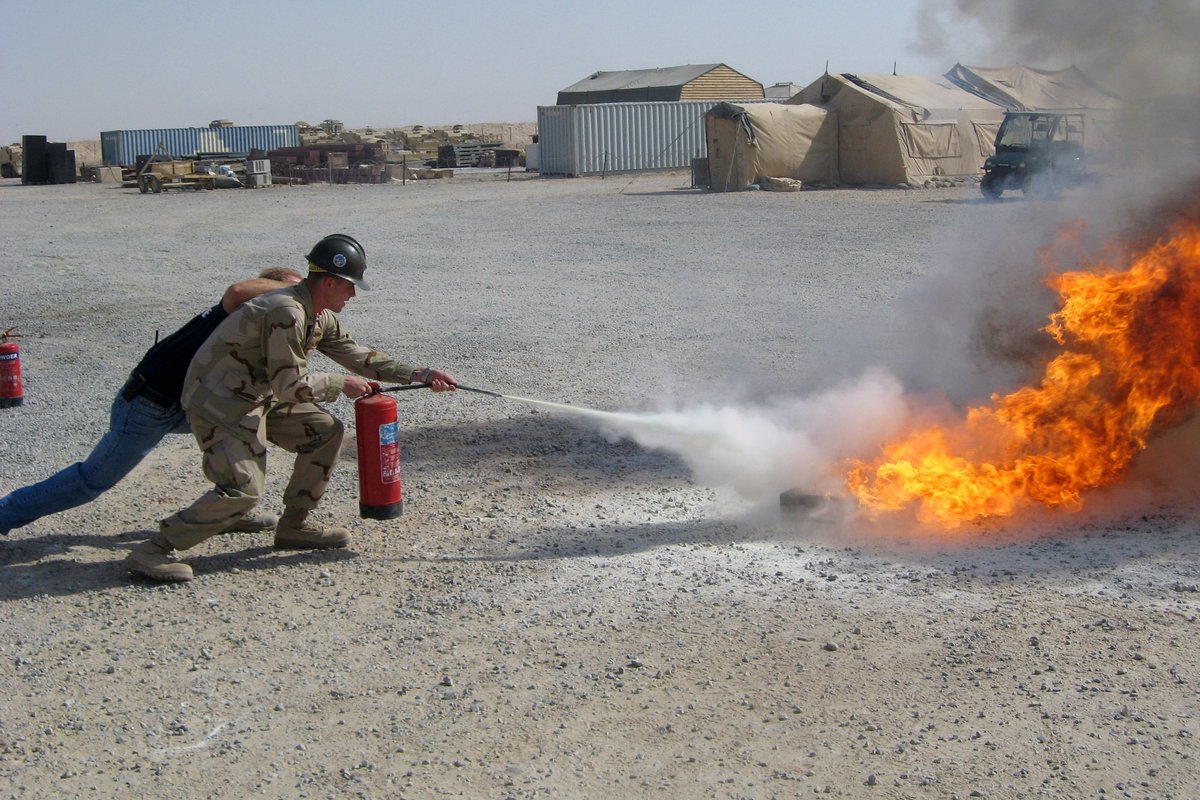
A live fire is different from hands-on equipment practice. OSHA's July 2, 1991 interpretation explains that training can simulate emergency conditions without starting a fire. It also describes practical equipment activities, including extinguisher discharge.
Select exercises that teach the assigned equipment safely. Where live-fire demonstrations are used, the interpretation calls for qualified supervision and a suitable facility, with attention to open-burning rules. Check applicable State Plan and local requirements when arranging the exercise.
Teach PASS within the response procedure
For portable extinguishers whose instructions use this method, PASS means:
- Pull the pin.
- Aim at the base of the fire.
- Squeeze the operating handle.
- Sweep the discharge across the base.
OSHA's extinguisher-use eTool places the operating sequence within the response procedure: sound the alarm, arrange the fire-department call as appropriate and identify an escape route before approaching. Keep fire, heat and smoke from coming between you and that route. Follow the extinguisher's operating distance and handling instructions.
If the extinguisher empties while the fire is still burning, evacuate. Evacuate if the fire grows beyond the incipient stage. After extinguishment, back away while watching for reignition and follow the site's reporting procedure.
During training, ask the employee to identify the correct equipment, explain the assigned role and show the escape route. Use the extinguisher toolbox talk to reinforce those points between sessions.
Construction fire protection and instruction
Construction employers must instruct employees in recognizing and avoiding unsafe conditions and the regulations governing their work under 1926.21(b)(2). Paragraph (b)(5) adds instruction for employees handling flammable liquids, gases or toxic materials, including the relevant requirements of Subparts D and F.
1926.150(a)(1) requires a fire protection program throughout construction and demolition. It addresses equipment, access, inspection, maintenance and alarms; paragraph (a)(5) requires a trained and equipped firefighting organization where the project warrants one.
These construction provisions establish their own duties. They do not repeat the general-industry initial-and-annual schedule in 1910.157(g). Set instruction for the work and update employees when fire hazards, equipment positions, alarms or escape routes change.
Keep equipment checks separate from employee instruction
In general industry, 1910.157(e) requires monthly visual inspections and annual maintenance checks. Training concerns the employee's knowledge and skills; inspection concerns the condition and availability of the extinguisher.
Use the fire extinguisher inspection checklist for equipment checks. Report a blocked, missing or defective device to the person responsible and track replacement or correction.
Suggested training record
Paragraph (g) does not prescribe a universal certificate form or training-record retention period. This record can document the session; other applicable requirements may call for additional records.
| Field | Session information |
|---|---|
| Employer, location and date | ____________________ |
| Employee group and response policy | ____________________ |
| Education or designated-equipment training | ____________________ |
| Equipment and manufacturer instructions covered | ____________________ |
| Instructor | ____________________ |
| Participants | ____________________ |
| Instruction and hands-on activities completed | ____________________ |
| Understanding or skill check | ____________________ |
| Problems found and person assigned to correct them | ____________________ |
| Next training due date, where needed | ____________________ |
Connect the session to the emergency action plan. If the employer operates a fire brigade, evaluate its separate requirements, including 1910.156, for the brigade's assigned duties.
Site-wide regulatory figures such as compliance dates and penalty amounts come from our regulatory source-of-truth modules, last checked against the eCFR, OSHA.gov, and the Federal Register on October 19, 2026. Last reviewed November 16, 2026.
About This Article
Published by: HazComFast
Published: November 16, 2026
Last Updated: November 16, 2026
- https://www.osha.gov/laws-regs/regulations/standardnumber/1910/1910.157
- https://www.osha.gov/laws-regs/regulations/standardnumber/1910/1910.155
- https://www.osha.gov/laws-regs/standardinterpretations/1986-09-12
- https://www.osha.gov/laws-regs/standardinterpretations/1991-07-02-0
- https://www.osha.gov/etools/evacuation-plans-procedures/emergency-standards/portable-extinguishers/use
- https://www.osha.gov/laws-regs/regulations/standardnumber/1926/1926.21
- https://www.osha.gov/laws-regs/regulations/standardnumber/1926/1926.150
- https://www.osha.gov/laws-regs/regulations/standardnumber/1910/1910.156
This content is for informational purposes only and does not constitute legal advice.