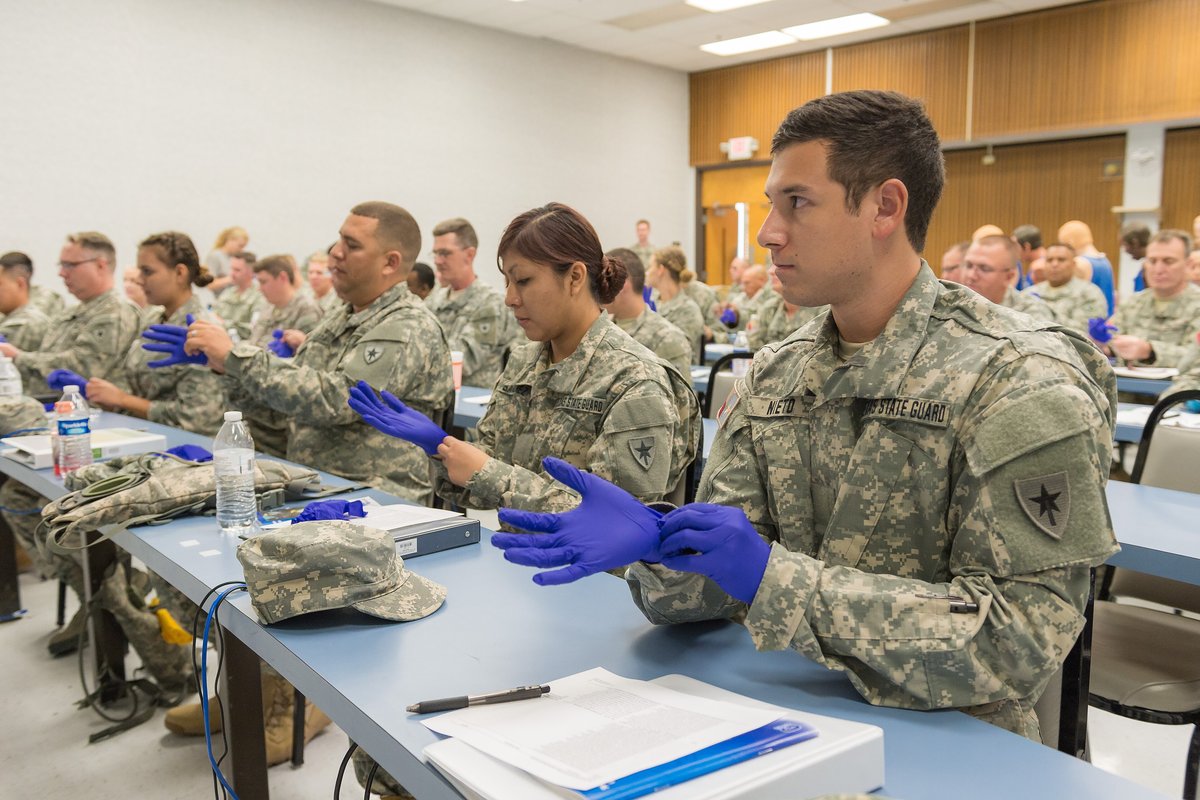
For work covered by federal OSHA's bloodborne pathogens standard, employees with occupational exposure to blood or other potentially infectious materials (OPIM) need training under 29 CFR 1910.1030(g)(2). Provide it at initial assignment, annually within one year of the previous session, and when changed tasks or procedures introduce exposure requiring additional instruction. Training must be free and during working hours.
The session needs to explain the employer's exposure control plan and the procedures employees use: obtaining personal protective equipment (PPE), handling contaminated items, reporting an incident and reaching medical evaluation during their shift.
Construction work has a different federal basis
Federal OSHA does not apply 1910.1030 to construction work. It does require construction employers to train designated first-aid providers about bloodborne hazards under 1926.21(b)(2), with other duties addressing protection and waste handling. The initial-and-annual schedule below comes from 1910.1030; it should be assigned on that basis only to covered work.
Maintenance activities with occupational exposure and personnel providing clinical services at a construction site may be covered by 1910.1030. OSHA's May 13, 1994 interpretation distinguishes these duties. Check the work performed and applicable State Plan requirements.
Who needs bloodborne pathogens training?
For covered work, start with the exposure determination required by 1910.1030(c)(2). Occupational exposure means reasonably anticipated skin, eye, mucous-membrane or parenteral contact with blood or OPIM through assigned duties. Parenteral contact includes a needlestick or other piercing of the skin or mucous membranes. Make the determination without regard to PPE.
OPIM is a defined term covering specified body fluids, certain tissues and laboratory materials. Paragraph (b) includes fluids visibly contaminated with blood and situations in which body fluids are difficult or impossible to differentiate. Evaluate the materials and duties against that definition.
| Assignment to evaluate | Exposure question |
|---|---|
| Custodial work | Does the employee handle blood, contaminated sharps or covered materials? |
| Designated first-aid or response duties | What contact is reasonably anticipated during the assigned response? |
| Service of contaminated equipment | What contamination may remain, and how is the equipment handed over? |
| Stocking a first-aid station | Do the duties involve exposure, or only unopened supplies? |
Assign training to the employees identified through that determination. A job title alone gives too little information to decide coverage.
When is training due?
| Trigger | Federal requirement, 1910.1030(g)(2) |
|---|---|
| Initial assignment to tasks where exposure may occur | Provide initial training. |
| Annual training | Complete it within one year of the previous training. |
| New or modified tasks or procedures affecting exposure | Provide additional training; it may focus on the new exposure. |
Track each employee's previous training and next due date. A calendar-year completion total can miss a gap longer than one year between sessions.
When employees move to another facility, explain the local equipment, plan access, reporting contacts and medical arrangements they will use there.
What must the training cover under 1910.1030?
Paragraph (g)(2)(vii) calls for the following content. Include the workplace details in the right-hand column when preparing the session.
| Required subject | What employees need to learn |
|---|---|
| The bloodborne pathogens standard | Access to the regulatory text and an explanation of its contents. |
| Epidemiology and symptoms | An explanation of bloodborne diseases and their symptoms. |
| Transmission | How bloodborne pathogens are transmitted. |
| The exposure control plan | Its procedures and how to obtain a copy. |
| Recognition of exposure | How to identify tasks and activities involving blood or OPIM. |
| Exposure controls and their limits | Use and limitations of engineering controls, work practices and PPE. |
| PPE procedures | Types, use, location, removal, handling, decontamination and disposal. |
| PPE selection | Why the employer selected the protection for the task. |
| Hepatitis B vaccine | Efficacy, safety, administration, benefits and the no-cost offer. |
| Emergencies involving blood or OPIM | Actions to take and people to contact. |
| Reporting an exposure incident | Reporting procedure and medical follow-up available. |
| Post-exposure evaluation and follow-up | What the employer must provide after an exposure incident under 1910.1030(f)(3). |
| Signs, labels and color coding | The identification required by paragraph (g)(1). |
| Interactive questions and answers | An opportunity to ask questions of the person conducting the session. |
Employees in covered HIV or HBV research laboratories and production facilities also need the initial training and demonstrated proficiency specified in (g)(2)(ix).
Use the workplace's equipment and procedures
Show employees where needed supplies are kept and how to report a missing or unsuitable item. Explain the controls for their assignments rather than presenting every job as the same exposure.
For PPE, cover putting it on, removing it and handling contamination afterward. Use the models and supplies the employer provides. If a device or procedure changes exposure, include that change in the instruction.
For incident reporting, give a working contact and backup for each covered shift. Have employees explain how they would reach the designated medical provider outside normal office hours. Resolve a disconnected number or unavailable provider before the employee needs it.
Who can conduct the training?
The trainer needs to be knowledgeable about the subject matter as it relates to the workplace. Paragraph (g)(2)(viii) sets that standard; it does not prescribe a universal commercial trainer certificate.
Select a trainer who can explain the exposed tasks, controls and local response procedures. Keep their name and qualifications in the training record. OSHA's bloodborne pathogens enforcement resources provide interpretations relevant to program design.
Can training be completed online?
The delivery method must provide the content required by 1910.1030(g)(2), accessible instruction and interactive questions and answers with the person conducting the training. A recorded video and an automatically scored quiz alone leave that interaction unaddressed.
Before assigning a course, confirm how employees can ask questions during the training and obtain answers from a knowledgeable person. Provide the site's plan, contacts and procedures alongside general material.
Training needs to suit employees' education, literacy and language. Use demonstrations and understandable terminology, and check that employees can apply the local instructions.
What records must the employer keep under 1910.1030?
1910.1030(h)(2) requires these four items:
| Field required by 1910.1030(h)(2)(i) | Session information |
|---|---|
| Training date or dates | ____________________ |
| Contents or summary | ____________________ |
| Trainer names and qualifications | ____________________ |
| Attendee names and job titles | ____________________ |
Retain training records for three years from the training date. Keep medical records, vaccination information and post-exposure results in the separate confidential record system.
The employer may also record the facility, tasks covered, exposure control plan version, language used and how interactive questions were handled. These details help demonstrate what the session covered; they are additional fields rather than a separate list mandated by (h)(2).
Check whether employees can use the procedure
Ask employees to apply the instruction to their assigned work:
- Where can you obtain the current exposure control plan?
- Which tasks create the exposure identified for your job?
- Which control and supplies need to be available before you start?
- What happens if the designated container is missing or damaged?
- Whom do you contact after an exposure, and who is the backup?
- How do you obtain confidential evaluation on this shift?
Use the answers to identify missed instruction or a procedure that needs correction. A problem in the plan may call for fixing the contact, equipment or access arrangement as well as repeating the training.
The 1910.1030 guide connects training with the exposure control plan, vaccination, post-exposure care and records.
Frequently Asked Questions
Does a toolbox talk meet the requirement?
It can contribute to the program if its content and delivery meet the relevant requirements. A short talk on one task usually addresses only part of the syllabus required by 1910.1030(g)(2). Track the full content, timing, language access and interaction across the training provided.
Does OSHA call for a fixed course length or a completion certificate?
1910.1030 does not set a universal number of course hours or require one standard certificate. It specifies content, delivery conditions, timing and records. Retain the session information required by 1910.1030(h)(2) even if a provider also issues certificates.
Does first-aid or CPR training cover bloodborne pathogens?
Compare the course content with (g)(2)(vii). First-aid or CPR instruction may contain overlapping material, but employees with occupational exposure still need the complete BBP instruction and the employer's local procedures.
Site-wide regulatory figures such as compliance dates and penalty amounts come from our regulatory source-of-truth modules, last checked against the eCFR, OSHA.gov, and the Federal Register on October 19, 2026. Last reviewed November 16, 2026.
About This Article
Published by: HazComFast
Published: November 16, 2026
Last Updated: November 16, 2026
This content is for informational purposes only and does not constitute legal advice.