
No federal OSHA standard requires workers to sign a toolbox talk sign-in sheet. OSHA's April 10, 2000 interpretation letter says "signatures of the employees are not required," and the construction training rule, 29 CFR 1926.21(b)(2), requires the employer to instruct each employee without naming a meeting or a sheet. In California, 8 CCR 1509(e) requires toolbox or tailgate meetings in construction at least every 10 working days, and it doesn't ask for signatures either.
Monday, 6:45, at the tailgate of the superintendent's pickup. Ten minutes on silica before the crew starts cutting the slab: water on the saw, the vacuum hooked to the grinder. Then the clipboard goes around. A laborer in his second week hands it back blank and asks whether he has to sign. The superintendent doesn't know, and nobody else at the truck does either.
Under federal OSHA, he doesn't have to. OSHA has said so in two interpretation letters, and the rule that governs construction training tells the employer to instruct him, with no word about his signature.
At a glance: OSHA's letters say no standard requires the employee's signature (August 14, 1997) and that employee signatures are not required (April 10, 2000). 29 CFR 1926.21(b)(2) requires instruction for each construction employee and asks for no meeting and no record. No standard in Title 29 of the CFR uses the term toolbox talk (eCFR full-text search, October 27, 2026). Where a standard requires a training record, it says what goes on it: for fall protection, 1926.503(b)(1) calls for the trainer's or the employer's signature, and for bloodborne pathogens, 1910.1030(h)(2) lists attendees by name and job title. In California, 8 CCR 1509(e) requires toolbox or tailgate meetings in construction at least every 10 working days, and 8 CCR 3203(b)(2) requires documentation of (a)(7) training, kept at least one year. Federal OSHA sets no retention period for a toolbox talk record.
Do workers have to sign a toolbox talk sheet under federal OSHA?
No. Two OSHA interpretation letters answer it. The first, dated August 14, 1997, reads:
"A search of all OSHA standards found that there is no standard that requires the employer to obtain the employee's signature. Instead, most OSHA standards concerning training require the employer and trainers to sign a certification record which includes the identity of the person(s) trained." (OSHA interpretation letter, August 14, 1997)
The second, dated April 10, 2000 and signed by Richard E. Fairfax, answered DaimlerChrysler, which had asked whether OSHA would accept electronic signatures in place of paper ones for "mandatory OSHA required training records." Before it gets to the signature pad, it repeats the point:
"OSHA training standards generally require the employer and trainers to sign a certification record which includes the identity of the person(s) trained; signatures of the employees are not required." (OSHA interpretation letter, April 10, 2000)
Neither letter is about toolbox talks. Both describe a certification record that the employer and trainers sign. The Standard Number line of the 2000 letter includes 1926, the construction part, and the letter carries OSHA's note that interpretation letters "cannot create additional employer obligations," so the answer rests on the standards themselves. None of the training provisions we read for this article asks for the employee's signature.
The standards don't use the term either. On October 27, 2026, we ran a full-text search of Title 29 of the Code of Federal Regulations on eCFR. No standard uses the term toolbox talk. A search for toolbox returns one hit, in the derrick standard, 29 CFR 1910.181(j)(6)(ii), where "necessary articles shall be stored in the toolbox, and shall not be permitted to lie loose." Spelled as two words, tool box returns three hits in the crane standards 1910.179 and 1910.180, all in the same storage sentence. Tailgate returns three hits. Two are the back gate of a vehicle, on dump trucks in 29 CFR 1926.601(b)(12) and in 29 CFR 500.105, a rule on transporting seasonal agricultural workers. The third is tailgating, as a security term, in Appendix A of the laboratory standard, 1910.1450. The phrase safety meeting returns nothing. That search covers the regulations only. OSHA's guidance pages and publications weren't part of it.
The one rule we read that names toolbox meetings is California's, 8 CCR 1509(e).
Does 1926.21(b)(2) require toolbox talks?
29 CFR 1926.21(b)(2) requires instruction. The general training duty for construction sits in one sentence:
"The employer shall instruct each employee in the recognition and avoidance of unsafe conditions and the regulations applicable to his work environment to control or eliminate any hazards or other exposure to illness or injury." (29 CFR 1926.21(b)(2))
It names what the instruction covers and who is owed it: each employee. The paragraph never mentions a meeting or a schedule. It asks for no record, so it has nothing to say about a signature or about how long to keep one. It doesn't say how the instruction is delivered either. A toolbox talk is one format employers use, and a foreman walking a new laborer through the task before they start it is another.
The paragraph above it is a recommendation. 29 CFR 1926.21(b)(1) reads: "The employer should avail himself of the safety and health training programs the Secretary provides." The verb is should. Paragraphs (b)(3) to (b)(5) add instruction for specific exposures, such as poisons and flammable liquids. The 1926.21 standard page has the full section.
The words frequent and regular do occur in the section before it, 1926.20, and they apply to inspections. Paragraph (b)(1) makes it "the responsibility of the employer to initiate and maintain such programs as may be necessary to comply with this part," and 1926.20(b)(2) says: "Such programs shall provide for frequent and regular inspections of the job sites, materials, and equipment to be made by competent persons designated by the employers." Neither 1926.20 nor 1926.21 sets a meeting schedule. Under those two sections, a weekly or a daily talk is a schedule the employer picks.
A few construction standards do require a meeting before specific work. In power line work, 29 CFR 1926.952(c)(1) calls for "at least one job briefing" before "the first job of each day or shift" when the work is repetitive and similar. Hoisting workers with a crane takes a pre-lift meeting under 1926.1431(m). A lift with more than one crane takes a meeting on the lift plan with all the workers involved, under 1926.1432(b)(2). On a hazardous waste site, the site safety and health plan provides for pre-entry briefings under 1926.65(b)(4)(iii). None of these paragraphs asks the workers to sign.
Which OSHA standards call for a written training record, and who signs it?
A few standards do, each for a named hazard, and each one says what goes on the record. None of the ones we read asks for the trainee's signature.
Fall protection is the construction case. Section 1926.503 opens by saying its training provisions "supplement and clarify the requirements of § 1926.21 regarding the hazards addressed in subpart M of this part." Then it asks for a written record:
"The employer shall verify compliance with paragraph (a) of this section by preparing a written certification record. The written certification record shall contain the name or other identity of the employee trained, the date(s) of the training, and the signature of the person who conducted the training or the signature of the employer." (29 CFR 1926.503(b)(1))
Read the last clause twice. The signature belongs to the person who ran the training or to the employer, and the word between them is or. The OSHA letters speak more loosely of "the employer and trainers" signing. The or in the standard is the more precise text, and the standard is what binds. The worker's own signature isn't in the paragraph. The same paragraph handles the new hire who was trained somewhere else: when the employer relies on training conducted by another employer, the record shows "the date the employer determined the prior training was adequate rather than the date of actual training." Paragraph 1926.503(b)(2) has one line on retention: "The latest training certification shall be maintained." The 1926.503 standard page has the rest of the section.
Lockout/tagout is a general industry case, and its scope paragraph leaves construction out. 29 CFR 1910.147(a)(1)(ii)(A) lists "Construction and agriculture employment" among what the standard "does not cover." Inside general industry, the certification reads:
"The employer shall certify that employee training has been accomplished and is being kept up to date. The certification shall contain each employee's name and dates of training." (29 CFR 1910.147(c)(7)(iv))
The word signature doesn't appear in (c)(7)(iv). The employer certifies, and the record names each employee with the dates. The 1910.147 standard page has the full text, and our article on whether lockout/tagout applies to construction covers the exclusion.
Confined spaces are covered twice. For permit-required confined spaces in general industry, 29 CFR 1910.146(g)(4) reads: "The certification shall contain each employee's name, the signatures or initials of the trainers, and the dates of training." The construction rule, 1926.1207(d), asks for "each employee's name, the name of the trainers, and the dates of training," and the records must be available for inspection "for the period of time the employee is employed by that employer." In general industry the trainers sign. Neither rule asks the employee to sign.
Bloodborne pathogens, a Part 1910 standard, writes its training record out item by item. Under 29 CFR 1910.1030(h)(2)(i), the record holds the dates of the training sessions, "the contents or a summary of the training sessions," "the names and qualifications of persons conducting the training," and "the names and job titles of all persons attending the training sessions." Paragraph 1910.1030(h)(2)(ii) keeps it "for 3 years from the date on which the training occurred," and (h)(3)(ii) makes it available on request "to employees, to employee representatives, to the Director, and to the Assistant Secretary." Attendees go on the record by name and job title. The text asks no one to sign. The 1910.1030 standard page has the section.
Hazard communication requires training and no record of it. The duty sits in 29 CFR 1910.1200(h)(1): "Employers shall provide employees with effective information and training on hazardous chemicals in their work area at the time of their initial assignment, and whenever a new chemical hazard the employees have not previously been trained about is introduced into their work area." The full eCFR text of 1910.1200, appendices included, uses the word record only once, as "recorded," in Appendix A, about effects seen in animal studies (counted October 28, 2026). OSHA said as much in a September 7, 1989 letter: "there is no requirement in the HCS to maintain any records of employee training." The written program in 1910.1200(e)(1) has to describe how the criteria for employee information and training "will be met," which makes it a plan. It doesn't list who was trained. The 1910.1200 standard page has the full section.
The table adds the two California rules from the next sections.
| Rule | Where it applies | What the record holds | Signature in the text | How long |
|---|---|---|---|---|
| 29 CFR 1926.21(b)(2) | Construction | No record required | None | No period set |
| 29 CFR 1926.503(b) | Construction, fall hazards of subpart M | Name or other identity of the employee trained, date(s) of training | Person who conducted the training, or the employer | The latest certification, (b)(2) |
| 29 CFR 1910.147(c)(7)(iv) | General industry, construction excluded by (a)(1)(ii)(A) | Each employee's name, dates of training | None, the employer certifies | Not stated in (c)(7)(iv) |
| 29 CFR 1910.146(g)(4) | General industry, permit-required confined spaces | Each employee's name, dates of training | Trainers, signatures or initials | Not stated in (g)(4) |
| 29 CFR 1926.1207(d) | Construction, confined spaces | Each employee's name, names of the trainers, dates of training | None | Available while the employee works for that employer |
| 29 CFR 1910.1030(h)(2) | Occupational exposure to blood or other potentially infectious materials, per (a) | Dates, contents or summary, trainers' names and qualifications, attendees' names and job titles | None | 3 years from the training date |
| 29 CFR 1910.1200(h) | Hazardous chemicals in the work area | No record required, per OSHA's 1989 letter | None | No period set |
| 8 CCR 1509(e) | California construction | No record named | None | No period set |
| 8 CCR 3203(b)(2) | California, training required by 3203(a)(7) | Employee name or other identifier, training dates, type(s) of training, training providers | None | At least one year |
How often does Cal/OSHA require toolbox talks under 8 CCR 1509(e)?
At least every 10 working days, in construction. California's Construction Safety Orders spell it out in 8 CCR 1509(e):
"Supervisory employees shall conduct 'toolbox' or 'tailgate' safety meetings, or equivalent, with their crews at least every 10 working days to emphasize safety." (8 CCR 1509(e))
The sentence sets who runs the meeting, who attends, how often and what for. It doesn't mention an attendance list, a signature, a written record or a retention period. The dir.ca.gov page for section 1509 doesn't define working days. On a crew that works Monday through Friday, 10 working days comes to two calendar weeks, if working days means the days the crew works.
The rest of 8 CCR 1509 ties the meetings to a larger program. Subsection (a) reads: "Every employer shall establish, implement and maintain an effective Injury and Illness Prevention Program in accordance with section 3203 of the General Industry Safety Orders." Subsection (d) adds meetings one level up: "Periodic meetings of supervisory employees shall be held under the direction of management for the discussion of safety problems and accidents that have occurred." The history note on the dir.ca.gov page lists the last amendment of the section as filed January 16, 1991 and operative February 15, 1991.
This article covers federal OSHA and California. In Washington, WAC 296-155-110(5) has construction employers hold crew leader-crew safety meetings "at the beginning of each job, and at least weekly thereafter." Paragraph (6)(d) of the same section reads "You must document attendance," and WAC 296-155-110(8) has the minutes kept at least one year. The section doesn't mention signatures. We didn't review the construction rules of the other state plans for it, so a contractor working in another state-plan state should read that plan's own rules on safety meetings.
What does 8 CCR 3203(b)(2) require you to document, and for how long?
8 CCR 3203(b)(2) requires documentation of the training listed in 3203(a)(7), with four items, kept for at least one year. Section 3203 is California's Injury and Illness Prevention Program rule. Its subsection (a) starts with "Effective July 1, 1991, every employer shall establish, implement and maintain an effective Injury and Illness Prevention Program," and the program has to be in writing. Paragraph (a)(7) says when training and instruction are due:
- (A) when the program is first established
- (B) to all new employees
- (C) to all employees given new job assignments for which training has not previously been received
- (D) whenever new substances, processes, procedures or equipment are introduced to the workplace and represent a new hazard
- (E) whenever the employer is made aware of a new or previously unrecognized hazard
- (F) for supervisors, to familiarize themselves with the safety and health hazards to which employees under their immediate direction and control may be exposed
The record of that training is (b)(2):
"Documentation of safety and health training required by subsection (a)(7) for each employee, including employee name or other identifier, training dates, type(s) of training, and training providers. This documentation shall be maintained for at least one (1) year." (8 CCR 3203(b)(2))
There is no signature in it. When a tailgate sheet serves as the documentation of (a)(7) training, the four items come down to the crew's names, the date, the type of training and who gave it. A sheet with names and a date, and nothing on the type of training or the presenter, is missing two of them.
Four exceptions and a note change the paperwork for some employers:
- In 8 CCR 3203(b), Exception No. 1 lets employers with fewer than 10 employees "substantially comply with the documentation provision by maintaining a log of instructions provided to the employee with respect to the hazards unique to the employees' job assignment when first hired or assigned new duties."
- Exception No. 2 says training records of employees who worked less than one year for the employer "need not be retained beyond the term of employment if they are provided to the employee upon termination of employment."
- Exception No. 3 covers employers with fewer than 20 employees in two situations: in an industry that isn't on the Department of Industrial Relations' list of high-hazard industries and with a workers' compensation experience modification rate of 1.1 or less, or in an industry on its list of low-hazard industries. Their written documentation of the program may be limited, and the shorter list still includes "Written documentation of training and instruction as required by subsection (a)(7)."
- Exception No. 4 covers local governmental entities, such as counties and cities, which "are not required to keep records concerning the steps taken to implement and maintain the Program."
- Note 2 lets construction employers who must be licensed under Chapter 9 of Division 3 of the Business and Professions Code use "records relating to employee training provided to the employer in connection with an occupational safety and health training program approved by the Division," and keep records only "with respect to hazards specific to the employee's job duties."
Section 3203 doesn't say whether a toolbox talk counts as (a)(7) training, and we read no Cal/OSHA interpretation on the point. Read literally, a talk held because a new substance or a newly recognized hazard came onto the job lines up with (a)(7)(D) or (E), and a talk that gives a new hire their first instruction lines up with (a)(7)(B). In each case, (b)(2) asks for documentation of that training. A refresher on a hazard the whole crew was already trained on matches none of the six occasions as written.
Section 3203 mentions meetings elsewhere too. 8 CCR 3203(a)(3) requires a system for communicating with employees, and its list of what counts toward substantial compliance starts with "meetings, training programs, posting, written communications." Nothing in subsection (b) ties a record to (a)(3). The only meeting records 3203 asks for in so many words belong to the labor/management safety and health committee in 8 CCR 3203(c)(2), for employers that choose that route: "The committee meeting records shall be maintained for at least one (1) year."
Can workers sign a toolbox talk sheet on a phone or tablet?
For the training records that OSHA standards require, OSHA's letters accept electronic signatures and electronic records under conditions. The April 10, 2000 letter answered the signature pad question this way:
"If you mean that every time the person signs, his or her signature will be electronically stored, then OSHA would have no objection to the use of an electronic signature pad to satisfy the certification requirements." (OSHA interpretation letter, April 10, 2000)
The September 22, 2014 letter, signed by Thomas Galassi and sent to William K. Principe, dealt with the form of the record. Training records "may be kept in any form deemed appropriate by the employer, so long as the records are readily accessible to the employer, employees and their representatives, and to OSHA." On badges, it said that "Electronic swiping of an employee identification badge would be acceptable under the standard if it records each employee's name and the date of training and the employer includes, as part of the badge swiping, a component that certifies the training occurred." The letter answered questions about general industry standards, and the standard in its badge example was the lockout/tagout certification, 1910.147(c)(7)(iv). The August 14, 1997 letter had already accepted scanned ID cards "if safeguards are taken to ensure that the ID card being scanned belongs to the employee being trained."
None of these letters is about toolbox talks, and each one accepts the electronic version on a condition. The 1997 letter wanted safeguards on whose card is scanned, the 2000 letter wanted each signature stored electronically, and the 2014 letter wanted the employee's name, the date and a step that certifies the training occurred. A routine toolbox talk under 1926.21(b)(2) has no required record, so federal OSHA sets no format for its sheet. That last point is our reading of the texts, because no letter we read takes up the question. In California, 3203(b)(2) lists the items the documentation holds and says nothing about paper or screens. The article on whether electronic signatures are valid for OSHA records goes through the conditions in more detail.
How long should you keep a toolbox talk sign-in sheet?
Federal OSHA sets no retention period for a toolbox talk record. The five years in the recordkeeping rule apply to the injury and illness forms:
"You must save the OSHA 300 Log, the privacy case list (if one exists), the annual summary, and the OSHA 301 Incident Report forms for five (5) years following the end of the calendar year that these records cover." (29 CFR 1904.33(a))
When a sheet doubles as a training record that a standard requires, that standard's period applies to it. For fall protection, 1926.503(b)(2) requires keeping "the latest training certification." For bloodborne pathogens, 1910.1030(h)(2)(ii) requires keeping training records 3 years from the date of the training. In California, documentation of (a)(7) training stays at least one year under 8 CCR 3203(b)(2). For an employee who worked less than a year, Exception No. 2 lets the employer hand that employee the training records when the job ends, instead of keeping them beyond it. When one sheet serves two rules, keeping it for the longer period meets both. The OSHA record retention chart lists the periods record by record.
Why have each worker sign their own line?
No federal standard we read requires it, and neither do 8 CCR 1509(e) and 3203(b)(2), so on our reading, collecting it is the employer's choice. Two sets of texts explain why an employer might want it anyway.
The first is 29 CFR 1926.20(f)(2):
"Standards in this part requiring training on hazards and related matters, such as standards requiring that employees receive training or that the employer train employees, provide training to employees, or institute or implement a training program, impose a separate compliance duty with respect to each employee covered by the requirement. The employer must train each affected employee in the manner required by the standard, and each failure to train an employee may be considered a separate violation." (29 CFR 1926.20(f)(2))
Paragraph (f)(2) doesn't name 1926.21. Applying it to 1926.21(b)(2), which says the employer "shall instruct each employee," is our reading. On that reading, the question gets asked worker by worker: was this employee instructed?
The second is the set of letters on electronic records covered above. The 1997 and 2014 letters both tie the record to the person trained, through a card that "belongs to the employee being trained" or through each employee's name on the record. A line workers sign themselves puts their own mark next to their name, which is one way to tie the record to them.
As for the laborer at the tailgate who handed the clipboard back: under federal OSHA, he didn't have to sign. The employer can still record that he attended, by name and date, the way the records in 1926.503(b)(1) and 1910.1030(h)(2) name the people trained without their signatures.
What does HazComFast record when each worker signs the toolbox talk?
In HazComFast, each worker on the attendance list signs their own line on their own phone, once. They tap Sign on their line, or scan the presenter's QR code, which opens the same Sign your attendance panel. They tick the statement "I attended this meeting and understood its content. / Asistí a esta reunión y comprendí su contenido." and sign with a finger. The signature takes the server's time, and a signed line can't be changed afterward. The presenter can't sign for anyone else.
To open the sign-in, the presenter taps Show QR code and picks who can sign with that code: Only people on the attendance list, or any employee assigned to the jobsite. The code stays valid until Close sign-in or the end of the day of the talk, whichever comes first. On the day of the talk, a worker who isn't on the list can tap I was here: the Declare your attendance window opens with the same statement, and they sign there. Their line is marked self-declared.
When a signature has to be redone, an administrator uses Reset signature and has to give a reason. The signed line is archived with that reason and stays in the audit trail, and a new unsigned line takes its place. The PDF of the sheet prints the statement the worker ticked and the signing time of the lines that were signed. A line with no one assigned to it prints as "Unassigned, no signature."
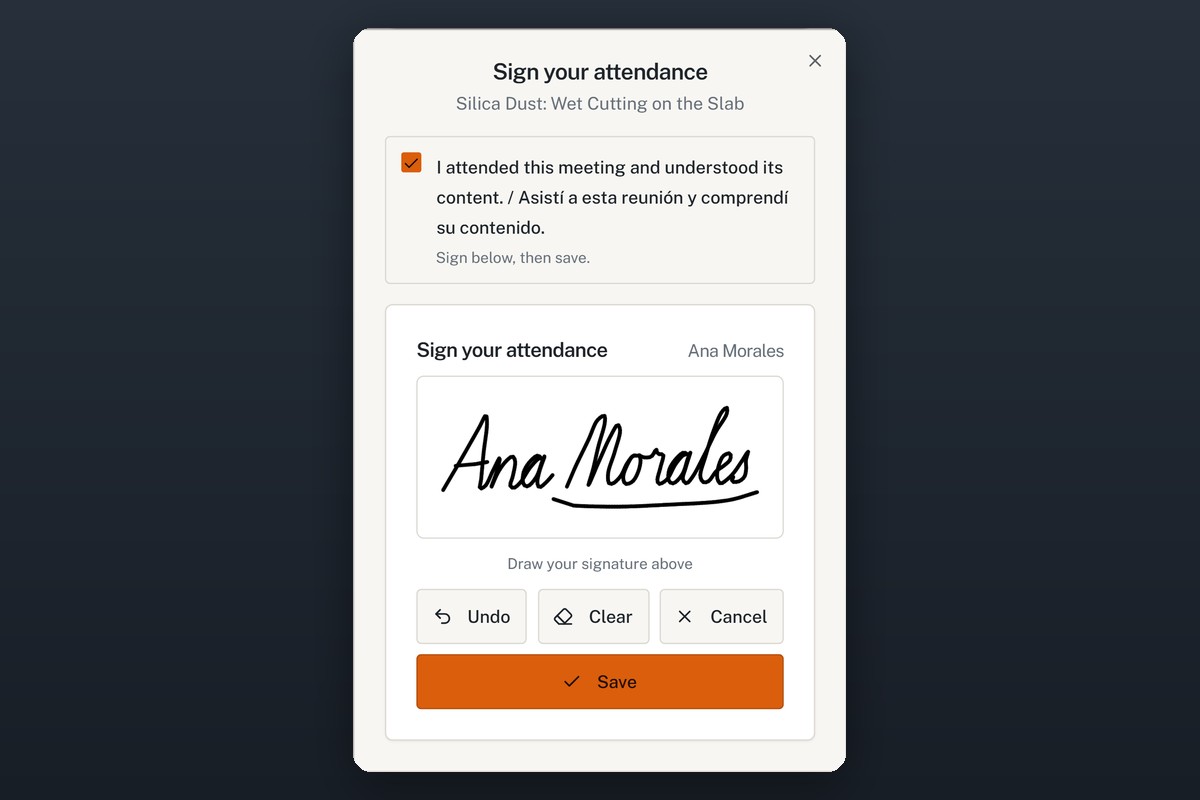
The sheet records attendance at a talk. Where a standard requires its own training record, that record keeps the content the standard sets. For fall protection, 1926.503(b)(1) calls for the name or other identity of the employee trained, the date(s) of the training, and the signature of the person who conducted the training or of the employer.
To see it on an existing account, open a toolbox talk and tap Show QR code. With the phone of a worker on the attendance list, scan the code: the Sign your attendance panel opens. Tick the statement and sign. The line turns signed at the server's time, and the PDF prints it with the statement.
Before the next talk
The Toolbox Talk Generator builds a talk with a built-in attendance sign-in sheet. The Safety Meeting Sign-In Sheet gives a blank or filled-in sheet in PDF, Word or Excel, in English or Spanish. Both are free.
Related: Are electronic signatures valid for OSHA records? · HazCom training sign-in log · How long to keep each OSHA record · Does lockout/tagout apply to construction?
Sources & verification: 29 CFR 1926.20(b)(1), (b)(2) and (f)(2), 1926.21(b)(1) to (b)(5), 1926.503 introductory text and (b), 1910.147(a)(1)(ii)(A) and (c)(7)(iv), 1910.1030(a), (h)(2) and (h)(3)(ii), 1910.1200(e)(1) and (h)(1), read on eCFR on October 27, 2026 (edition of October 14, 2026), and 1910.146(g)(4), 1926.952(c)(1), 1926.1207(d), 1926.1431(m), 1926.1432(b)(2) and 1926.65(b)(4)(iii), read on eCFR on October 28, 2026 (edition of October 26, 2026). Full-text search of Title 29 of the CFR on eCFR on October 27, 2026, run again October 28, 2026, for toolbox, tool box, tailgate and safety meeting (hits in 1910.179, 1910.180, 1910.181, 1910.1450, 1926.601 and 500.105). 29 CFR 1904.33(a) as published on osha.gov, read July 28, 2026. OSHA interpretation letters of September 7, 1989 (read July 28, 2026), August 14, 1997 (read September 4, 2026), April 10, 2000 and September 22, 2014 (read October 27, 2026). 8 CCR 1509 and 3203 on dir.ca.gov, read October 27 and 28, 2026. WAC 296-155-110 on app.leg.wa.gov, read October 28, 2026. Both dir.ca.gov pages carry the notice that "no representation or warranty is made that the information is current or accurate." Search results for the question reviewed on October 27, 2026. This article is general guidance and isn't legal advice.
Frequently Asked Questions
Does OSHA require employees to sign a toolbox talk sign-in sheet? (1926.21)
No federal OSHA standard requires it. OSHA wrote in an August 14, 1997 letter that “there is no standard that requires the employer to obtain the employee's signature,” and its April 10, 2000 letter says “signatures of the employees are not required.” The construction training rule, 29 CFR 1926.21(b)(2), requires the employer to instruct each employee and says nothing about a sign-in sheet.
Does OSHA require toolbox talks?
Not in the general construction training rule. 29 CFR 1926.21(b)(2) requires the employer to instruct each employee and names no meeting or schedule, and the “frequent and regular” wording in 1926.20(b)(2) applies to inspections of job sites, materials and equipment. Some standards do require a meeting before specific work, such as the job briefing in power line work, at least one before each day or shift under 1926.952(c)(1), and the pre-lift meeting before workers are hoisted by crane under 1926.1431(m). A full-text search of Title 29 of the CFR on October 27, 2026 found no standard that uses the term “toolbox talk.” California does require them in construction, under 8 CCR § 1509(e).
How often does Cal/OSHA require toolbox talks? (8 CCR 1509(e))
In construction, 8 CCR § 1509(e) says supervisory employees shall conduct “toolbox” or “tailgate” safety meetings, or equivalent, with their crews at least every 10 working days. The section doesn't say how to record the meeting, and its dir.ca.gov page doesn't define working days.
Which OSHA training records need a signature?
Among the federal standards read for this article, two training records mention a signature. 29 CFR 1926.503(b)(1), for fall protection, asks for that of the person who conducted the training or that of the employer, and 1910.146(g)(4), for permit-required confined spaces in general industry, asks for “the signatures or initials of the trainers.” The lockout/tagout certification in 1910.147(c)(7)(iv), a general industry rule, holds each employee's name and dates of training, and bloodborne pathogens records under 1910.1030(h)(2) list attendees by name and job title. None asks for the employee's signature.
Can workers sign a toolbox talk sheet electronically?
For training records under OSHA standards, the April 10, 2000 letter says OSHA would have no objection to an electronic signature pad if each signature is electronically stored, and the September 22, 2014 letter accepts records kept in “any form deemed appropriate by the employer” as long as they are readily accessible to the employer, employees and their representatives, and OSHA. Neither letter is about toolbox talks.
How long should you keep toolbox talk sign-in sheets?
Federal OSHA sets no retention period for a toolbox talk record. The five years in 29 CFR 1904.33(a) cover the OSHA 300 Log, the privacy case list, the annual summary and the 301 forms. Records a specific standard requires follow that standard, such as 3 years for bloodborne pathogens training under 1910.1030(h)(2)(ii), and in California, 8 CCR § 3203(b)(2) has documented (a)(7) training kept for at least one year.
Site-wide regulatory figures such as compliance dates and penalty amounts come from our regulatory source-of-truth modules, last checked against the eCFR, OSHA.gov, and the Federal Register on October 19, 2026. Last reviewed October 28, 2026.
About This Article
Published by: HazComFast
Published: October 27, 2026
Last Updated: October 28, 2026
- https://www.ecfr.gov/current/title-29/section-1926.21
- https://www.ecfr.gov/current/title-29/section-1926.20
- https://www.ecfr.gov/current/title-29/section-1926.503
- https://www.ecfr.gov/current/title-29/section-1910.147
- https://www.ecfr.gov/current/title-29/section-1910.1030
- https://www.ecfr.gov/current/title-29/section-1910.1200
- https://www.ecfr.gov/current/title-29/section-1910.181
- https://www.ecfr.gov/current/title-29/section-1910.146
- https://www.ecfr.gov/current/title-29/section-1926.1207
- https://www.ecfr.gov/current/title-29/section-1926.952
- https://www.ecfr.gov/current/title-29/section-1926.1431
- https://www.ecfr.gov/current/title-29/section-1926.1432
- https://www.ecfr.gov/current/title-29/section-1926.65
- https://www.osha.gov/laws-regs/regulations/standardnumber/1904/1904.33
- https://www.osha.gov/laws-regs/standardinterpretations/1989-09-07-0
- https://www.osha.gov/laws-regs/standardinterpretations/1997-08-14
- https://www.osha.gov/laws-regs/standardinterpretations/2000-04-10
- https://www.osha.gov/laws-regs/standardinterpretations/2014-09-22
- https://www.dir.ca.gov/title8/1509.html
- https://www.dir.ca.gov/title8/3203.html
- https://app.leg.wa.gov/wac/default.aspx?cite=296-155-110
This content is for informational purposes only and does not constitute legal advice.