This free OSHA 300 log Excel template follows Form 300 column by column, A to M6, and fills in the 300A totals and the TRIR and DART rates by formula. 29 CFR 1904.29(a) lets you use OSHA's forms or equivalent forms, and the workbook is laid out as one. It does not replace the executive's certification or the posting of the 300A.
At a glance
- Columns A to M6 with the wording and instructions of OSHA Form 300 (Rev. 04/2004).
- The 300A Summary tab reads the log's page totals; you add the establishment, the headcount and the hours.
- A check line tells you when a case has no outcome, two outcomes, or no injury or illness type.
- The privacy case list is a separate file, so it never travels with the log.
What's in the workbook
| Tab | What it holds |
|---|---|
| Read me | How to use it, the rules it follows and where they come from. |
| OSHA 300 Log | Year, establishment, 100 case lines, page totals and the check line. Rows 5 to 7 repeat on every printed page. |
| 300A Summary | The totals of columns G to M, the establishment and employment information, and the certification block. |
| Rates (optional) | TRIR, TRIR without deaths, DART and LTIR from the 300A totals and the hours. |
| Hours worksheet | OSHA's optional worksheet for the annual average number of employees and the hours worked. |
The OSHA 300 log columns, A to M6
| Column | Title on Form 300 |
|---|---|
| (A) | Case no. |
| (B) | Employee's name |
| (C) | Job title (e.g., Welder) |
| (D) | Date of injury or onset of illness (e.g., 2/10) |
| (E) | Where the event occurred (e.g., Loading dock north end) |
| (F) | Describe injury or illness, parts of body affected, and object/substance that directly injured or made person ill (e.g., Second degree burns on right forearm from acetylene torch) |
| (G) | Death |
| (H) | Days away from work |
| (I) | Remained at work: job transfer or restriction |
| (J) | Remained at work: other recordable cases |
| (K) | Away from work (days) |
| (L) | On job transfer or restriction (days) |
| (M)(1) | Injury |
| (M)(2) | Skin disorder |
| (M)(3) | Respiratory condition |
| (M)(4) | Poisoning |
| (M)(5) | Hearing loss |
| (M)(6) | All other illnesses |
Columns G to J take one mark each, the most serious outcome: OSHA's instructions rank column G (Death) as the most serious and column J (Other recordable cases) as the least. Columns K and L count calendar days, and the count starts on the day after the injury or the onset of the illness (29 CFR 1904.7(b)(3)(i)). Columns M(1) to M(6) take one mark: the injury column, or one type of illness.
How to fill in a case
- Identify the person: case number, name (or “Privacy Case”), job title.
- Describe the case: the date, where it happened, and what happened, the part of the body and what did it, in one or two lines.
- Classify it with one mark in G, H, I or J, the most serious outcome.
- Enter the days away from work and the days of job transfer or restriction.
- Mark the injury column or one illness type.
Each recordable case goes on the log and on a 301 within seven calendar days of receiving information that it occurred (29 CFR 1904.29(b)(3)). The free OSHA 301 form covers the incident report, and the recordability decision tree helps when you are not sure a case belongs on the log. When a case changes later, 29 CFR 1904.33(b)(1) asks you to remove or line out the original entry and enter the new information.
Privacy cases: what goes in column B
For a privacy concern case you write “privacy case” where the name goes, and you keep a separate, confidential list of the case numbers and names (29 CFR 1904.29(b)(6)). The list of privacy concern cases in 1904.29(b)(7) is complete, and 1904.29(b)(8) allows no others:
- An injury or illness to an intimate body part or the reproductive system.
- An injury or illness resulting from a sexual assault.
- Mental illnesses.
- HIV infection, hepatitis, or tuberculosis.
- Needlestick injuries and cuts from sharp objects contaminated with another person's blood or other potentially infectious material.
- Other illnesses, if the employee voluntarily asks that the name be left off the log.
When the description could still point to the person, 29 CFR 1904.29(b)(9) lets you describe the case with discretion, as long as it shows the cause and the general severity: the regulation's own example writes “injury from assault” for a sexual assault case.
Is an Excel spreadsheet an acceptable OSHA 300 log?
Yes, on a condition. 29 CFR 1904.29(b)(4) defines an equivalent form as one that has the same information, is as readable and understandable, and is completed using the same instructions as the OSHA form it replaces, and 1904.29(b)(5) allows records kept on a computer if it can produce equivalent forms when they are needed. The template keeps Form 300's columns, wording and instructions for that reason.
“When they are needed” has a clock. An authorized government representative gets copies of your part 1904 records within four business hours of asking (29 CFR 1904.40(a)), and an employee or former employee who asks for the 300 Log gets a copy by the end of the next business day (29 CFR 1904.35(b)(2)(iii)). Keep the file where whoever answers those requests can print it.
From the log to the 300A
At year end you total the columns of the log, with zeros when there were no cases, and enter the year, the company and establishment names, the address, the annual average number of employees and the total hours worked (29 CFR 1904.32(b)(2)). The workbook's 300A tab does the totals; the rest you type in.
Then a company executive certifies the summary after examining the log (29 CFR 1904.32(b)(3)), and it must be one of the company executives listed in 1904.32(b)(4). A copy is posted in each establishment where notices to employees are customarily posted (29 CFR 1904.32(b)(5)), from February 1 to April 30 (29 CFR 1904.32(b)(6)). The 300A due date guide has the dates for the next season, and the ITA checker tells you whether the 300A also goes to OSHA electronically.
What OSHA cited most on these forms in FY2025
| Paragraph | What it covers | FY2025 citations |
|---|---|---|
| 1904.29(a) | Using Forms 300, 300A and 301, or equivalent forms | 419 |
| 1904.29(b)(1) | Business information at the top of the log, a description of each case, the 300A at year end | 126 |
| 1904.29(b)(3) | Entering each case within seven calendar days | 59 |
| 1904.29(b)(2) | A 301 or equivalent form for each case on the log | 37 |
| 1904.29(b)(4) | What counts as an equivalent form | 4 |
| 1904.29(b)(6) | "Privacy case" in place of the name, and the separate list | 2 |
| 1904.32(a)(4) | Posting the summary | 70 |
| 1904.32(a)(2) | Creating the annual summary | 47 |
| 1904.32(b)(3) | Certification by a company executive | 45 |
| 1904.32(b)(6) | Posting from February 1 to April 30 | 36 |
| 1904.32(a)(3) | Certifying the summary | 34 |
| 1904.32(b)(2)(ii) | Year, company, establishment, address, average employees and hours on the summary | 26 |
| 1904.40(a) | Copies to a government representative within four business hours | 344 |
1904.29: 649 citations in FY2025 at 365 inspections, 110 of them at construction sites (NAICS 23). 1904.32: 308 citations in FY2025 at 269 inspections, 27 of them at construction sites (NAICS 23). 1904.40: 344 citations in FY2025 at 317 inspections, 106 of them at construction sites (NAICS 23). Citation items issued Oct 1, 2024 to Sep 30, 2025, counted by HazComFast on U.S. Department of Labor enforcement data (extracted Oct 13, 2026). Inspected establishments, not the whole industry.
From one spreadsheet to every establishment, in HazComFast
The template gives you a clean log for one establishment and one year. HazComFast keeps the log of every establishment case by case, with the 301 behind each line, the deadlines, the employee requests and the proof an inspector asks for.
Forms in OSHA's layout, in English or Spanish
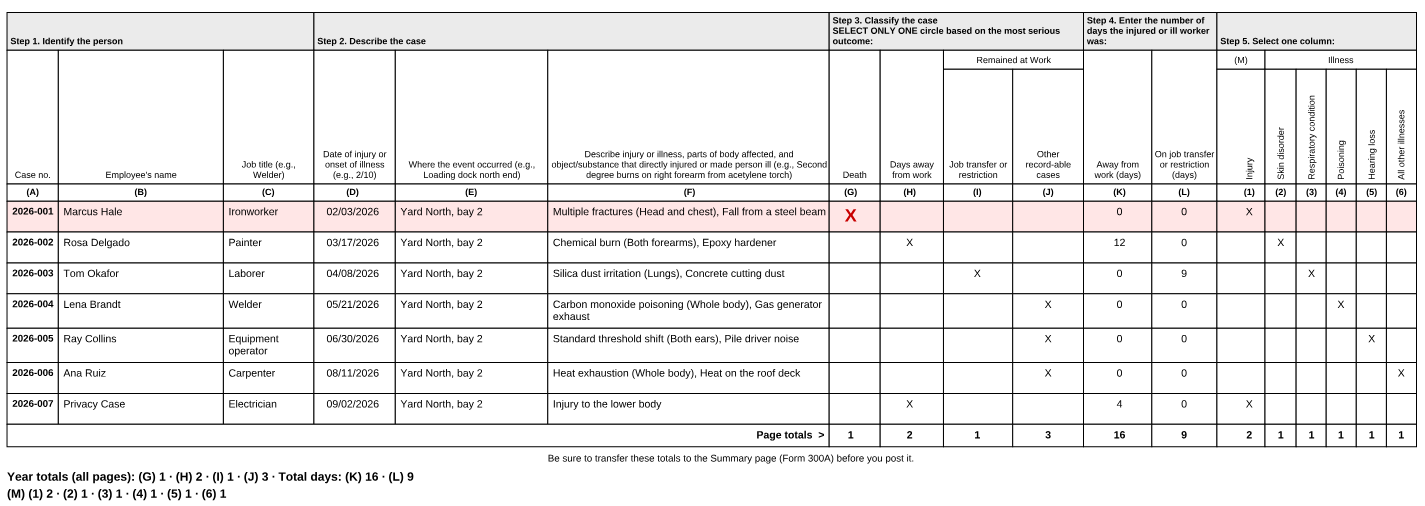
The 300, 301 and 300A print in the structure of OSHA's forms, in English or in Spanish: lettered columns A to M on the 300, questions 1 to 18 on the 301, and a certification block that's never split across pages. The 300 Log also exports as an Excel file in the 300's column layout, privacy cases masked. They are built as equivalent forms under 29 CFR 1904.29(a) and (b)(4) and 1904.32(b)(2)(iii); OSHA does not approve or certify any software.
Day counts and privacy cases
When a case passes 180 “days away from work and/or days of job transfer or restriction”, the app stops at 180, the cap 29 CFR 1904.7(b)(3)(vii) allows. Cases still open on December 31 get an estimate before the 300A is generated, as 1904.7(b)(3)(ix) asks. A privacy concern case prints as “Privacy Case” in the name column, with the names on a separate confidential list (1904.29(b)(6)), and a worker who signs in reads their own 301, never a coworker's.
One log per establishment, with central storage
HazComFast keeps one 300 Log and one 300A per establishment and per year (29 CFR 1904.30(a)). For construction, 1904.46 makes the establishment the office that supervises the work or that crews leave from, so a contractor with forty jobsites and one office keeps one log. Keeping records centrally is allowed by 1904.30(b)(2) when each case reaches the central log within seven calendar days, and the app tracks that clock for each site.
Employee access to the records
A worker signs in on a phone and opens My records: their own 301 in full, and the establishment's 300 Log with privacy cases masked. Requests from employees, former employees and representatives go on a register with a countdown to the end of the next business day (29 CFR 1904.35(b)(2)(iii)), skipping weekends and federal holidays as a stated HazComFast convention, since OSHA does not define a business day. A union representative gets a 301 copy limited to “Tell us about the case” within 7 calendar days (1904.35(b)(2)(v)(B)), and the first copy is never charged (1904.35(b)(2)(vi)).
Inspection Day
When an inspector arrives, an admin prepares the binder PDF first, then issues a read-only guest link that lasts 4, 8, 24 or 72 hours, one snapshot per site.
The readiness check looks at the five closed years the records must be kept (29 CFR 1904.33(a)): a 300A certified and a 301 for every case on the log, year by year, with years before you joined HazComFast named as such.
Is the case recordable?
The recordability assistant asks OSHA's questions one at a time: work-relatedness under 29 CFR 1904.5 and its exceptions, then new case or continuation, then whether the treatment went past the 14 first-aid treatments of 1904.7(b)(5)(ii). A person makes the call, and the reasoning stays with the case. A near miss that turns out to have hurt someone converts into a pre-filled 301.
Questions about the OSHA 300 log in Excel
Can I keep my OSHA 300 log in Excel?
Yes. 29 CFR 1904.29(a) allows OSHA's forms or equivalent forms, and 1904.29(b)(5) allows records kept on a computer if it can produce equivalent forms when they are needed. A spreadsheet works when it carries the same information as Form 300, reads as clearly, and is filled in with the same instructions, which is the test of 1904.29(b)(4).
Do I post the 300 log or the 300A?
The 300A. OSHA's forms package says it plainly: "You don't post the Log. You post only the Summary at the end of the year." Under 29 CFR 1904.32(b)(6) the summary is posted from February 1 to April 30 of the year after the year it covers.
What do I write for a privacy case?
Write "privacy case" where the name goes, never the name, and keep the case numbers and names on a separate, confidential list (29 CFR 1904.29(b)(6)). The list of privacy concern cases in 1904.29(b)(7) is complete; 1904.29(b)(8) allows no others. The template gives you that list as its own file.
How long do I keep the OSHA 300 log?
Five years following the end of the calendar year it covers, together with the privacy case list, the 300A and the 301 forms (29 CFR 1904.33(a)). During those years you update the stored logs with newly discovered cases and changes in classification (1904.33(b)(1)).
Who has to keep an OSHA 300 log?
A company that had more than ten employees at any time during the last calendar year, counted across the entire company, keeps records unless the establishment is in a partially exempt industry (29 CFR 1904.1(a)(2) and 1904.2(a)). The industry exemption is judged establishment by establishment (1904.2(b)(1)). Every employer reports fatalities, in-patient hospitalizations, amputations and losses of an eye (1904.39).
Can I send my 300 log to a general contractor?
No rule requires it, and a copy you hand to someone outside the people 1904.35 and 1904.40 name is a voluntary disclosure: 29 CFR 1904.29(b)(10) requires removing or hiding employees' names and other personally identifying information first, with a few listed exceptions.
Sources and verification
- OSHA, Forms for Recording Work-Related Injuries and Illnesses (PDF of Aug 5, 2025)
- 29 CFR 1904.29, Forms
- 29 CFR 1904.32, Annual summary
- 29 CFR 1904.33, Retention and updating
- 29 CFR 1904.40, Providing records to government representatives
Verified against the eCFR on Oct 20, 2026 (title 29 current to Oct 16, 2026) and against OSHA's forms package read the same day. State Plans record injuries and illnesses the way federal OSHA does (29 CFR 1904.37(b)(1)). Not legal advice.
OSHA 300A Auto-Filler →TRIR calculator →OSHA 301 form →OSHA recordkeeping guide →All free OSHA tools →