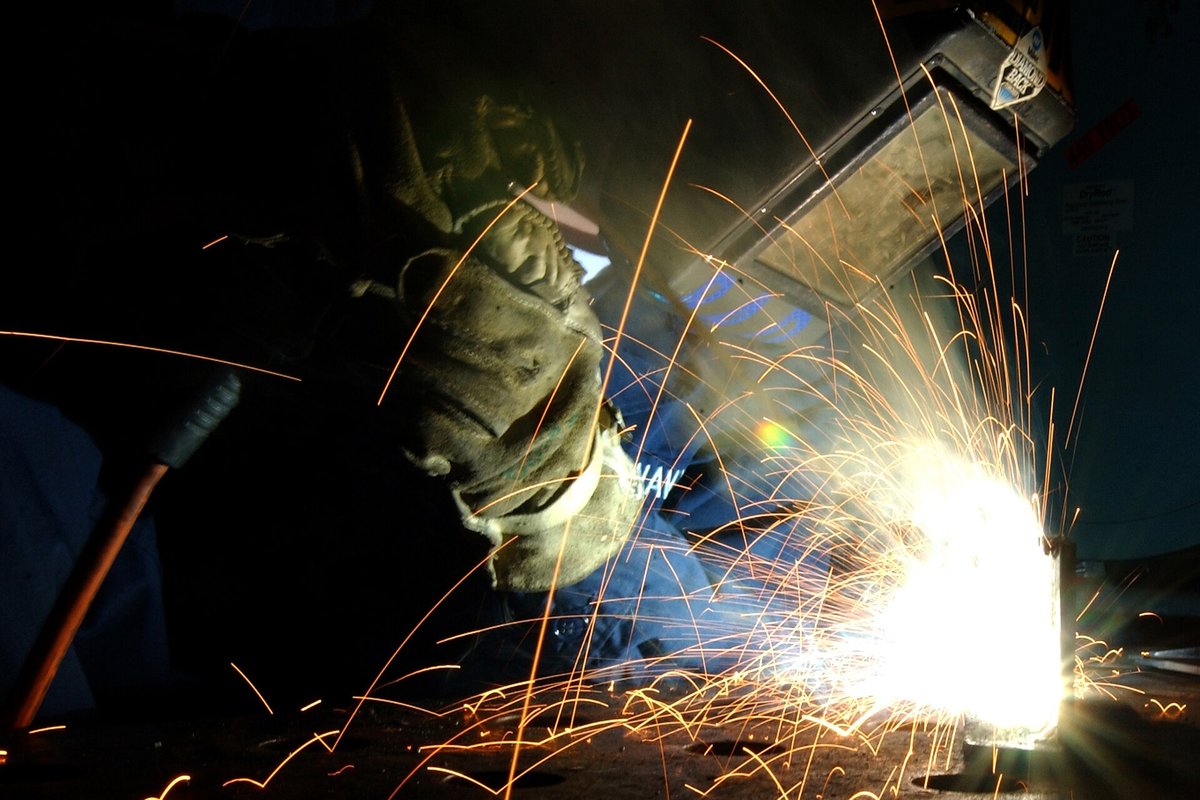
Manganese is present in many steels and welding consumables. When an arc heats metal, some material becomes airborne as fine fume; the welder, a helper, or someone working nearby may inhale manganese-containing particles. The exposure cannot be read from the percentage of manganese on a filler-metal safety data sheet (SDS). It needs to be assessed in the air workers breathe, under the processes and conditions they actually use.
This guide focuses on the industrial hygiene questions that a general welding safety overview cannot answer: where manganese comes from, how to sample it, how to interpret different exposure limits, and how to verify that ventilation and respiratory protection actually control exposure. The relevant federal standards differ between general industry and construction; OSHA-approved State Plans may impose additional or more protective requirements.
The essential distinctions
- OSHA's federal permissible exposure limit (PEL) for manganese fume is a 5 mg/m³ ceiling, measured as manganese. It is not a permissible 8-hour average. When instantaneous monitoring is infeasible, OSHA provides a 15-minute time-weighted-average assessment approach for the ceiling 1, 2.
- NIOSH recommends a 1 mg/m³ TWA and a 3 mg/m³ short-term exposure limit for manganese compounds and fume. These are recommendations, not alternative federal PELs 3, 4.
- The NIOSH TWA uses NIOSH’s up-to-10-hour workday and 40-hour workweek convention; the 3 mg/m³ short-term REL is a 15-minute STEL 3, 4.
- ACGIH currently lists manganese TLVs of 0.1 mg/m³ for the inhalable fraction and 0.02 mg/m³ for the respirable fraction, each as a conventional 8-hour TWA. The particle-size fraction needs to match the criterion used; a generic total-metals sample is not automatically interchangeable 4, 19.
- Jurisdiction can change the enforceable result. California's Title 8 §5155 specifies a manganese-fume 0.2 mg/m³ 8-hour PEL and 3 mg/m³ 15-minute STEL, not the federal 5 mg/m³ ceiling 20.
- A low full-shift average does not rule out a short, high-exposure welding task. A compliant OSHA ceiling assessment does not, by itself, establish that the exposure is below more protective professional recommendations.
- Capture at the arc, followed by verification with personal air sampling, is the central control strategy. General room airflow can dilute accumulated fume but may not intercept the plume before it reaches the breathing zone 5, 6.
What creates manganese-containing welding fume?
At the arc, high temperatures vaporize small amounts of material from the consumable and the workpiece. As the vapor leaves the hottest region and cools, it oxidizes and condenses into very small airborne particles. These particles can agglomerate and mix with material originating from flux, coatings, or the surrounding atmosphere. Welding fume is therefore a process-generated aerosol, not simply dust shaken off a metal surface.
Manganese may enter that aerosol from:
- The filler metal, solid wire, flux-cored wire, or a covered electrode. Filler chemistry can be a major contributor even when the workpiece is ordinary carbon steel.
- The base metal, carbon steel, low-alloy steel, and various stainless steels can contain manganese. Their precise compositions vary by grade.
- Fluxes, electrode coatings, and other consumables, depending on formulation.
- Existing coatings or contamination on the workpiece, which can add other hazardous constituents and change the appropriate sampling panel.
Gas-shielded processes also create hazards unrelated to manganese particulates, including potentially harmful gases under some conditions. A particulate filter selected for manganese does not automatically protect against ozone, nitrogen oxides, carbon monoxide, oxygen displacement, or gases from heated coatings. Those hazards need their own assessment 7.
Does the percentage of manganese in an electrode tell you the exposure?
No. An SDS or mill certificate documents material composition and relevant hazards. It does not establish the concentration in a worker's breathing zone. Airborne exposure also depends on fume-generation rate, current and voltage, wire-feed rate, deposition rate, shielding gas, transfer mode, arc time, position, enclosure, local exhaust, and how the worker's head moves in relation to the plume.
A documented consumable example, not an exposure formula. In Hanley and colleagues' 2017 field study of carbon-steel GMAW, the authors reported AWS ER70S-3 wire containing about 1% manganese at two plants and AWS ER70S-6 wire containing less than 2% manganese at the third 9. Those are compositions reported for the study consumables, not universal guarantees for every wire sold under those classifications. The plants also differed in shielding gas, operations and other conditions. The study was not a controlled ER70S-3-versus-ER70S-6 exposure trial; neither percentage predicts the concentration in a welder's breathing zone.
For a current job, use the exact manufacturer's SDS to identify hazardous ingredients and relevant precautions; use the manufacturer's product specification or certified composition information, where available, to clarify a filler-metal grade or range. A base-metal mill test report can help identify alloy composition but does not characterize airborne fume. SDS ingredients may be reported as ranges, and a commercially available wire may not match a research paper's particular formulation. Compare personal air measurements and engineering controls, not manganese percentages alone, when deciding whether an alternative consumable reduces exposure.
Why process, material, and work location matter
| Welding situation | Manganese-assessment implications | What to document |
|---|---|---|
| Gas metal arc welding (GMAW/MIG/MAG) on carbon steel | Solid wire and base metal may supply manganese. Transfer mode, settings, duty cycle, and plume capture influence exposure. | Wire classification and SDS, base-metal grade, shielding gas, settings, arc-on time, extraction setup. |
| Flux-cored arc welding (FCAW) | Both wire metal and flux system can contribute to fume. Fume generation may be substantial, but a fixed process-wide exposure ranking is unreliable. | Exact consumable, flux type, operating parameters, work location, extraction effectiveness. |
| Shielded metal arc welding (SMAW/stick) | Covered electrodes introduce core-wire and coating ingredients; frequent work in tanks or restricted spaces can increase breathing-zone concentrations. | Electrode designation and SDS, work position, enclosure, arc time, ventilation. |
| Gas tungsten arc welding (GTAW/TIG) | Often generates less fume than many consumable-electrode processes under comparable tasks, but low visible fume does not prove no manganese exposure. | Whether filler is used, alloy chemistry, process settings, adjacent welding. |
| Stainless or alloy-steel welding | Manganese assessment remains relevant, but chromium, nickel, and potentially hexavalent chromium may call for separate methods and standards. | Exact alloy/filler, coatings, Cr(VI) assessment where applicable. |
| Outdoor or open-bay welding | Crosswinds and worker posture can move the plume toward or away from the face; an open side is not proof of adequate exposure control. | Wind and airflow, screens, nearby workers, workpiece orientation. |
| Tanks, pits, ship compartments, or enclosed fabrications | Restricted air movement can increase fume accumulation. Atmospheric, fire, rescue, and confined-space hazards need to be assessed independently of manganese. | Entry classification, permit controls, atmospheric testing, ventilation, rescue arrangements. |
NIOSH’s analysis of welding datasets identified enclosure, ventilation and sampler position relative to the helmet as important exposure modifiers 8. In a study of GMAW at three heavy-equipment plants, researchers monitored 109 worker-days. Full-shift summed manganese ranged from 6.9–610 µg/m³ in total particulate samples and 36–530 µg/m³ in respirable samples 9.
Those ranges cannot supply a respirable-to-total conversion factor: they represent separate samples, with respirable impactors outside the helmets and total cassettes intended to sit inside. The authors also reported uncertainty about the total cassettes’ position. The sequential extraction method grouped manganese by chemical solubility; it did not uniquely identify every manganese species. For another shop, collect task-specific samples with a documented sampler position and size fraction.
Open shops versus confined spaces
The relevant concern is not whether a workplace is labeled indoors or outdoors but whether contaminated air is captured or diluted before it reaches people. A large shop with several simultaneous arcs, welding curtains, and poorly positioned fans may expose workers. A small booth with properly designed source capture may perform better, but its effectiveness needs confirmation.
For general industry, 29 CFR 1910.252(c) addresses welding ventilation, including particular mechanical-ventilation conditions, movable local exhaust hoods, and confined-space provisions 5. Construction applies 29 CFR 1926.353 and other applicable construction standards 10. California employers need to evaluate §5150 (general-industry welding) or §1536 (construction welding), as applicable, alongside the exposure limits and monitoring duties of §5155 20, 21, 26. Shipyard employment has its own welding and air-contaminant provisions (29 CFR 1915.51 and 1915.1000); do not assume that every provision for an ordinary factory applies unchanged aboard a vessel 22. In a true confined space, manganese sampling is only one part of the hazard assessment. Oxygen deficiency, flammability, asphyxiant shielding gases, and other toxic contaminants may demand immediate protective measures and an entry program under 29 CFR 1910.146 or 29 CFR 1926 Subpart AA, as applicable. Never use oxygen as ventilation air.
OSHA, NIOSH, and ACGIH: different limits, different questions
| Benchmark | Manganese concentration (as Mn) | Averaging period or fraction | How to use it |
|---|---|---|---|
| Federal OSHA PEL, 29 CFR 1910.1000 Table Z-1 | 5 mg/m³ | Ceiling for manganese compounds and fume; use a 15-minute TWA to assess the ceiling if instantaneous monitoring is not feasible | Enforceable federal general-industry limit 1. |
| Federal OSHA PEL, 29 CFR 1926.55 Table 1 | 5 mg/m³ | Ceiling, same assessment principle | Enforceable federal construction limit 2. |
| NIOSH REL | 1 mg/m³ | TWA, under NIOSH's up-to-10-hour workday convention | Nonbinding occupational recommendation for manganese compounds and fume 3, 12. |
| NIOSH REL, short term | 3 mg/m³ | 15-minute short-term exposure limit | Nonbinding short-duration recommendation 3, 4. |
| Cal/OSHA Title 8 §5155, manganese fume PEL | 0.2 mg/m³ | 8-hour TWA, as Mn | Enforceable California limit, where the State Plan applies 20. |
| Cal/OSHA Title 8 §5155, manganese fume STEL | 3 mg/m³ | 15-minute STEL, as Mn | Separate enforceable California short-term limit 20. |
| ACGIH TLV, inhalable fraction | 0.1 mg/m³ | Conventional 8-hour TWA, inhalable aerosol | Nonbinding professional guidance on ACGIH's published manganese page; calls for fraction-matched sampling 19. |
| ACGIH TLV, respirable fraction | 0.02 mg/m³ | Conventional 8-hour TWA, respirable aerosol | Nonbinding professional guidance on ACGIH's published manganese page; calls for fraction-matched sampling 19. |
Units matter. A concentration expressed in mg/m³ is 1,000 times the same number expressed in µg/m³. Thus, 0.02 mg/m³ equals 20 µg/m³. All manganese results need to be clearly labeled as Mn, not as the mass of a particular manganese oxide or the mass of total welding fume.
A ceiling is not a shift average. Under 29 CFR 1910.1000(a)(1) and 29 CFR 1926.55(a)(1), the 5 mg/m³ ceiling may not be exceeded at any time. If instantaneous measurement is infeasible, the standard specifies assessment as a 15-minute TWA that may not be exceeded during the workday. A routine eight-hour personal sample cannot, by itself, rule out a ceiling exceedance during concentrated arc work. Nor does a 15-minute ceiling assessment replace the separate full-shift sample needed to evaluate a TWA recommendation.
Particle-size fractions matter. An inhalable sampler, a respirable size-selective sampler, and a total-particulate cassette do not necessarily collect the same aerosol mass. Before evaluating the ACGIH criteria, verify which aerosol fraction the sampling train collects and that the method's detection capability is appropriate. An OSHA total-metals result should not simply be divided by the respirable TLV and labeled compliant or noncompliant.
Shift length and jurisdiction matter. NIOSH's ordinary REL-TWA convention permits up to a 10-hour workday; ACGIH's published TLV-TWA is designed for a conventional 8-hour day and 40-hour week, with professional adjustment considerations for unusual schedules. California's §5155 Appendix A expressly uses 8 hours in the denominator even if a workday is longer when determining its 8-hour PEL. Do not compute a 12-hour result by silently dividing by 12 and call it an 8-hour Cal/OSHA TWA. Conversely, do not apply the California 0.2 mg/m³ limit as if it were automatically a federal PEL 19, 20.
California exposure-monitoring trigger. Under §5155(e)(1), employers need to monitor, or arrange monitoring, when it is reasonable to suspect employees may exceed the concentrations permitted by §5155(c). Section 5155(e) also addresses control, competent industrial-hygiene supervision, and records. For welding, check §5150 in general industry or §1536 in construction rather than applying the former uncritically to a jobsite. A favorable federal ceiling comparison does not close these California questions 20, 21, 26.
There is no general federal manganese-specific action level or universal periodic-sampling schedule comparable to those found in some substance-specific OSHA standards. The absence of such a manganese rule does not remove the employer's responsibility to control hazardous exposures under applicable standards. State Plan limits and other substances generated during welding may impose separate obligations; for example, stainless-steel work may call for a distinct hexavalent-chromium assessment.
Personal breathing-zone sampling: designing the assessment
1. Define the exposure groups and their tasks
Start with workers who share similar materials, processes, controls, and work patterns. Separate enclosed-space stick welders from open-bay GMAW operators rather than averaging their environments together. Include helpers, tackers, fitters, grinders, or adjacent workers when their locations place them in the plume. Record how often the worker welds and whether several arcs run simultaneously.
Before sampling, identify the exact base-metal grades, consumable names, SDSs, coatings, and nearby sources. Consider a broader analyte panel when the work generates iron oxide, chromium or Cr(VI), nickel, lead, cadmium, zinc, or other contaminants. Do not assume a total-welding-fume gravimetric result is a manganese measurement.
2. Collect full-shift and task-based personal samples for different purposes
Collect representative personal breathing-zone samples over full work shifts for manganese TWA evaluation. Include high-output tasks and meaningful variations across days, workers, and workspaces rather than sampling only a short, easy weld. Document whether sampling spans the full shift or calls for a valid time-weighted combination of separate periods. If part of the shift is unmeasured, do not silently assume zero exposure; document and justify the estimate and its effect on the result. Collect different size fractions when comparison to both inhalable and respirable TLVs is planned.
For the OSHA ceiling and NIOSH short-term recommendation, plan targeted short-duration samples during the highest credible 15-minute exposure windows, such as overhead welding, sustained production passes, or enclosed work. Under the federal OSHA ceiling provisions, a 15-minute TWA is the assessment basis where instantaneous monitoring is infeasible; the NIOSH short-term limit is also a 15-minute criterion but has a different value and legal status. California's manganese-fume 15-minute STEL is yet another, separately enforceable comparison. Short task samples that do not cover a full 15 minutes cannot automatically be read as a 15-minute TWA 1, 2, 3, 4, 20.
Check short-sample analytical feasibility before sampling. The original OSHA ID-125G method expressly includes 15-minute STEL and ceiling samples at a recommended 2 L/min, giving 30 L 24. The current OSHA manganese sampling-group page separately notes 10–30 L for manganese STEL sampling 25; the group page's primary table is otherwise organized around full-shift samples. These are method and OSHA compliance-sampling instructions, not a statement that 15-minute sampling is analytically adequate for every comparison limit or aerosol fraction. Confirm the laboratory's mass reporting limit, blank handling, collection medium, digestion suitability and expected loading before sampling. A 30-L elemental-manganese sample may answer a 5 mg/m³ federal ceiling question yet be insufficiently sensitive to assess a substantially lower fraction-specific ACGIH TLV; it also cannot determine an 8-hour TWA. If the sample cannot resolve the selected criterion, document the uncertainty and redesign the survey rather than calling an unquantifiable result compliant.
Sampling decision matrix, select the collection train for the question.
| Question | Sampling and analytical approach | Important limitation |
|---|---|---|
| Federal manganese ceiling (as Mn) | Target the credible peak-exposure period using a personal sample suitable for elemental Mn. OSHA ID-125G recommends 2 L/min for 15 minutes (30 L) for ceiling samples; the OSHA sampling-group note states 10–30 L for manganese STEL. Use the federal ceiling's 15-minute assessment rule only when instantaneous monitoring is infeasible. | Method recommendations do not prove that the peak interval was captured, or that a particular laboratory's reporting limit resolves the comparison. The sample measures elemental Mn, not Cr(VI), gases, or a size-selective respirable/inhalable fraction 1, 2, 11, 12, 24, 25. |
| Full-shift elemental manganese | A personal 25- or 37-mm MCE cassette with elemental ICP analysis may be appropriate under OSHA ID-125G for the applicable assessment objective. Record helmet position and complete exposure-period coverage. | An elemental/total cassette result is not automatically a size-selective inhalable or respirable measurement 11, 12. |
| ACGIH inhalable manganese TLV | Specify an inhalable-fraction sampling convention and an analysis that accounts for recovered manganese, including relevant sampler-wall deposits as applicable. | Do not assume a conventional closed-face cassette satisfies the inhalable sampling convention without evidence for the selected device and workplace aerosol 19. |
| ACGIH respirable manganese TLV | Specify a respirable size-selective sampling train, appropriately calibrated to its needed flow/cut performance, with an elemental analysis procedure validated for that medium and anticipated mass. | Do not compare a total or inhalable result directly with the 0.02 mg/m³ respirable TLV 19. |
Minimum decision sensitivity is calculable before the visit. If the laboratory reports a manganese mass reporting limit M_RL in µg per sample, the planned air volume is V in liters, and the decision concentration is C_decision in mg/m³, the implied airborne reporting limit is:
C_RL (mg/m³) = M_RL (µg/sample) / V (L)
The numeric equality follows from 1 mg/m³ = 1 µg/L. Equivalently, V_min (L) = M_RL (µg/sample) / C_decision (mg/m³) is the theoretical volume at which the reporting limit merely equals the comparison concentration; it is not an adequate safety margin by itself. The industrial hygienist and laboratory should design for sensitivity appreciably below the benchmark while respecting method validation, loading, the selected sampler's allowable flow, and the fixed short-term window. If the maximum defensible air volume produces a reporting limit too high for the decision, the assessment is inconclusive, even if the laboratory prints “not detected.” No generic instrument flow rate or sampling duration can resolve that problem for every method.
An area sample near a welding station may help map the room or evaluate control performance, but it does not automatically represent the concentration inhaled by a particular person.
3. Put the sample where OSHA says the breathing zone is
OSHA's current Technical Manual gives unusually important guidance for welding:
- Welding helmet, no respirator: place the sampling cassette in the breathing zone under the welding helmet while the helmet is in its working position.
- Welding helmet plus a tight-fitting respirator: place the cassette outside the respirator but under the helmet. The goal is to characterize the challenge to the respirator, not filtered air behind its facepiece.
- Supplied-air or powered air-purifying welding hood: sample outside the protective hood, avoiding a position artificially diluted by its clean-air exhaust.
Record the cassette position and helmet/respirator configuration. The location can materially change the result; do not mix samples taken on the outer lapel with samples taken beneath a helmet without acknowledging that difference 11.
4. Use an appropriate validated analytical method
OSHA's occupational chemical database lists ID-125G, a validated inductively coupled plasma atomic emission spectroscopy (ICP-AES) elemental analysis method, for manganese compounds and fume. The database lists a 0.8-µm mixed-cellulose-ester (MCE) filter in a 25- or 37-mm cassette; smaller cassettes are recommended for sampling under welding helmets. Its standard full-shift guidance lists 2 L/min for 240–480 minutes (480–960 L) 12. The original ID-125G method also specifically recommends no less than 480 L for a TWA, 30 L for a short-term sample, and 30 L for a ceiling sample, at a recommended flow of 2 L/min, with 15 minutes recommended for STEL and ceiling collection 24. OSHA's manganese sampling-group page independently notes 10–30 L for manganese STEL 25. Follow the intended criterion and method instructions; consult the laboratory if its reporting limit, validated range or sample loading calls for another approach. Neither a short sample nor a long one is automatically a valid substitute for the other exposure assessment.
The NIOSH Pocket Guide also references NIOSH NMAM 7300, 7301, and 7303, while the current fifth-edition NMAM index lists further elemental methods, including 7302, 7304, and 7306 for manganese 3, 13. Method numbers are not interchangeable promises of equivalent sampling fractions, digestion recoveries, or detection limits. Agree with the laboratory on method edition, target fraction, expected mass, reporting limit, matrix, and appropriate field blanks before collecting samples. Confirm the pump's pre- and post-sampling flows and the laboratory's procedure for any drift outside its acceptance limits.
Sampler-wall deposits are part of method selection. NIOSH Method 7306 uses a cellulosic internal capsule to recover material that otherwise might remain on cassette walls. That improves accountability for material entering that sampler, but does not, on its own, establish that a closed-face cassette sampled the ACGIH inhalable fraction. The correct aspiration convention, collected deposits, digestion recovery and analyte reporting limit needs to be considered together 13, 19.
OSHA's ICP elemental analysis measures the amount of manganese recovered from the collected particulate. It does not automatically identify each manganese compound or prove that a specific chemical species caused the exposure. The work materials and process history remain necessary to interpret the sample 12.
5. Keep sufficient quality and context records
Retain the sampling plan, worker/job identifiers, date and location, tasks and arc times, materials, enclosed-space status, exhaust configuration, helmet/respirator position, pump identification, pre- and post-sampling flow verification, start/stop times, field blanks where appropriate, chain of custody, analytical method, results, non-detects, laboratory reporting limits, uncertainty information, and corrective actions. Record excursions such as a failed extractor or unexpected adjacent welding; those may explain a result but should not be used to dismiss it.
How to interpret the laboratory report
A report that reads manganese, mg/m³ is not enough. The reviewer should ask:
- What was sampled? Personal versus area; under the helmet versus outside it; total, inhalable, or respirable fraction; outside or inside respiratory protective equipment.
- What time interval does the result represent? Entire shift, a calculated TWA, or a documented short-duration task. Is the duration appropriate to the selected limit?
- Was the laboratory sensitive enough? Compare the reporting limit with the relevant assessment benchmark. A non-detect does not mean zero exposure.
- Was sampling representative? Materials, production rate, operator position, ventilation status, and enclosure should match the conditions being evaluated.
- How variable is the exposure? One result is a measurement of one interval under one set of conditions, not a guarantee about future shifts.
- Are other hazards evaluated separately? A manganese result cannot determine compliance with Cr(VI), cadmium, lead, or gas-specific requirements.
Calculation checks: air volume, blank correction, and time weighting
For a mass-based filter sample, the underlying concentration relationship is:
C_Mn (µg/m³) = M_Mn, corrected (µg) / V_air (m³)
The corrected mass accounts for the analytical and blank treatment applicable to the method. If the laboratory has already blank-corrected the reported mass, do not subtract a field blank a second time. With approximately constant flow, V_air (m³) = Q (L/min) × t (min) / 1,000; for varying flow, use a validated estimate of the integrated sampled air volume. Pump calibration and any substantial flow drift affect this denominator. Convert the result to mg/m³ by dividing the µg/m³ value by 1,000.
Where consecutive or otherwise valid segments cover the whole assessment period, the time-weighted concentration is:
C_TWA = Σ(C_i × t_i) / Σ(t_i)
Here C_i is the measured or validly estimated concentration in a segment and t_i is its duration. This is the average over the period actually represented; it is not a universal regulatory formula. To compare with an 8-hour PEL or TLV, apply the specific benchmark's prescribed averaging method, including the §5155 Appendix A eight-hour denominator for California. For an OSHA ceiling, analyze the relevant maximum credible interval under the federal ceiling's measurement rule; an arithmetic full-shift mean cannot establish non-exceedance. For a NIOSH up-to-10-hour TWA, do not substitute an unrelated eight-hour or short-term sample without a documented method of comparison 1, 2, 3, 4, 20.
Combining samples across a 15-minute window
Suppose a complete 15-minute assessment window consists of two properly characterized consecutive segments, with concentrations labeled C_A and C_B and durations t_A and t_B. If t_A + t_B = 15 minutes, the window average is:
C_15 = (C_A × t_A + C_B × t_B) / 15 minutes
The result can support a 15-minute comparison only when the sample type, analytical sensitivity, sampling coverage, measurement rule, and relevant high-exposure window are defensible. For a single properly collected 15-minute sample, use its blank-corrected elemental mass and verified sampled volume to calculate the interval concentration. Merely dividing the mass from a shorter sample by a nominal 15-minute volume would artificially dilute it; do not do so.
For an eight-hour California PEL comparison, if periods t_1 through t_n cover the actual exposure history, §5155 Appendix A calls for:
C_8h, California = Σ(C_i × t_i) / 8 hours
Here each t_i needs to be expressed in hours. The 8-hour denominator remains eight under that rule even if the total workday is longer. Missing exposure periods should not be silently assigned zero. A full-shift calculation answers a different question from the federal ceiling assessment; evaluate both when both criteria apply 1, 2, 20.
Treat a laboratory result marked less than the reporting limit as a censored result, not zero. If the resulting uncertainty spans a decision benchmark, the evidence is inconclusive at that benchmark; use a sufficiently sensitive sampling method or additional sampling rather than treating the non-detect as proof of compliance. Sampling variance, analytical uncertainty, incomplete shift coverage, and cross-day differences likewise belong in the interpretation.
Treat OSHA compliance, NIOSH guidance, and ACGIH criteria as separate comparisons. If exposures exceed the OSHA ceiling, promptly address the inadequacy of controls and any needed respiratory protection; do not wait for a second favorable sample to erase the first. If the OSHA limit is met but a more protective recommendation is exceeded, document the remaining health concern, improve feasible controls, and verify their effectiveness. If measured levels are below the selected benchmarks, preserve the evidence and reassess after meaningful process or ventilation changes; avoid declaring the process permanently safe.
Exposure-assessment decision tree
Start: welding task proposed or an existing task changes.
- Is the atmosphere oxygen-deficient, IDLH, potentially flammable, or insufficiently characterized for entry? → Stop the task, assess the space and its hazards, and follow the applicable confined-space and respiratory standards. A particulate respirator or PAPR is not a substitute for safe entry conditions.
- Are the base metal, consumable, process, ventilation and similarly exposed workers identified? → If not, complete the hazard inventory and sampling design before concluding exposure is controlled.
- Is personal monitoring valid for the OSHA manganese ceiling? → If no, arrange exposure assessment targeting credible high-exposure periods. A low full-shift TWA is not the answer to this question.
- Does a valid assessment indicate an OSHA ceiling exceedance? → Take immediate protective action; correct the exposure control deficiency; evaluate respirator requirements; repeat sampling to verify the correction.
- Have all applicable enforceable limits, including Cal/OSHA's 8-hour PEL and 15-minute STEL, when jurisdiction applies, been assessed with suitable samples? → If no, complete those comparisons before claiming compliance. Meeting the federal ceiling alone cannot demonstrate compliance with a stricter State Plan.
- Are appropriate results below the employer's chosen NIOSH and fraction-matched ACGIH assessment benchmarks? → If no, improve the controls and repeat representative monitoring. This is a preventive response; exceeding a nonbinding recommendation is not automatically an OSHA PEL violation.
- Are results sufficiently representative and consistently controlled? → If yes, retain records and define change-triggered verification. If uncertainty remains, limited sample coverage, a high reporting limit, changed welding conditions, or inconsistent capture, sample further before closing the assessment.
This is an assessment workflow, not a statistical exposure determination or a substitute for a qualified industrial hygienist's judgment.
Local exhaust ventilation: capture the plume before it rises through the breathing zone
The most direct engineering control is local exhaust ventilation (LEV) positioned close enough to intercept fume without destabilizing shielding gas or creating a new hazard. The welding position, hood geometry, exhaust airflow, crossdrafts, and worker head location jointly determine performance.
| Control | Strengths | Limitations and verification |
|---|---|---|
| Moveable capture arm or portable extraction hood | Can be positioned at the weld for varied work and retrofits. | Capture falls rapidly as the hood moves away. Reposition after changes in weld location; verify capture during actual welding. |
| Fume-extraction gun or on-torch extraction | Capture point moves with the arc and may suit repetitive GMAW. | Equipment and operating settings need to preserve weld quality, shielding, and capture; test the actual task. |
| Backdraft or downdraft welding table | Can collect fumes from reasonably fixed workpieces and well-defined weld zones. | Workpiece geometry or welding outside the capture zone reduces effectiveness; assess welder position. |
| Fixed booth or engineered enclosure with extraction | Can isolate emissions and stabilize airflow for repetitive operations. | An inadequately designed enclosure may concentrate pollutants; nearby personnel and makeup air still matter. |
| General mechanical or dilution ventilation | Reduces room accumulation and supports background air quality. | May move a plume across the breathing zone before dilution; room flow is not proof of individual protection. |
| Outdoor air movement or portable fans | May reduce stagnation in some circumstances. | Wind shifts, recirculation, and fan direction can increase personal exposure. Do not use oxygen for ventilation. |
Ventilation requirements by jurisdiction
For ordinary welding and cutting on metals covered by the general ventilation provisions, federal 29 CFR 1910.252(c)(2)(i) calls for mechanical ventilation when any of these conditions applies: the space has less than 10,000 cubic feet per welder; the ceiling is less than 16 feet high; or a confined space, partitions, balconies, or other barriers significantly obstruct cross ventilation. Specific metals and materials addressed elsewhere in §1910.252(c)(5)–(12) have additional rules. The general provision §1910.252(c)(2)(ii) specifies no less than 2,000 cubic feet per minute per welder, but expressly excepts operations provided with qualifying local exhaust hoods or booths under (c)(3), or the specified airline-respirator arrangement. The 2,000-cfm provision is not a universal flow target for every extraction arm 5.
For a freely movable local exhaust hood, §1910.252(c)(3)(i) describes 100 linear feet per minute directed toward the hood in the welding zone with the hood at its most remote intended position. A fixed enclosure has a separate §1910.252(c)(3)(ii) design description. OSHA's August 27, 1993 interpretation, addressed to a federal agency, describes a policy of issuing notices for inadequate actual exposure control rather than failure to meet the prescribed flow rates for freely movable hoods and fixed enclosures. Its federal-agency context matters; confirm the current enforcement policy with the responsible OSHA office before relying on that letter for a private-sector or State Plan workplace. That interpretation does not repeal the ventilation standard, remove other applicable engineering-control requirements, or allow employers to exceed airborne PELs. It also does not state that the entire 2,000-cfm general-ventilation provision is unenforceable 5, 23.
In construction, apply 29 CFR 1926.353 to the actual task, including the requirements for sufficient clean replacement air and suitable exhaust handling; 29 CFR 1926.353(a)(6) expressly prohibits using oxygen for ventilation or cleaning. The standard contains special provisions for confined-space welding and hazardous materials. Do not automatically import the general-industry 2,000-cfm-per-welder figure into a construction compliance conclusion 10.
California general industry: Title 8 §5150(a) generally calls for local exhaust achieving no less than 100 linear feet per minute in the welding zone for indoor operations, subject to its alternatives and exceptions. If local exhaust is infeasible, the provision calls for adequate mechanical dilution; if neither method is feasible, appropriate respiratory protection is addressed under §5144. Its §5150(a)(3) exception permits dispensing with mechanical ventilation and respiratory protection under that paragraph where workplace monitoring records clearly demonstrate compliance with §5155 exposure limits. Do not extend that exception to other independently applicable provisions 21.
California construction: Title 8 §1536(a) separately calls for local exhaust with no less than 100 linear feet per minute in the indoor welding zone, unless its specified alternative is used. §1536(a)(1) allows adequate mechanical dilution when local exhaust is infeasible; §1536(a)(2) addresses respiratory protection when those approaches are infeasible. Unlike §5150(a), §1536 does not contain a comparable general monitoring-record exception. Sections §1536(b)–(c) also impose special precautions for listed toxic materials in enclosed spaces and in open air; §1536(d) prohibits use of welding compressed gases for ventilation, cooling, dust removal or cleaning. The construction provision still refers to §1531 for respirators, but Cal/OSHA's current §1531 page labels that provision repealed and directs readers to the corresponding requirements in §5144. The enforceable respiratory-program criteria should therefore be checked against §5144 rather than describing repealed §1531 as a stand-alone active program rule. Because cross-references and enforcement guidance may change, verify the current Cal/OSHA interpretation for the particular project 26, 27, 28.
A 2025 NIOSH shipbuilding and repair evaluation collected 41 full-shift metal samples. Thirteen manganese measurements exceeded the NIOSH REL and/or the investigators’ adjusted ACGIH comparison; the report identified no OSHA PEL exceedance 14. The investigators used 0.07 mg/m³, adjusted for predominantly 10-hour shifts, as their inhalable-TLV comparison. That adjustment was not a federal PEL.
Interpret the comparison with its sampling limitations: full-shift samples cannot rule out a short ceiling excursion, and the report describes conventional 37-mm MCE cassettes on outer clothing without establishing an inhalable sampling convention or under-helmet placement. The practical recommendations, portable source capture, correct hood placement, repaired exhaust fans and training, remain useful, but their effectiveness need to be verified for the actual task 14.
Commission and maintain the control. Verify hood placement, airflow direction, duct condition, pressure/flow indicators, filter condition, discharge and makeup-air arrangements, and whether nearby workers are protected. Repeat personal breathing-zone sampling under representative production conditions after commissioning or a major adjustment. A visible plume capture demonstration can help diagnose problems but does not replace exposure sampling.
Work-practice controls that complement ventilation
- Position the work, whenever practicable, so the welder's head is not directly over the rising plume. Confirm that a new body position does not compromise ergonomics or weld quality.
- Arrange extraction before striking the arc; reposition the hood as the weld advances. Include capture checks in pre-task work planning.
- Control unnecessary simultaneous welding close to other crews, and prevent exhaust discharge into occupied spaces or building air intakes.
- Review whether a different consumable, lower-fume process, or modified settings can reduce emissions without creating a new metallurgy or quality problem. Compare measured emissions and personal exposures; do not select solely by a nominal manganese percentage.
- Remove incompatible coatings or contaminants using a method assessed for its own exposure hazards; assess grinding and preparation dust separately.
- Maintain equipment and clean accumulated dust using suitable methods rather than blowing it into the air. Provide appropriate hygiene facilities and discourage food or drink in contaminated work areas.
- Train operators and supervisors to identify failed extraction and to report changing conditions promptly.
Work practices are not a substitute for source control where feasible engineering controls are needed to meet OSHA limits.
When respiratory protection is needed
Federal engineering controls are not optional merely because a respirator has been issued. For general industry, 29 CFR 1910.1000(e) requires feasible administrative or engineering controls first to achieve compliance with covered air-contaminant limits; when those controls cannot fully achieve compliance, additional protective measures are required. 29 CFR 1926.55(b) establishes the corresponding feasible-control requirement for construction and calls for technically qualified approval of equipment and measures for each use. 29 CFR 1910.134(a)(1)–(2) governs appropriate respiratory protection where needed, including while effective engineering controls are being instituted or are infeasible. Construction applies the respiratory-protection requirements through 29 CFR 1926.103 1, 2, 15. State Plans may add or change requirements; in California use §5144 for respirator-program provisions and separately assess §5150 or §1536 for welding ventilation 21, 26, 27.
A respirator decision begins with an assessment of all relevant airborne hazards, their concentrations, oxygen availability, and the needed assigned protection factor (APF). For manganese particles in a non-IDLH, oxygen-sufficient atmosphere, a suitable NIOSH-approved particulate-filtering respirator may be considered if its APF is sufficient. An N95 is not automatically prohibited for welding fume, but neither is it a default recommendation: fit, filter service environment, heat, communication, other gases, and the measured concentration matter. A P100 filter provides high particulate filtration but does not remove carbon monoxide or replace oxygen. A PAPR or supplied-air system may be appropriate for the complete hazard profile and working conditions.
OSHA's assigned protection factors include 10 for a tight-fitting half-mask (including filtering facepieces when used as such) and 50 for a tight-fitting full-facepiece air-purifying respirator when all program conditions are met. Loose-fitting PAPR facepieces ordinarily have an APF of 25; some hoods/helmets can qualify for higher protection only with the manufacturer evidence specified by the OSHA footnotes. A maximum-use-concentration calculation needs to also respect the hazard's IDLH value and equipment limitations 15. These are selection parameters, not a license to use a respirator without properly assessing the atmosphere.
When respirator use is needed, the employer needs to implement a written, worksite-specific program administered by a suitably trained program administrator, including:
- NIOSH-certified respirator selection appropriate to measured or reasonably estimated hazards.
- Medical evaluation by a physician or other licensed health care professional before needed use and before fit testing.
- Fit testing of tight-fitting facepieces before first use, no less than once a year, and when changes could affect fit; user seal checks when putting them on.
- Training before use and no less than once a year, including capabilities, limitations, inspection, emergency use, and maintenance.
- Cleaning, storage, filter and cartridge management, program evaluation, and applicable records. The employer needs to provide needed respirators and associated program elements at no cost to workers.
See HazComFast's respiratory protection guide and respirator fit-test log for supporting program documentation; neither substitutes for the hazard assessment or the medical professional's determination.
Confined-space warning: Air-purifying respirators, including PAPRs, do not supply oxygen and may not be chosen for oxygen-deficient or otherwise IDLH atmospheres. OSHA specifies particular pressure-demand SCBA or combination supplied-air/auxiliary-SCBA protection for IDLH conditions, alongside the applicable entry, attendant, and rescue controls 15.
What the health evidence supports: and what it does not
Manganese is an essential dietary element. Excess inhaled manganese is a different occupational concern. NIOSH identifies the central nervous system among relevant target organs and describes possible neurological and neurobehavioral effects of excessive exposure, including impaired movement, tremor, slowed responses, mood changes, and other symptoms. Severe manganese-related neurotoxicity can present as manganism, a Parkinsonian syndrome 3, 4.
It is important not to equate manganism automatically with idiopathic Parkinson disease, or to claim that every welder will develop neurological disease. Welding exposures are mixtures; epidemiologic results can be influenced by cumulative exposure estimates, other metals, work history, smoking, and study design. A longitudinal cohort enrolled 886 U.S. welding-exposed workers, of whom 398 had follow-up examinations, and researchers reported an association between estimated cumulative manganese exposure and progression of standardized Parkinsonian motor signs. The full cohort size may not be mistaken for the number followed longitudinally. An association in motor scores is not a measured rate of clinically diagnosed Parkinson disease, and the study's exposure estimates are not a workplace sampling substitute. Taken together with NIOSH's toxicological assessment, this evidence supports prevention while preserving uncertainty about the relationship to idiopathic Parkinson disease 16.
Workers reporting persistent tremor, slowed movement, gait changes, or cognitive symptoms should receive appropriate clinical assessment. Air sampling measures exposure, not disease. A blood manganese measurement or clinical test is not a routine replacement for workplace breathing-zone monitoring, nor does a single normal test rule out significant historical exposure.
Hazard communication, worker involvement, and long-term records
For general industry, 29 CFR 1910.252(c)(1)(iv) specifically addresses welding fluxes, coatings, coverings, filler metals, and materials released during welding under the Hazard Communication Standard. Relevant employers need to ensure accessible SDSs and labels and train workers on the applicable chemical hazards and controls. Construction applies Hazard Communication through 29 CFR 1926.59 5, 17.
Training should explain where manganese comes from, why changing a wire or enclosed location can change exposure, how to position exhaust, how to recognize failed airflow, and whom to notify before continuing work. Discuss what sampling actually showed, including measurement uncertainty, rather than merely announcing that a site 'passed.' HazComFast's welding and cutting toolbox talk can support a short field discussion but does not replace needed hazard-specific training.
Employee exposure records covered by 29 CFR 1910.1020 generally need to be preserved for no less than 30 years. There are specified exceptions, including certain background laboratory materials that may be kept for one year if the needed results, sampling methodology, analytical/mathematical methods, and contextual summary are preserved for 30 years. Covered employee medical records generally have a retention period of employment plus 30 years, subject to the standard's express exceptions 18. Respirator fit-test records have a different rule: under 29 CFR 1910.134(m)(2)(ii), keep them until the next fit test; medical evaluation records are handled under 29 CFR 1910.1020 15.
There is no universal OSHA rule requiring manganese sampling every six or twelve months. Establish a defensible reassessment trigger when consumables, base-metal alloys, current/voltage settings, production volumes, enclosure, LEV, work schedules, or adjacent operations materially change. The exposure record should explain why a group and a sampling day were representative.
Manganese welding exposure assessment checklist
Use this checklist before the survey and again when evaluating corrective actions. It is a field planning aid, not a certification of compliance.
Materials and processes
- Identify each base-metal alloy/grade and any coatings or contamination; distinguish base-metal test reports from filler-metal SDS and manufacturer specifications.
- Collect current SDSs and exact designations for filler wires, covered electrodes, fluxes, and other relevant products; do not infer breathing-zone manganese from nominal wire manganese percentages.
- Record welding process, parameters, arc-on time, positions, and number of simultaneous welders.
- Identify helpers and neighboring workers whose breathing zones may receive the plume.
Workplace and controls
- Classify open, partially enclosed, and confined-space tasks correctly.
- Identify the actual enforcement jurisdiction: federal OSHA, Cal/OSHA, another State Plan, construction, general industry, or shipyard; in California distinguish §5150 from §1536 and check §5144 for respirators.
- Evaluate oxygen, combustible atmospheres, shielding gases, and other contaminants where applicable.
- Record LEV type, hood position, airflow condition, exhaust discharge, makeup air, and any recirculation controls.
- Check the applicable mechanical-ventilation trigger, design/performance provision, exception, and any needed exposure evidence, not just the installed fan's nameplate cfm.
- Note crossdrafts, curtains, workpiece orientation, and the worker's head position.
Sampling design and execution
- Group workers by genuinely similar exposures; select representative and credible high-exposure work periods.
- Select personal full-shift and appropriate short-duration samples for the distinct assessment objectives.
- Place samplers relative to the welding helmet and respirator according to OSHA guidance.
- Specify analyte as manganese, as Mn, sample fraction, analytical method/edition, and laboratory reporting limit.
- Check pump flow, record timing and disruptions, use quality controls, and retain chain of custody.
- Confirm the intended sampling duration and method: original OSHA ID-125G recommends 15 min × 2 L/min = 30 L for STEL/ceiling, subject to laboratory sensitivity; confirm full-shift sampling and quantitation separately.
- Evaluate other metals or gases with separate appropriate methods when indicated.
Interpretation and follow-up
- Compare ceiling measurements with the OSHA ceiling, not just an eight-hour average.
- Where applicable, independently assess the California 0.2 mg/m³ 8-hour PEL and 3 mg/m³ 15-minute STEL and the state's monitoring trigger.
- Compare TWA, short-term, inhalable, and respirable data only with matching criteria and sample types.
- Review non-detects, uncertainty, incomplete coverage, and between-day variability.
- Implement feasible source controls and necessary interim protection where indicated.
- Verify actual LEV performance and repeat personal monitoring after material changes or corrective action.
- Communicate findings, retain exposure records, and review respiratory protection program obligations.
Primary sources, official methods, and original research
-
OSHA. 29 CFR 1910.1000, Air Contaminants, including Table Z-1.
-
OSHA. 29 CFR 1926.55, Gases, Vapors, Fumes, Dusts, and Mists, including Table 1 and paragraph (a)(1).
-
NIOSH. Pocket Guide to Chemical Hazards: Manganese Compounds and Fume (as Mn).
-
NIOSH. Welding Fumes and Manganese, updated July 16, 2026.
-
OSHA. 29 CFR 1910.252, General Welding Requirements, especially paragraph (c).
-
NIOSH. Engineering Controls Database: Local Exhaust Ventilation Systems for Welding.
-
OSHA. Oil and Gas Hot Work: Welding Fumes and Other Hazards.
-
Flynn MR, Susi P. Manganese, Iron, and Total Particulate Exposures to Welders. Journal of Occupational and Environmental Hygiene. 2010.
-
Hanley KW, Andrews R, Bertke S, Ashley K. Exploring Manganese Fractionation Using a Sequential Extraction Method to Evaluate Welders' Gas Metal Arc Welding Exposures During Heavy Equipment Manufacturing. Annals of Work Exposures and Health. 2017;61(1):123–134. doi:10.1093/annweh/wxw005. NIOSH-hosted archive.
-
OSHA. 29 CFR 1926.353, Ventilation and Protection in Welding, Cutting, and Heating.
-
OSHA. Technical Manual, Section II, Chapter 1, personal sampling and welding fume sections; see also OSHA's February 3, 1999 interpretation.
-
OSHA. Occupational Chemical Database: Manganese Compounds and Fume, including elemental analysis method and current sampling-group guidance; see also the full original method 24.
-
NIOSH. NMAM, Fifth Edition: Manganese Method Index and NMAM, Fifth Edition, Method 7306: Elements by Cellulosic Internal Capsule Sampler (Issue 1, September 10, 2015; relevant full-method specifications).
-
Methner MM, Brueck SE; NIOSH. Evaluation of Exposure to Metals and Noise During Shipbuilding and Ship Repair Operations. Health Hazard Evaluation Report 2023-0084-3425. August 2025.
-
OSHA. 29 CFR 1910.134, Respiratory Protection; construction incorporation at 29 CFR 1926.103.
-
Racette BA, Searles Nielsen S, Criswell SR, et al. Dose-Dependent Progression of Parkinsonism in Manganese-Exposed Welders. Neurology. 2017;88(4):344–351. doi:10.1212/WNL.0000000000003533.
-
OSHA. 29 CFR 1910.1200, Hazard Communication and 29 CFR 1926.59.
-
OSHA. 29 CFR 1910.1020, Access to Employee Exposure and Medical Records.
-
ACGIH. Manganese, Elemental and Inorganic Compounds, currently published TLV–TWAs for inhalable and respirable particulate matter; see also ACGIH definitions and notations.
-
California Division of Occupational Safety and Health. Title 8 §5155, Airborne Contaminants, Table AC-1, paragraphs (b), (c), (e), and Appendix A.
-
California Division of Occupational Safety and Health. Title 8 §5150, Ventilation and Personal Protective Equipment Requirements for Welding, Brazing and Cutting.
-
OSHA. 29 CFR 1915.51, Ventilation and Protection in Welding, Cutting and Heating, and 29 CFR 1915.1000, Air Contaminants.
-
OSHA. Method ID-125G: Metal and Metalloid Particulates in Workplace Atmospheres (ICP Analysis). Revised September 2002, pp. 1 and 4: 480-L minimum recommended TWA volume, 30-L short-term and ceiling volumes, 2-L/min recommended rate, 15-minute short-term and ceiling sampling recommendations. These are method recommendations rather than the legal ceiling limit itself.
-
OSHA. Sampling Group METALSSG-2: general 240–480-minute elemental-metals sampling conditions and explicit special note, “For Manganese STEL take only a 10–30 L sample.”
-
California Division of Occupational Safety and Health. Title 8 §1536, Ventilation Requirements for Welding, Brazing, and Cutting, Construction Safety Orders.
-
California Division of Occupational Safety and Health. Title 8 §5144, Respiratory Protection.
-
California Division of Occupational Safety and Health. Title 8 §1531, Respiratory Protective Equipment, labeled repealed; directs readers to equivalent requirements of §5144.
Frequently Asked Questions
What is OSHA's manganese limit for welding fume?
The federal OSHA limit for manganese fume, as Mn, is a 5 mg/m³ ceiling in general industry's Table Z-1 and construction's 1926.55 Table 1. Where instantaneous monitoring is not feasible, the standards allow assessment of the ceiling using a 15-minute TWA. It is not a general 8-hour TWA limit. California is different: Cal/OSHA Title 8 §5155 lists a 0.2 mg/m³ 8-hour PEL and a 3 mg/m³ 15-minute STEL for manganese fume.
Can a manganese percentage on an SDS establish airborne exposure?
No. Material composition identifies a potential source, but airborne exposure depends on welding process and settings, fume generation, position, ventilation, enclosure, and time. Representative personal breathing-zone measurements against the limits of 29 CFR 1910.1000 are needed for a defensible concentration assessment.
Should a manganese sampler go inside or outside the welding helmet?
For a conventional welding helmet, OSHA directs sampling under the helmet, in the breathing zone, for comparison with the limits of 29 CFR 1910.1000. If the welder also wears a respirator, sample outside the respirator; with a supplied-air or PAPR hood, sample outside the protective hood. Record the actual configuration.
Is a P100 filter enough for welding fumes?
Not necessarily. P100 filtration addresses particles, but it does not supply oxygen or automatically protect against gases such as carbon monoxide or ozone. Respirator selection under 29 CFR 1910.134(d)(1) calls for an assessment of all hazards, concentration, equipment limitations, and the OSHA respiratory protection program.
Does welding in an open shop eliminate manganese exposure?
No. A large opening or moving air can help dilute fume but may direct it across a welder's face or into nearby work areas. The effectiveness of ventilation should be checked while the task runs and confirmed with representative personal samples. Welding ventilation rules are in 29 CFR 1910.252(c) and 1926.353.
How long should manganese exposure-monitoring records be kept?
Employee exposure records covered by 29 CFR 1910.1020 generally need to be retained for no less than 30 years, subject to the regulation's specified exceptions. Respirator fit-test records are retained until the next fit test under 1910.134(m)(2)(ii); covered medical records follow separate retention requirements.
Site-wide regulatory figures such as compliance dates and penalty amounts come from our regulatory source-of-truth modules, last checked against the eCFR, OSHA.gov, and the Federal Register on October 19, 2026. Last reviewed November 14, 2026.
About This Article
Published by: HazComFast
Published: November 14, 2026
Last Updated: November 14, 2026
- https://www.osha.gov/laws-regs/regulations/standardnumber/1910/1910.1000
- https://www.osha.gov/laws-regs/regulations/standardnumber/1910/1910.1000TableZ1
- https://www.osha.gov/laws-regs/regulations/standardnumber/1926/1926.55
- https://www.cdc.gov/niosh/npg/npgd0379.html
- https://www.cdc.gov/niosh/welding/about/
- https://www.osha.gov/laws-regs/regulations/standardnumber/1910/1910.252
- https://www.cdc.gov/niosh/engcontrols/ecd/detail44.html
- https://www.osha.gov/etools/oil-and-gas/general-safety/hot-work-welding
This content is for informational purposes only and does not constitute legal advice.