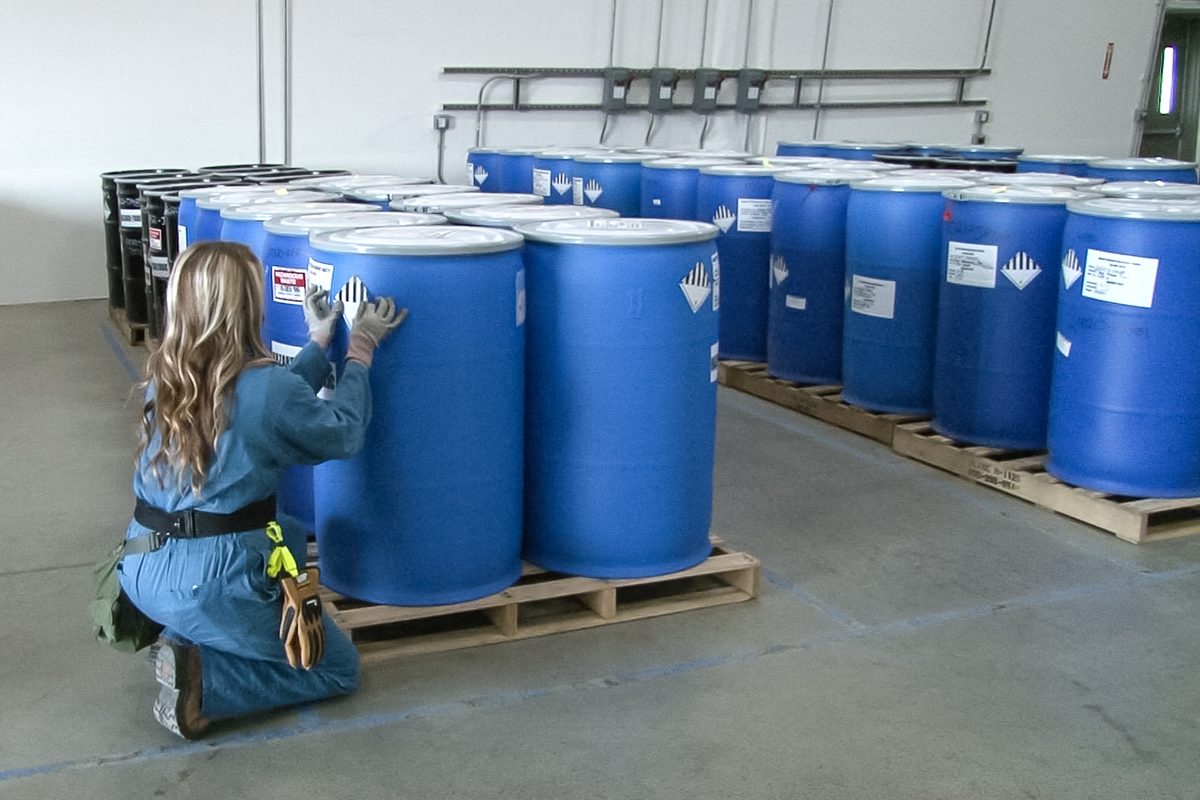
A Prop 65 CAS lookup can identify an ingredient that needs review. It cannot establish the worker's exposure, determine every applicable exemption, or prove that an unmatched product is clear.
A purchasing team sends EHS an SDS with a spreadsheet attached. One ingredient is red because its CAS number appears in a Proposition 65 list. Another is green because the lookup returned nothing. Neither color tells the superintendent what to do with the product.
Record the chemical identity and the California warning decision in separate fields. A product can belong in the inventory under 29 CFR 1910.1200 while its warning analysis remains open. The purchasing record should show who is resolving that question before the proposed use begins.
Start with the listing's actual words
Open the current OEHHA list. Save the edition date and the entry reviewed. A spreadsheet copied last year without its source date gives the next reviewer no way to reproduce your result. Health and Safety Code §25249.8 governs the state's list; updates to that list need their own change control.
Read the chemical name, any CAS number shown, toxicity endpoint, and listing date. Some entries describe a specific chemical. Others reach a family or a particular form. A lookup that compares only a string of digits discards that wording. Appendix D to 29 CFR 1910.1200 uses chemical identifiers for SDS disclosure, but those identifiers don't rewrite the scope of a separate California listing.
For example, OEHHA's entry for crystalline silica is qualified by airborne particles of respirable size. The task that generates dust therefore matters. A CAS match in a bag of material is useful for screening; it doesn't by itself characterize a worker's exposure during cutting, mixing, cleanup, or storage.
Cadmium shows why the name needs to stay beside the number. OEHHA displays CAS 7440-43-9 for both the cadmium entry and the broader cadmium-and-cadmium-compounds entry. An exact match to that number would not find every compound with its own identifier. Compare the ingredient name with the family entry before closing an unmatched result.
Keep product composition and exposure on different lines
SDS Section 3 is prepared under the disclosure rules in 29 CFR 1910.1200 Appendix D. It is not necessarily a complete recipe. Permitted concentration ranges, trade-secret provisions, and disclosure thresholds affect what appears. An omitted ingredient cannot always be treated as absent from the formulation.
The Section 3 guide explains the federal trade-secret framework. For a California decision, check 8 CCR §5194 as well. If a supplier's answer is needed, ask a specific question that resolves the issue: the chemical family, relevant physical form, or information about the intended operation. A request for the entire confidential formulation may be unnecessary.
Exposure calls for another set of facts. Record how the product is handled, whether it is heated, sprayed, cut, or abraded, and how employees could contact it. The same unopened product and a task that creates a respirable aerosol present different factual questions. A concentration in the product is not a measured breathing-zone concentration.
This distinction also matters under OSHA substance standards. A Prop 65 result does not satisfy an exposure assessment needed by 29 CFR 1926.1153 or 1926.1126. Keep their scope tests and evidence in the corresponding occupational exposure file.
Separate the legal questions before deciding on a warning
Health and Safety Code §25249.6 addresses knowing and intentional exposure without a clear and reasonable warning, subject to the Act's conditions and exemptions. Health and Safety Code §25249.10 includes exemptions relevant to warning requirements. OEHHA's plain-language explanation describes the program, but a short web summary cannot decide a particular workplace exposure.
For occupational exposures, 8 CCR §5194(b)(6) connects Prop 65 with California's hazard communication requirements. Its pathways depend in part on whether the hazardous substance is within HazCom and calls for a warning under the Act. Start there instead of assuming that a retail warning label, an SDS, and employee training are interchangeable.
Use the applicability question to identify what evidence is missing. If you are relying on an exposure-based exemption, retain the technical support and the identity of the person who evaluated it. If no appropriate safe-harbor level has been adopted, a blank field in a database is not evidence of an exemption. The relevant analysis remains the one needed by the Act and applicable regulations.
An EHS screening record should say who owns the next decision. It can name legal counsel, an industrial hygienist, or the person responsible for the California program, depending on the unresolved question. Avoid letting an automated status silently become the company's legal conclusion.
Use a screening worksheet that exposes uncertainty
The following fields are a recommended internal workflow. They are not a form prescribed by 29 CFR 1910.1200 or Health and Safety Code §25249.6.
| Field | What to preserve | What it prevents |
|---|---|---|
| Product identity | Manufacturer, product identifier, SDS revision | Reviewing a similar trade name or old formulation |
| Ingredient evidence | Name, CAS, range, and supplier clarification | Treating an incomplete SDS as a complete recipe |
| Listing evidence | Exact OEHHA entry and edition date | Losing qualifiers about family or physical form |
| Task | Operation, exposed people, routes, controls | Equating stock on a shelf with workplace exposure |
| Analysis | Applicable pathway, technical support, reviewer | Replacing a conclusion with a red or green cell |
| Next action | Owner, due date, interim controls | Leaving an unresolved result in routine purchasing |
Start with a chemical inventory template for product identity. Add the analysis in a separate controlled worksheet. A row marked “review needed” should identify the missing fact, such as chemical form or task exposure, rather than implying that the company has already met a warning obligation.
Before releasing a silica-containing product
Consider this illustrative case: a contractor buys a material whose SDS lists crystalline silica. Purchasing finds the ingredient in a chemical database and asks for a yes-or-no release. The crew will cut the cured material later in the project.
First, confirm the actual product and current SDS under 29 CFR 1910.1200(g). Read the qualified OEHHA listing. Then obtain the cutting method and anticipated dust controls from the project team. The review must address the exposure that operation could create, not just the unopened material purchased today.
Evaluate the construction silica rule independently. Under 29 CFR 1926.1153, the applicable exposure-control route and its conditions matter. A proposed water-delivery system, for example, needs to be evaluated in the context of the actual task and the standard. A green purchasing cell cannot substitute for that work.
Keep the release tied to the intended operation. A review supported only for storage of unopened material does not resolve the later cutting task. If purchasing approves delivery before that second decision is complete, tell the project manager what remains open and who needs to resolve it before cutting starts. This is an internal purchasing control, not a new statutory permit.
Record the status of the California warning review separately from the silica-control review. The supplier might answer the chemical-identity question while the project team still needs to establish the cutting method. Keeping those decisions separate makes the remaining work visible to the person scheduling the crew.
Handle a supplier's reassurance carefully
A statement that the product is “Prop 65 compliant” may omit the exposure conditions or the basis for the statement. Ask what it means for your use. Was the conclusion about a finished consumer product, an occupational exposure, a particular application method, or a different formulation?
Keep the original response with the SDS. Preserve its limitations when you summarize it. 29 CFR 1910.1200 Appendix D supplies a structured SDS format, but a marketing email is not an additional SDS section and does not establish an exposure assessment. If the supplier cannot answer the operative question, keep that issue assigned rather than filling in a reassuring interpretation.
The same care applies to an absence of warning language in SDS Section 15. Federal OSHA does not enforce the content of Sections 12 through 15 under 29 CFR 1910.1200(g)(2). A missing Prop 65 reference there is not a decision by California that the exposure is exempt.
Set review triggers that match the decision
Reopen the review when a new SDS, formulation, application method or OEHHA entry could change its basis. These are proposed management controls; 29 CFR 1910.1200 does not set a universal annual-review interval for this process.
Preserve the reasoning behind the previous decision so the reviewer can identify which change matters. A new product name with identical technical evidence may need its identity checked. Heating a product previously used cold may reopen the exposure analysis. The file should explain the difference.
For broader inventory questions, consult which chemicals need an SDS. For exposure terminology, use the PEL and TLV guide. Put the final California decision beside the supporting evidence, with its date and reviewer, before the next purchase is released.
Frequently Asked Questions
Does a CAS match mean that a Prop 65 warning is needed?
A match identifies a chemical for further review. California Health and Safety Code §25249.6 addresses exposure; §25249.10 contains exemptions. The listing alone does not resolve those conditions.
Does no CAS match mean a product is outside Prop 65?
No. The OEHHA list includes entries described by chemical family or physical form. Review the listing wording and the exposure covered by Health and Safety Code §25249.6.
Can an SDS establish the amount a worker inhales?
No. The composition information needed by 29 CFR 1910.1200 Appendix D, Section 3, describes the product. Airborne exposure depends on the operation and its controls.
Does federal HazCom replace the California warning analysis?
No. California addresses occupational warning obligations in 8 CCR §5194(b)(6). Establish which of its pathways applies to the exposure before relying on HazCom documents.
Site-wide regulatory figures such as compliance dates and penalty amounts come from our regulatory source-of-truth modules, last checked against the eCFR, OSHA.gov, and the Federal Register on October 19, 2026. Last reviewed November 15, 2026.
About This Article
Published by: HazComFast
Published: November 15, 2026
Last Updated: November 15, 2026
This content is for informational purposes only and does not constitute legal advice.