A nitrogen line can be doing exactly what the process designer intended, displacing oxygen from a tank, and still create an atmosphere that cannot support a person entering that tank. The same hazard can occur outside a vessel, near a nitrogen discharge, in a cryogenic storage room, or at a worksite where a nitrogen line is mistaken for breathing air.
Nitrogen (N₂) is normally colorless, odorless, nonflammable, and not intrinsically toxic in the way carbon monoxide or hydrogen sulfide is. Its principal inhalation hazard in these situations is simple asphyxiation: nitrogen dilutes oxygen in the air. There may be no smell, irritation, or reliable sensation to warn a worker that oxygen has fallen. An affected person can become confused or lose consciousness before leaving. OSHA Hazard Communication Standard, 29 CFR 1910.1200; U.S. Chemical Safety Board (CSB), Hazards of Nitrogen Asphyxiation.
The core preventive measures are to identify where nitrogen can be released, keep it out of occupied breathing zones, provide ventilation and monitoring appropriate to the actual release scenarios, isolate supplies before maintenance, and control confined-space entry and rescue. An oxygen reading within the normal range is one piece of evidence, not permission to enter.
How nitrogen displaces oxygen
Outdoor air at ordinary conditions is approximately 20.9% oxygen and 78% nitrogen. Introducing additional nitrogen into a space reduces the proportion of oxygen-bearing air. This dilution does not call for nitrogen to react chemically with oxygen or consume it.
For illustration only, in a perfectly mixed atmosphere where nitrogen replaces 10% of the original air, the oxygen fraction would be approximately 0.90 × 20.9%, or 18.8%. A workplace release will not necessarily mix uniformly, and this calculation is not a room-design method, release allowance, or safe-cylinder-count rule. Local concentrations, changing flow, and the time needed to detect and respond to a release matter.
OSHA uses less than 19.5% oxygen by volume to define an oxygen-deficient atmosphere under the general-industry and construction confined-space provisions. In these provisions, an atmosphere with more than 23.5% oxygen is oxygen-enriched. These are hazard definitions, not a complete pass/fail test for an entry permit or a universal oxygen-alarm setting. Shipyard provisions use a different enrichment boundary; apply the standard governing the particular work. 29 CFR 1910.146(b); 29 CFR 1926.1202; OSHA shipyard guidance.
Oxygen deprivation affects judgment, coordination, breathing, and consciousness. The effects depend on the severity and duration of oxygen deficiency, exertion, health, and other conditions. Symptoms are neither a reliable warning system nor a way to infer the oxygen percentage. Severe hypoxia can cause lasting brain injury. OSHA interpretation of the 19.5% threshold; NIH MedlinePlus, Cerebral hypoxia.
Do not confuse N₂ with nitrogen dioxide (NO₂), nitric oxide (NO), or nitrous oxide (N₂O). They are different chemicals with different hazards. An elemental-nitrogen release does not need to be characterized as a toxic-gas exposure to explain the asphyxiation risk.
Where the hazard develops: and what to examine
| Location or activity | Credible nitrogen source | Points to check |
|---|---|---|
| Process tank, vessel, reactor, or railcar | Nitrogen blanketing, inerting, purge, or residual gas | Connected supply lines; inaccessible pockets; entry opening; prior contents; reintroduction of gas |
| Pit, vault, sump, or below-grade equipment area | Leaks or discharges from nearby piping and equipment | Restricted airflow, drainage paths, adjacent connections, worker access |
| Packaging, manufacturing, or food-freezing room | Manifold, bulk supply, hoses, freezers, relief outlets | Maximum credible flow, ventilation failure, alarm coverage, occupants and adjacent rooms |
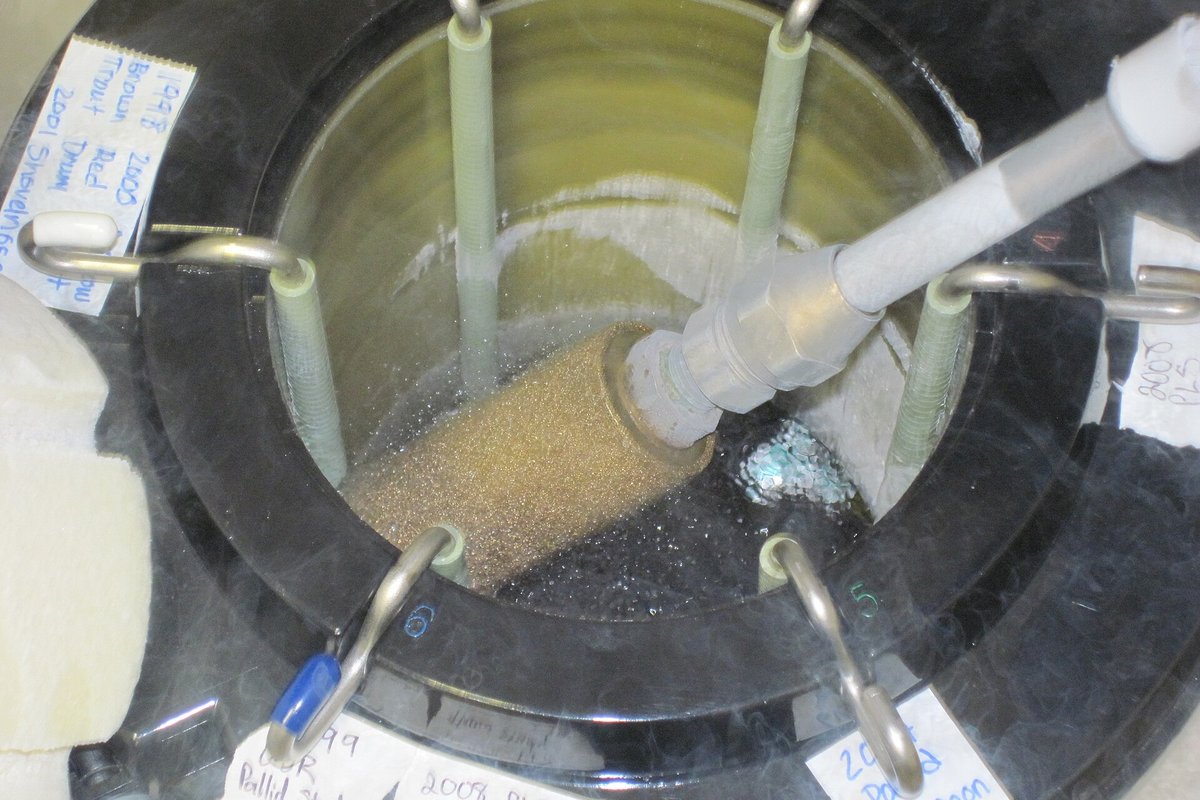
| Laboratory or cryogenic storage room | Dewar boil-off, filling operation, damaged transfer connection | Small enclosure, routine venting, automatic filling, oxygen alarm and exhaust arrangements |
| Maintenance and line-breaking area | Residual pressure, inadvertent valve operation, purged equipment | Isolation boundaries, stored energy, disconnected lines, changing work scope |
| Area beside a vessel or discharge | Nitrogen escaping through an opening or vent | Workers who lean into an opening or stand in an affected breathing zone |
The last row deserves particular attention. The CSB's 2003 nitrogen bulletin documents injuries and fatalities involving people working in or next to oxygen-deficient spaces. A worker does not need to place their entire body inside a vessel to inhale air from that vessel.
For permit-space purposes, entry begins when any part of the person's body crosses the plane of the opening, not only when both feet are inside. This is the definition in 29 CFR 1910.146(b) and 1926.1202. A person's breathing zone can also be exposed immediately outside an opening; those exposures still need evaluation even when no regulatory entry has occurred.
Room air patterns cannot be predicted simply by saying nitrogen is lighter or heavier than air. Warm nitrogen has a density close to air; cold nitrogen vapor from a cryogenic release may initially behave quite differently. Supply pressure, temperature, obstacles, exhaust location, and air movement determine exposure at a worker's breathing zone. Detector placement should be justified for the actual installation.
Purging, inerting, and blanketing are different operations
- Purging replaces or removes an unwanted gas, vapor, or atmosphere from equipment. The sequence, purge medium, verification method, and endpoint depend on the process.
- Inerting deliberately creates a noncombustible atmosphere by displacing oxygen with a noncombustible gas. Under OSHA's permit-space definition, nitrogen inerting creates an immediately dangerous to life or health (IDLH) oxygen-deficient atmosphere.
- Blanketing maintains an inert atmosphere, often over a product or within process equipment, to exclude air or prevent undesired reactions. Blanketing can remain active even when production is stopped.
These terms are not interchangeable entry authorizations. A vessel can be correctly inerted for fire prevention and wholly unsuitable for breathing. 29 CFR 1910.146(b); CSB safety bulletin.
Five distinct control points in a purge-to-maintenance job
1. Design and authorization. Establish the objective of the purge, the process materials involved, the boundary of the equipment, the authorized nitrogen source, the expected flow and pressure, the discharge destination, and who controls the operation. Identify work that may not overlap with the purge. A written operation-specific procedure should explain how completion is verified; there is no universal safe purge duration or flow rate.
2. Purge execution. Control access around potential discharges. Verify the intended gas source and connections. Maintain the ventilation, monitoring, communications, and shutdown arrangements specified by the assessment. Account for areas affected outside the equipment, not only the vessel interior.
3. Handover to maintenance. End or secure the nitrogen feed as needed by the maintenance plan. Identify automatic blanketing, pressure regulators, bypasses, trapped nitrogen, and systems that could reconnect. Establish and verify the needed process isolation and hazardous-energy controls. A closed valve or a successful purge alone is not proof that a worker can enter.
4. Entry authorization, if entry is necessary. Classify the space under the applicable regulation, identify other atmospheric and physical hazards, perform the needed tests and monitoring, establish entry conditions, authorize personnel, and arrange rescue. Restoring oxygen without controlling flammable or reactive residues can create a different hazard. Reintroducing air needs to therefore be evaluated as a process operation, not treated as an automatic safe step.
5. Return to service. Account for all people and tools, close permits, verify needed restorations, and coordinate removal of isolation under the governing procedures. Reinstating a purge or blanketing system can re-create oxygen deficiency: establish restricted access, warning, and monitoring arrangements before recommissioning.
These control points are a planning framework. The operating procedure needs to identify the actual equipment, valve sequence, isolation method, verification steps, and person responsible for each handover. OSHA tank-cleaning work activities; OSHA nitrogen pressure-vessel maintenance case study.
Which OSHA requirements apply?
| Regulation | Application to nitrogen work | Important limit |
|---|---|---|
| 29 CFR 1910.146 | General-industry entry into permit-required confined spaces (scope in 1910.146(a)) | Not the construction or shipyard confined-space standard |
| 29 CFR 1926 Subpart AA | Covered confined-space work in construction | Determine applicability and exclusions under 1926.1201 |
| 29 CFR 1910.134 / 1926.103 | Respirator hazard assessment, selection, use, and IDLH procedures | Air-purifying respirators cannot supply oxygen |
| 29 CFR 1910.147 | Hazardous-energy control during covered general-industry servicing and maintenance | Does not replace permit-space material isolation; it does not generally apply to construction |
| 29 CFR 1910.1200 / 1926.59 | Hazard communication, safety data sheets, labels, and training where applicable | A nitrogen-specific PEL is not the criterion for oxygen adequacy |
| 29 CFR 1910.101 | Specified compressed-gas container inspection, handling, storage, and use | It incorporates a particular edition of CGA P-1; newer CGA guidance is not automatically incorporated |
| 29 CFR 1910.1450 | Covered laboratory use of hazardous chemicals | Applicability depends on the nature and scale of laboratory operations |
OSHA's October 29, 2020 interpretation on pure nitrogen identifies the relevance of hazard communication, laboratory and compressed-gas requirements. When state-plan rules, building or fire codes, or a site permit impose additional provisions, evaluate them separately rather than presenting one federal article as an exhaustive local compliance determination.
Confined-space classification comes first
A confined space under 1910.146(b) needs to be large enough for bodily entry and assigned work, have limited or restricted entry or exit, and not be designed for continuous occupancy. A space is permit-required if it has or may have a hazardous atmosphere or another specified serious hazard. A regular production room does not become a permit-required confined space merely because nitrogen is present; conversely, it may still present a serious oxygen-deficiency hazard outside the permit-space definition.
Even a vessel ventilated before maintenance may remain permit-required (1910.146(b)) when nitrogen can re-enter. In a 1996 OSHA interpretation concerning an ordinarily nitrogen-inerted chamber, OSHA highlighted the potential for nitrogen exposure, proper isolation, and the need to demonstrate conditions throughout workers' occupied areas rather than relying on a single oxygen sample.
General industry's alternate procedure in 1910.146(c)(5) is conditional: the employer must demonstrate that the space's only hazard is an actual or potential hazardous atmosphere, that continuous forced-air ventilation alone is sufficient to maintain safe entry, and that the required supporting data and written certification are available. Reclassification under 1910.146(c)(7) has different criteria, including elimination of the hazards rather than simply relying on ventilation. Construction has its own alternate procedure under 1926.1203(e); do not substitute the general-industry provisions for it. None of these pathways makes a live nitrogen connection inherently safe.
Isolation and LOTO are not synonyms
The 1910.146 definition of permit-space isolation concerns protection against release of energy and material into the space. Examples include an adequately rated blank, a disconnected or misaligned section of line, or a properly implemented double-block-and-bleed arrangement. OSHA's 2021 interpretation found that the single knife-gate-valve arrangement described in the inquiry did not satisfy permit-space material isolation.
Under 1910.147, covered maintenance also calls for an energy-control procedure addressing pressure and the possibility of hazardous energy reaccumulation. OSHA's nitrogen pressure-vessel case study discusses isolation, pressure relief, and group lockout for seal replacement. The exact requirements depend on the activity: do not assume a standard LOTO tag alone proves that a nitrogen line cannot introduce material into a permit space.
Respiratory protection in oxygen deficiency
Under 1910.134(d)(2)(iii), oxygen-deficient atmospheres are treated as IDLH, with a narrow exception concerning demonstrated oxygen conditions and the selection of atmosphere-supplying respirators under Table II. That exception is not permission for unprotected entry.
For IDLH use, 1910.134(d)(2)(i) specifies a NIOSH-certified full-facepiece pressure-demand SCBA with a minimum 30-minute service life, or a qualifying combination full-facepiece pressure-demand supplied-air respirator with auxiliary self-contained air supply. The IDLH standby, communication, and rescue requirements also apply. A cartridge respirator or ordinary PAPR cannot replace missing oxygen. Construction respiratory-protection requirements under 1926.103 are equivalent to those in 1910.134. 29 CFR 1910.134; 29 CFR 1926.103.
Another often overlooked control is breathing-air connection integrity. Section 1910.134(i)(8) calls for couplings for breathing air to be incompatible with outlets for other gases and prohibits introducing an asphyxiating substance into breathing-air lines. This addresses a failure mechanism documented by the CSB: workers unknowingly connected respirators or equipment to nitrogen rather than breathing air. CSB bulletin.
Atmospheric testing: the five stages that should not be collapsed
Hazard evaluation: Identify oxygen deficiency, flammability, toxic contaminants, changing processes, and other hazards that could exist or develop. Select instruments that actually measure those hazards. OSHA's 1910.146 Appendix B distinguishes evaluation testing from verification testing and recommends review of the assessment by a technically qualified professional.
Initial baseline assessment: Under construction 1926.1204(e)(1), test conditions before changes are made to the space's natural ventilation and before entry is authorized, subject to its stated provisions for circumstances where isolation is infeasible. This is a specific construction requirement and should not be casually paraphrased as merely “test sometime before entry.”
Pre-entry verification: Test the atmosphere against the acceptable entry conditions and other requirements established for the space. For applicable confined-space testing, use the sequence oxygen → combustible gases and vapors → toxic gases and vapors. Allow sufficient time for the sample to reach the sensor and the detector to respond. Record the measurements with the information the applicable permit standard calls for; a generic statement that the atmosphere was “OK” does not substitute for the needed actual results.
Monitoring during entry: General-industry 1910.146(d)(5)(ii) calls for testing or monitoring as necessary to confirm acceptable conditions remain in place, with continuous monitoring specified in certain circumstances. Construction 1926.1204(e)(2) generally calls for continuous monitoring of atmospheric hazards, subject to the stated demonstrations allowing periodic monitoring. The general-industry alternate entry procedure in 1910.146(c)(5) separately calls for continuous forced-air ventilation and periodic testing as necessary.
Reevaluation: Changes in ventilation, a detector alarm, a new nitrogen connection, unexpected process flow, instrument failure, or evidence that the original assessment was inadequate call for action under the applicable entry procedure. Do not keep using an old reading after conditions have changed.
Entry records and worker access to measurements: A general-industry entry permit needs to identify the results of initial and periodic tests, the tester's name or initials, and when tests occurred (1910.146(f)(10)). Under 1910.146(d)(5)(iv)–(vi), authorized entrants or their representatives need to have an opportunity to observe testing, may request reevaluation when they have reason to believe the evaluation was inadequate, and needs to immediately receive the test results. Construction 1926.1204(e)(4)–(6) likewise calls for observation opportunities, reevaluation on a qualifying request, and immediate provision of results. For construction permits, consult 1926.1206(k) for recorded results, tester identification, and time. The employer should define who reviews readings, how an unacceptable result stops the operation, and how any necessary new authorization occurs.
References: 1910.146(d)(5) and (f)(10), 1910.146 Appendix B, 1926.1204(e), 1926.1206(k), and OSHA atmospheric-testing fact sheet.
Why oxygen is tested first
Many combustible-gas instruments depend on sufficient oxygen for reliable detection; an oxygen-deficient atmosphere can invalidate some combustible-gas readings. A four-gas meter also does not measure every chemical or physical hazard a space may contain. The testing order does not excuse failure to test for relevant additional contaminants. OSHA Appendix B.
Oxygen monitors: failure modes and verification
An oxygen sensor measures oxygen at the point sampled. It generally does not quantify nitrogen directly. A normal value at one location cannot establish that a vessel, room, or nearby pit is uniformly safe.
| Failure or limitation | Why it matters | Verification or control |
|---|---|---|
| Wrong sampling point | Oxygen may be different at a discharge, inside a vessel, or in another occupied zone | Evaluate source, geometry, airflow, and occupied locations; sample appropriately |
| Sampling-line transport delay | The displayed measurement may lag behind changing conditions | Include hose volume, pump flow, and sensor response in the testing plan; follow instrument instructions |
| Sensor response time | A brief test may end before the reading stabilizes | Observe the manufacturer's minimum response time and allow for sample transport |
| Calibration drift or failed function check | Incorrect readings or failed alarms can falsely reassure workers | Perform checks and calibration as instructed; remove failed instruments from safety-critical use |
| Temperature, humidity, pressure, or altitude effects | Instrument response can change with operating conditions | Review model-specific limits and compensation; calibrate or verify appropriately |
| Power, battery, pump, or communications loss | Warning may not reach an exposed worker | Define fault indications, backup response, inspection and shutdown arrangements |
| Poor fixed-detector placement | A release may reach workers before a remote sensor detects it | Validate sensor coverage for credible releases, air movement, obstacles, and occupancy |
| Monitoring only oxygen | Flammable or toxic hazards may remain despite adequate oxygen | Test for all hazards the assessment identifies, using instruments suitable for each |
OSHA's 2024 bulletin on calibrating and testing direct-reading monitors emphasizes manufacturer instructions, appropriate calibration gas, instrument function, environmental conditions, and maintenance records. It reports an industry recommendation to verify operational capability before each day's use; it does not turn every full calibration into a universal daily OSHA mandate.
OSHA's 2014 interpretation on centralized confined-space monitoring is especially instructive. It evaluated the delay between a remotely located sampling point and display. OSHA explained that even a short delay can matter critically when hazards develop rapidly. Do not copy the illustrative tubing time used in that correspondence into a universal formula for other pumps or tubing systems.
Fixed monitors versus portable monitors
Fixed area monitoring may be appropriate for laboratories, storage rooms, food-freezing operations, or other installations with credible nitrogen releases. Personal monitors can provide warnings near the worker, while pumped instruments can test remote or inaccessible locations. None automatically replaces the others; choose the arrangement by the exposure scenario.
For an enclosed laboratory using liquid nitrogen, CDC laboratory guidance recommends oxygen monitoring and alarms audible both inside and outside the room when enclosed spaces need to be used.
In the specific context of liquid-nitrogen food freezing, CGA Safety Alert SA-41 (2023) calls for fixed area oxygen monitoring with audible and visual alarms below 19.5% oxygen, personal monitors, no less than six air changes per hour, suitable emergency nitrogen-stop controls, warning signs, and worker training. These are application-specific industry recommendations, not an OSHA-wide alarm or ventilation rule. Even where adopted, six nominal air changes do not by themselves demonstrate control of a rapid release at every occupied location; verify the actual design, release scenarios, and warning time.
What alarm threshold should be used?
There is no universal oxygen alarm value at 19.5%, 20%, or any other level. An engineered alarm strategy needs to consider the governing standard, instrument uncertainty, detector location, response delay, credible rate of oxygen reduction, time to warn occupants, and the site's actions on alarm or equipment failure. A setpoint may not be treated as permission to remain where an uncontrolled release is suspected.
An oxygen-monitoring decision guide
| Work situation | Monitoring decision | Regulatory versus advisory basis |
|---|---|---|
| Permit-required confined-space entry (1910.146(b)), general industry | Conduct needed pre-entry testing and monitoring sufficient to maintain acceptable entry conditions; apply specific continuous-monitoring provisions where relevant | 29 CFR 1910.146; requirements depend on entry procedure and hazards |
| Permit-required confined-space entry, construction | Test as 1926.1204(e) specifies; generally continuously monitor, using the regulatory periodic-monitoring exceptions only where demonstrated | 29 CFR 1926.1204(e) |
| Enclosed cryogenic laboratory | Assess boil-off, filling failures, ventilation, and alarm coverage; CDC recommends oxygen monitoring where enclosed nitrogen use is necessary | CDC guidance plus applicable OSHA requirements; not a blanket federal rule for every dewar |
| Production or food-freezing room | Engineer ventilation and monitoring against normal and credible abnormal releases; account for adjacent occupancy and shutdown | Risk assessment, applicable requirements, and application-specific CGA guidance |
| Open or outdoor nitrogen discharge | Assess breathing zones, nearby openings and enclosures, pits, and discharge direction before deciding that area monitoring is unnecessary | Hazard-specific assessment; outdoors is not an automatic exemption |
Choose monitoring by assessing foreseeable oxygen depletion, release prevention, ventilation performance, and the warning time available if a control fails. Include adjacent occupied areas and the route workers will use to escape.
Ventilation and engineered prevention
Ventilation should be designed around actual release behavior. Relevant factors include normal consumption, credible maximum release, release direction and temperature, enclosure geometry, airflow distribution, discharge routing, loss of power, and whether nitrogen can migrate through ducts or doors.
Practical controls include:
- Preventing unnecessary nitrogen release into occupied space and routing intended discharges to assessed locations.
- Using equipment and connections suited to the gas, service pressure, temperature, and duty.
- Protecting lines, hoses, relief devices, and controls from damage and accidental operation.
- Verifying ventilation performance and what occurs if the ventilation stops.
- Placing and testing warning devices where affected workers can perceive them.
- Marking nitrogen supplies and physically preventing confusion with breathing-air systems.
- Establishing safe remote shutdown or isolation where justified by the engineered design.
- Restricting access during purging, maintenance, and abnormal releases.
Do not prescribe a generic air-change rate as proof of safety. A nominal ventilation rate does not guarantee adequate mixing, protection near a jet release, or warning before a rapid oxygen decrease. An assessment may call for measurement, commissioning tests, and qualified engineering review.
Liquid nitrogen: three hazards in one operation
Liquid nitrogen is extremely cold, approximately −196°C (−320°F), and rapidly becomes gas as it warms. CGA notes that one cubic foot of liquid can expand to approximately 700 cubic feet of gas at room temperature. The magnitude is useful for recognizing release potential, but actual gas volumes depend on conditions and cannot be used alone to declare a room safe. CGA, Liquid Nitrogen Safety.
Oxygen displacement. Normal boil-off, a faulty automatic fill system, transfer-hose failure, or relief discharge can introduce nitrogen into an occupied area. Evaluate the discharge path and adjacent rooms, not merely the dewar's immediate vicinity.
Cryogenic contact. Liquid and very cold vapor can injure skin and eyes. Select splash protection and equipment suitable for the actual work, and follow manufacturer and supplier instructions. Do not treat ordinary gloves as cryogenic protection.
Pressure buildup. Trapping liquid nitrogen in a sealed container or between closed valves creates a pressure hazard as the liquid warms and vaporizes. Systems need equipment and pressure-relief provisions designed for cryogenic service. CGA expressly warns against trapping liquid nitrogen in containers, tubing, or piping. CGA guidance.
OSHA's 2020 nitrogen interpretation also points readers to its laboratory cryogen guidance. For a laboratory or production area, the risk review should identify who controls transfers and fill systems, who verifies relief and exhaust arrangements, and what happens if ventilation or an automatic control fails.
Emergency response and secondary rescuer fatalities
An oxygen-deficiency alarm, unexplained collapse near nitrogen equipment, or suspected uncontrolled release calls for the site's emergency response, not an improvised rescue.
Workers should leave the potentially affected atmosphere by a safe route, warn others if this can be done without exposure, prevent unauthorized entry, and summon the designated emergency response service. An untrained coworker needs to not enter a tank, pit, room, or other suspected oxygen-deficient area to retrieve a person. Do not rely on the absence of odor, fog, or visible distress.
For permit-space operations, OSHA requires rescue planning, evaluation of prospective rescue services for timely and capable response, and provisions for non-entry rescue unless the stated conditions make retrieval inappropriate. General-industry requirements are in 1910.146(k); construction provisions are in 1926.1211. Qualified entry rescue requires suitable respiratory protection and other equipment, personnel training, communication, and a rescue plan for the actual space. Simply writing “call 911” on an entry permit does not establish rescue capability. 1910.146(k); 1926.1211.
Practice and availability are verifiable duties. For general-industry employers whose employees are assigned permit-space rescue duties, 1910.146(k)(2)(iv) requires simulated rescue practice at least once every 12 months, using the actual or representative spaces described in the rule. Construction 1926.1211(b)(4) requires practice before an actual rescue and at least once every 12 months, subject to its specified exception for a properly performed rescue during the preceding 12 months in the same or a similar space. These are rescuer practice requirements, not universal annual nitrogen-awareness training rules. The entry supervisor must also verify that rescue services are available and the means of summoning them work under 1910.146(j)(4). A construction employer using non-entry rescue must confirm that emergency assistance will be available if retrieval fails under 1926.1211(c).
After appropriately equipped rescuers have safely removed the person, emergency medical personnel should assess and treat oxygen deprivation according to their protocols. Severe hypoxia is a medical emergency; restoring adequate oxygen delivery promptly is essential, and neurological injury may persist despite apparent recovery. NIH MedlinePlus, Cerebral hypoxia; CGA nitrogen information.
Two documented workplace cases
Nitrogen-purged transport tank, Oregon. An Oregon FACE investigation reported that on February 4, 2004, a mechanic entered a transport tank that had been purged with nitrogen and died of asphyxiation. A coworker later entered to help without first checking the atmosphere. Fire responders measured approximately 12% oxygen at the bottom. The case emphasizes verification before entry and planned rescue rather than impulsive entry. Oregon FACE Report 2004-02-1.
Mistaken use of nitrogen as compressed air. The CSB's 2003 safety bulletin describes a coating-tank incident in which the atmosphere had been ventilated with what workers believed was compressed air but was nitrogen. The atmosphere was not retested before work the following day; an entering contractor and two attempted rescuers died. The bulletin also documents a separate fatality involving an air-line respirator connected to a line that actually carried nitrogen. These cases support gas-source identification, incompatible breathing-air connections, current atmosphere verification, and a rescue plan. CSB Safety Bulletin No. 2003-10-B.
The CSB incident compilation is historical and based on events available to the agency. It is not a current nationwide incident rate or a basis for predicting the probability of a fatality at a particular plant.
Facility nitrogen risk-assessment worksheet
Complete one worksheet for each process, area, or distinct operating mode. A blank response is not evidence that the hazard is absent.
| Field | What to record |
|---|---|
| Area / equipment / drawing reference | Identify boundaries and connections |
| Normal nitrogen operations | State actual purpose, expected flow, pressure, and operating conditions |
| Credible abnormal releases | List failures such as hose rupture, regulator failure, valve misoperation, fill malfunction, or relief discharge where relevant |
| Occupied and adjacent locations | Include work platforms, entrances, pits, connected rooms, and maintenance access |
| Exposure pathway | Explain how nitrogen could reach a person's breathing zone |
| Existing source controls | Identify isolation, shutdown, pressure protection, and routing measures |
| Ventilation basis | State design assumptions, commissioning evidence, performance limitations, and failure mode |
| Monitoring decision | State whether fixed, portable, both, or neither is justified and why |
| Instrument limitations | Sampling location, response, calibration, alarm, power and communication faults |
| Access / work authorization | Identify restrictions, roles, and applicable permit provisions |
| Emergency provision | Alarm actions, designated responder, rescue capability, and access control |
| Residual concern | Record what remains possible after controls are applied |
| Action / owner / due date | Give an accountable corrective action and target date |
| Verification / acceptance | Record how completion is demonstrated and who approves it |
| Review trigger | Changed nitrogen capacity, new equipment, room layout, ventilation, incident, or near miss |
The assessment needs to end in a decision
For each credible exposure scenario, the responsible team should conclude whether existing controls are adequate, additional engineering or monitoring is necessary, the work needs to be restricted pending correction, and which facts need to be verified before use. This assessment should not be reduced to an unsupported numerical risk score or a calculated “safe number of cylinders.”
Nitrogen-purge planning and handover checklist
Use this checklist alongside, not in place of, the authorized process procedure and any needed entry or energy-control documentation.
Before the purge
- The objective, materials, process hazards, and boundaries are documented.
- The nitrogen source and all relevant connections are positively identified.
- Authorized gas pressure, flow, equipment rating, and discharge arrangements are verified for this operation.
- Other simultaneous operations and contractor exposures are addressed.
- Potential occupied and adjacent oxygen-deficiency zones are identified.
- Ventilation, monitors, warnings, communication, and access restrictions are confirmed.
- Responsible operators, shutdown authority, and abnormal-condition response are assigned.
During the purge
- The written process procedure is followed by authorized personnel.
- Unauthorized entry into affected areas or equipment is prevented.
- Control and monitoring status remains visible to those responsible.
- Any unexpected release, loss of ventilation, faulty monitor, or changed condition triggers the specified stop/response decision.
Before maintenance or vessel entry
- Nitrogen feeds, bypasses, automatic systems, and potential reaccumulation are assessed.
- Needed material isolation and hazardous-energy controls are implemented and verified.
- Residual pressure and other stored energy are addressed.
- The consequences of admitting air to remaining process material are evaluated.
- Needed atmosphere tests are complete and suitable to the work area.
- The correct confined-space classification, authorization, personnel, monitoring, and rescue arrangements are in place if entry occurs.
- The selected rescue service's availability, capability for this space, means of contact, and needed practice are verified; the response to unsuccessful non-entry retrieval is identified.
- The permit or maintenance authorization states who may release the isolation and when.
Return to service
- Personnel, tools, work completion, and permit closure are accounted for.
- Reinstating nitrogen supply is coordinated with the return-to-service procedure.
- Occupancy restrictions, monitoring, alarms, and ventilation are restored or confirmed before the new operating condition begins.
- Records and changes requiring reassessment are retained under the employer's system.
Worker training: the questions personnel should be able to answer
Workers exposed to nitrogen operations should understand what equipment contains nitrogen, where it can discharge, why oxygen depletion cannot be detected by smell, which alarms and restrictions apply, and how to summon help without becoming a second victim. Operators need task-specific training on sources, controls, limitations, and shutdown responsibilities. Persons assigned confined-space duties call for the applicable role training; training records and retraining triggers differ by standard.
Under 1910.1200(h), applicable hazard-communication training includes simple-asphyxiation hazards and protective measures. Under construction 1926.1207, confined-space personnel must be trained before initial assignment and on specified changes or demonstrated deficiencies, with documentation prescribed by that section. General-industry confined-space role training is addressed separately in 1910.146(g). Set training and retraining to the duties and triggers in the applicable standard. The rescue-practice intervals discussed above apply to assigned rescuers; they do not establish an annual awareness-course requirement for everyone who works near nitrogen. 29 CFR 1910.1200(h); 29 CFR 1926.1207; 29 CFR 1910.146(g).
Related HazComFast reading
Related HazComFast guides:
- Confined Spaces in Construction: Subpart AA vs. 1910.146, which standard applies.
- Confined Space Training by Role (Construction), entrants, attendants, supervisors, and rescue.
- Lockout/Tagout Complete Guide, control of hazardous energy.
- Atmospheric Testing, testing order and limitations.
- Confined Space Entry Permit Generator, construction-focused template under 1926 Subpart AA.
Frequently Asked Questions
Is nitrogen gas poisonous?
Elemental nitrogen is generally a simple asphyxiant rather than an intrinsically toxic inhalation gas. In an oxygen-deficient atmosphere, as defined in 1910.146(b), it can nevertheless cause severe injury or death by displacing the oxygen needed for breathing. Nitrogen oxides and nitrous oxide are different substances with their own hazards.
What oxygen concentration is considered deficient under OSHA rules?
For general-industry and construction confined-space definitions (1910.146(b) and 1926.1202), below 19.5% oxygen by volume is oxygen deficient. Exactly 19.5% is not “below,” but that boundary does not authorize entry if other hazards, uncertainty, or permit requirements remain.
Does a four-gas monitor detect nitrogen directly?
Usually not. Its oxygen channel detects oxygen concentration at the sampling location and can reveal oxygen displacement. Its LEL, carbon monoxide, and hydrogen sulfide channels do not measure nitrogen. Instrument selection and sampling coverage need to reflect the hazards and conditions, as in the pre-entry testing of 1910.146(d)(5).
Does every nitrogen storage room need a fixed oxygen detector?
No single OSHA rule imposes the same fixed-detector configuration on every room containing nitrogen. Certain activities have specific atmospheric testing requirements, such as permit-space entry under 1910.146(d)(5). Other workplaces call for assessment of credible releases, ventilation, occupancy, applicable regulations, and technical guidance to select the necessary protective controls.
Can a ventilated nitrogen-purged vessel be entered without a permit?
Not merely because ventilation is operating. The employer needs to evaluate whether the vessel remains a permit-required confined space (1910.146(c)(1)), verify effective nitrogen isolation and atmospheric conditions, and satisfy the applicable requirements. General-industry alternate entry under 1910.146(c)(5) calls for a demonstrated atmospheric-only hazard that can be controlled by continuous forced-air ventilation alone, with supporting data and certification. Reclassification under 1910.146(c)(7) calls for elimination of the relevant hazards. Construction has distinct procedures under 1926.1203.
What should workers do if someone collapses near a nitrogen release?
Activate the site's emergency response, move away from the affected atmosphere by a safe route, summon designated responders, and prevent unprotected entry. Untrained coworkers may not enter to attempt rescue. Qualified rescuers and medical personnel should use the procedures and equipment appropriate to the actual hazard, such as the rescue arrangements of 1910.146(k) for permit spaces.
Site-wide regulatory figures such as compliance dates and penalty amounts come from our regulatory source-of-truth modules, last checked against the eCFR, OSHA.gov, and the Federal Register on October 19, 2026. Last reviewed November 14, 2026.
About This Article
Published by: HazComFast
Published: November 14, 2026
Last Updated: November 14, 2026
- https://www.ecfr.gov/current/title-29/subtitle-B/chapter-XVII/part-1910/section-1910.1200
- https://www.csb.gov/hazards-of-nitrogen-asphyxiation/
- https://www.osha.gov/laws-regs/regulations/standardnumber/1910/1910.146
- https://www.osha.gov/laws-regs/regulations/standardnumber/1926/1926.1202
- https://www.osha.gov/etools/shipyard/ship-repair/confined-spaces/oxygen-deficient
- https://www.osha.gov/laws-regs/standardinterpretations/2007-04-02-0
- https://medlineplus.gov/ency/article/001435.htm
- https://www.csb.gov/file.aspx?DocumentId=5636
This content is for informational purposes only and does not constitute legal advice.