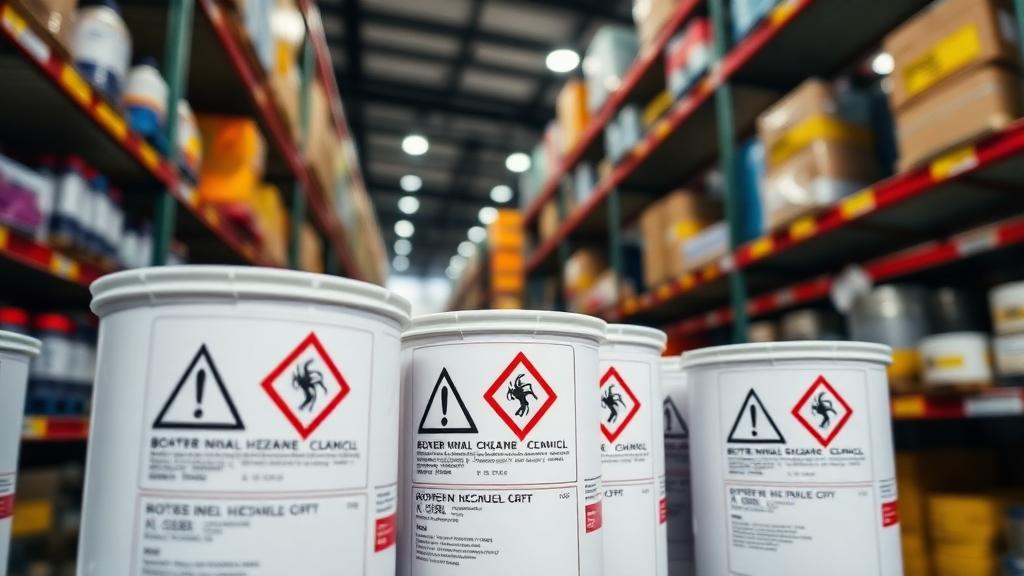
One of the most common labeling questions on a jobsite: "We already put the NFPA fire diamond on our tanks — can that be our label?" The short answer is yes, on workplace containers, with conditions — but the systems are built for different audiences and their rating numbers run in opposite directions, which is where compliance (and safety) goes wrong.
At a glance: OSHA accepts NFPA 704 and HMIS as workplace/secondary container labels under 29 CFR 1910.1200(f)(6)(ii) — if the label also carries the product identifier, conveys at least general hazard information, does not conflict with the required GHS elements, and your workers are trained on it. Two traps: the rating scales are reversed (NFPA/HMIS 4 = worst; GHS category 1 = worst), and you may never substitute NFPA/HMIS for the full GHS label on a shipped container. OSHA allows NFPA 704 and HMIS as workplace container labels under 29 CFR 1910.1200(f)(6)(ii) if the label carries the product identifier and general hazard information, does not conflict with the GHS elements, and employees are trained — but the NFPA and GHS rating scales run in opposite directions, and NFPA cannot replace the full GHS label on a shipped container.
Yes — as a Workplace Label
OSHA's Hazard Communication Standard gives you two options for a workplace (secondary) container you fill in-house (1910.1200(f)(6)): reproduce the full GHS label, or use the product identifier plus "words, pictures, symbols, or a combination" that provide at least general information about the hazards. An NFPA 704 diamond or an HMIS bar label fits the second option — OSHA has long confirmed both are acceptable workplace labeling systems.
Four conditions make it compliant:
- The product identifier is on the label (the same identifier that ties to the SDS).
- It conveys at least general hazard information — the ratings/colors have to actually tell a worker what they're dealing with.
- It does not conflict with the GHS pictograms or warnings required by the standard.
- Employees are trained on the system — what the colors and numbers mean, and how they differ from GHS.
That last point is not optional paperwork. Because the systems disagree on what a number means, an untrained worker can read an NFPA "1" as "barely hazardous" when the GHS classification behind it is Category 1 — the most severe.
The Reversal That Fools Everyone
This is the single most important thing to teach. Straight from OSHA's own NFPA-vs-HazCom comparison:
| NFPA 704 / HMIS | OSHA GHS classification | |
|---|---|---|
| Scale | 0–4 | 1–4 |
| What the extreme means | 4 = most hazardous, 0 = least | 1 = most severe, 4 = least severe |
| Where the number lives | On the diamond/bar label | In SDS Section 2 (not required on the label) |
So a "1" means near-opposite things: a mild hazard in NFPA/HMIS, but the worst category in GHS. OSHA is explicit about the consequence: do not copy the GHS hazard category numbers from SDS Section 2 into the NFPA 704 diamond. The NFPA numbers come from the NFPA 704 criteria tables, using hazard data in SDS Sections 9 (flammability), 10 (instability), and 11 (health) — not the GHS categories.
Different Audiences, Different Coverage
NFPA 704 and the HazCom label were built for different readers, and it shows in what they cover:
- NFPA 704 — basic information for emergency responders arriving at a fire or spill, and for emergency planning. It covers acute (short-term) health hazards only; chronic effects like carcinogenicity are not covered.
- The HazCom label — informs workers about the hazards under normal use and foreseeable emergencies. It covers acute and chronic hazards, including carcinogens, sensitizers, and target-organ toxicity. NFPA 704, as OSHA's QuickCard 3678 puts it, covers acute health hazards only, which is why it cannot stand in for the chronic warnings a HazCom label carries.
That chronic-hazard gap is why an NFPA-only workplace label can under-communicate a long-term hazard — and why the "general hazard information" and training conditions matter. A blue "2" doesn't tell a worker the product is a carcinogen.
One distinction between the two alternative systems matters right here: HMIS III added a chronic-hazard asterisk. A white asterisk (*) in the HMIS Health bar flags that the chemical has a chronic health hazard — a carcinogen, an organ toxicant, a reproductive hazard — the exact long-term risk a bare number can't convey. NFPA 704 has no equivalent indicator at all. So if you must run an alternative system on workplace containers, HMIS III at least signals that a chronic hazard exists; the NFPA fire diamond leaves it entirely to your training and the SDS. Either way, GHS08 (the health-hazard pictogram) is what carries that message on a GHS-style label.
The color codes
NFPA 704 diamond: Blue = Health · Red = Flammability · Yellow = Instability · White = Special hazards (OX oxidizers, W water-reactive, SA simple asphyxiant).
HMIS bars: Blue = Health · Red = Flammability · Orange = Physical hazard · White = PPE (a letter code for required protective equipment — the main structural difference from NFPA).
Where You Can't Use Them: Shipped Containers
The alternative systems are for the containers you fill. A container that leaves a manufacturer, importer, or distributor must carry the full six-element GHS label under 1910.1200(f)(1): product identifier, signal word, hazard statement(s), pictogram(s), precautionary statement(s), and the responsible party's name/address/phone. You cannot ship a drum with only a fire diamond, and you cannot deface the supplier's GHS label on an incoming container.
The Practical Call
| Situation | Compliant label |
|---|---|
| Container you fill in-house, workers trained on NFPA/HMIS | NFPA 704 or HMIS + product identifier — acceptable under 29 CFR 1910.1200(f)(6)(ii). Workers must be trained on the system you use (29 CFR 1910.1200(h)(3)(iv)) |
| Same, but workers not trained on the system | Not compliant — train them, or use a GHS-style workplace label |
| Immediate-use container, same worker, same shift | No label required (1910.1200(f)(8)) |
| Container shipped off-site | Full GHS label required by 29 CFR 1910.1200(f)(1); NFPA/HMIS cannot substitute |
| Stationary process tank | Signs, placards, or process sheets allowed by 29 CFR 1910.1200(f)(7) |
| Pipes and piping systems | Not containers (1910.1200(c)): no label; cover them in the written program (1910.1200(e)(1)(ii)) |
If your site already runs on NFPA/HMIS and your training covers the reversed scale, you can keep using it for workplace containers — just add the product identifier and make sure nothing on the label conflicts with the GHS hazards. If you're starting fresh, a GHS-style workplace label avoids the cross-system confusion entirely.
Skip the cross-system guesswork
HazComFast builds GHS-consistent workplace labels straight from the product's SDS — the right pictograms, signal word, and product identifier, no reversed-number confusion. Generate a compliant label in seconds, or a QR code to the full sheet.
The standard, tools & related reading
- The standard: Hazard Communication — 29 CFR 1910.1200 · GHS Labels hub
- On the job: GHS Label Generator · Secondary Container Label Decision
- Related guides: Shipped vs Workplace Labels · Secondary Container Labels: OSHA Rules · Secondary-label citation? The fix · 8 OSHA Pictograms vs 9 GHS Pictograms
The fire diamond isn't wrong — it's just built for the firefighter at the gate, not the worker at the bench. Keep it if your training closes the gap, and never let a reversed number decide how carefully someone handles a chemical.
Frequently Asked Questions
Can I use NFPA 704 or HMIS labels on workplace containers?
Yes. OSHA accepts NFPA 704 and HMIS as workplace/secondary container labels under 29 CFR 1910.1200(f)(6)(ii), provided the label also carries the product identifier, conveys at least general information about the hazards, does not conflict with the required GHS pictograms or warnings, and your employees are trained on the system.
Can I use the NFPA diamond on a shipped container instead of the GHS label?
No. Containers shipped from a manufacturer, importer, or distributor must carry the full six-element GHS label under 1910.1200(f)(1). NFPA 704 and HMIS are alternatives only for the containers you label in-house (workplace/secondary containers).
Why do the NFPA and GHS numbers run opposite ways?
They are different systems. NFPA 704 and HMIS rate 0-4 where 4 is the MOST hazardous. OSHA's GHS classification runs 1-4 where category 1 is the MOST severe. A '1' means near-opposite things in the two systems, which is exactly why training on the workplace labeling system is required when you use an alternative rating system (29 CFR 1910.1200(h)(3)(iv)).
Can I copy the GHS category numbers from SDS Section 2 into the NFPA diamond?
No. OSHA's QuickCard 3678 says the hazard category numbers in Section 2 of the SDS are not to be used to fill in the NFPA 704 diamond. NFPA ratings come from the NFPA 704 criteria tables using hazard data in SDS Sections 9, 10, and 11, not from the GHS category numbers; the SDS sections themselves are set by 29 CFR 1910.1200(g)(2) and Appendix D.
Does NFPA 704 cover chronic health hazards like carcinogens?
No. NFPA 704 covers ACUTE (short-term) health hazards only — it is built for emergency responders. The HazCom label covers both acute and chronic hazards (including carcinogens). That gap is one reason an NFPA-only workplace label must still convey general hazard information and be backed by training (29 CFR 1910.1200(f)(6)(ii) and (h)(3)(iv); OSHA QuickCard 3678).
OSHA figures and citations here come from our regulatory source-of-truth modules, last checked against the eCFR, OSHA.gov, and the Federal Register on October 5, 2026. Last reviewed October 5, 2026.
About This Article
Published by: HazComFast
Published: July 18, 2026
Last Updated: October 5, 2026
This content is for informational purposes only and does not constitute legal advice.