A replacement gearbox fits the machine but changes its operating speed. A water-based cleaning product reduces one solvent hazard while introducing a different exposure. An exhaust hood is moved to accommodate larger workpieces. A breakdown prompts a supervisor to consider an operating bypass that no one has assessed.
None of these situations necessarily involves a process covered by OSHA's Process Safety Management (PSM) standard. Each could still change how employees encounter hazards or how safeguards perform.
Management of Change (MOC) is a way to identify and assess the safety consequences of a modification before implementation and before normal operation resumes. A useful review records what is changing, its technical basis, which hazards and people may be affected, the needed controls, and the evidence needed to release the modified operation.
Formal written MOC is binding for processes within the scope of OSHA's PSM MOC provision and for certain processes under EPA's Risk Management Program (RMP). There is no universal federal OSHA requirement for every employer to operate the PSM MOC system. Other employers may voluntarily use a proportionate procedure, while complying with any task-specific or hazard-specific regulations that apply. [1–4]
This guide provides a decision procedure, chemical and equipment examples, a one-page screening option, and a more detailed change-review form. The forms are not substitutes for a regulated PSM or RMP program.
When is management of change legally mandated?
OSHA PSM: covered processes
Under 29 CFR 1910.119(l)(1), a PSM-covered employer must establish and implement written procedures for changes to process chemicals, technology, equipment, procedures, and facilities affecting a covered process, except replacement in kind. Determine applicability under 1910.119(a), rather than assuming that any industrial chemical triggers PSM. [1]
For a change within the provision's scope, 1910.119(l)(2) requires the procedure to address, before the change, the technical basis; safety and health impacts; necessary operating-procedure modifications; necessary time period; and authorization requirements. Paragraph (l)(3) requires affected operating employees and maintenance and contract employees whose work is affected to be informed of and trained in the change before startup of the affected process or portion. Paragraphs (l)(4)–(5) require applicable process-safety-information and operating-procedure updates. [1]
Pre-startup safety review (PSSR) is a distinct requirement. Under 1910.119(i), it applies to new facilities and to modified facilities when the modification is significant enough to call for a change in process safety information. It is not a blanket requirement to perform a full PSM PSSR for each routine adjustment. [1]
OSHA's nonmandatory PSM Appendix C, Section 11, provides guidance on temporary changes, operating deviations, computer program modifications, documentation, and reviews scaled to the change. It does not add new enforceable obligations. [2]
EPA RMP: separate applicability
40 CFR 68.75 calls for written MOC procedures for changes affecting a process subject to RMP Program 3 prevention requirements, except replacements in kind. Whether Part 68 applies depends on covered substances, thresholds, process classification and other regulatory provisions. A facility can be outside OSHA PSM but still have EPA duties. Its actual RMP program and requirements need to be assessed before choosing a voluntary template. [3]
Other OSHA duties still apply outside PSM
| Potential change | Applicable federal provision, when within scope | Specific issue |
|---|---|---|
| Introduce a previously unaddressed chemical hazard | 29 CFR 1910.1200(h)(1) | Effective information and training when the new hazard is introduced |
| Revise chemical use, labeling or SDS availability | 1910.1200(e), (f), (g) | Applicable written-program, label and SDS duties |
| Replace, renovate or significantly modify equipment | 1910.147(c)(2)(iii) | Design of energy-isolating devices to accept lockout under the specified conditions |
| Change machines or energy-control procedures | 1910.147(c)(7)(iii) | Retraining when the described changes or knowledge deficiencies trigger it |
| Modify or relocate machinery | 1910.212(a), (b) | Guards and anchoring, as applicable |
| Modify electrical equipment | 1910.303 and other relevant Subpart S provisions | Suitability, installation and use |
| Alter certain airborne exposure controls | 1910.1000(e) | Feasible controls and approval of technical measures for their particular use by a competent industrial hygienist or other technically qualified person |
| Modify specified ventilation operations | 1910.94 | Operation-specific ventilation duties |
| Change silica-generating processes or controls | 1910.1053(d)(4), as applicable | Reassessment when changed conditions may create new/additional exposure at or above the action level |
| Change respirator requirements | 1910.134 | Applicable respiratory protection program duties |
These are examples, not a universal compliance checklist. 1910.147 excludes construction employment; relevant construction standards and state-plan requirements need to be checked separately. A voluntary MOC signoff does not establish compliance with the underlying rules. [5–12]
What counts as a safety-relevant change?
A proposed modification deserves screening if it could change the hazards, exposure, protection, operating envelope, emergency arrangements, or people involved in an operation. A low-cost software revision can have more safety impact than an expensive equivalent equipment replacement.
| Category | Example | What might change |
|---|---|---|
| Chemical | New degreaser, adhesive, process gas | Health effects, flammability, incompatibility, exposure controls |
| Equipment | Motor, pump, conveyor, valve, gearbox | Speed, force, pressure, materials, hazardous energy |
| Relocation | Machine or workstation moved | Machine access, traffic, electrical supply, anchoring, ventilation |
| Engineering controls | Hood, duct, fan, filter or enclosure revised | Capture, containment, worker exposure |
| Procedures | New startup, maintenance or cleaning sequence | Isolation, human error opportunities, exposure |
| Staffing | Different shift coverage, contractor interface | Monitoring, emergency duties, handover |
| Controls | PLC logic, robot path, interlock or reset | Unexpected motion, fault response, protective functions |
| Temporary arrangement | Rental pump, bypass or provisional exhaust | Restrictions, expiration, restoration |
| Abnormal deviation | Process outside evaluated limits or repeated workaround | Unassessed hazards and degraded safeguards |
Screen changes that originate in procurement, maintenance, engineering, operations, controls vendors, and contracting, not just formal capital projects. Evaluate connected or simultaneous changes affecting the same system.
Replacement in kind is about design, not appearance
OSHA defines replacement in kind in 1910.119(b) as a replacement that satisfies the design specification. It need not carry the same manufacturer name; physical fit alone is insufficient. Compare relevant capacity, speed, pressure, temperature, torque, material compatibility, electrical characteristics, failure behavior, safeguards and documented use limits. [1]
For example, an alternative conveyor gearbox with the same mounting pattern but a different reduction ratio may change output speed, loads and stopping requirements. If equivalence is uncertain, hold the substitution for technical review. A verified equivalent replacement can follow ordinary maintenance controls outside PSM, but guarding, hazardous-energy and other duties remain applicable.
A proportionate, two-level non-PSM procedure
Level 1, Quick Screen. Use a short documented screen for a change with limited, well-understood effects. State the current and proposed conditions, applicable requirements, site-specific hazards, controls, evidence, decision and return-to-service checks. The screen can conclude that ordinary work controls are appropriate or escalate the request.
Level 2, Full MOC. Use a detailed technical review when there is uncertainty, a new or changed significant hazard, altered interlocks or exposure controls, complex automation, connected system effects, important temporary restrictions, or a change in established operating limits. Record hazard evaluation, action owners, risk decision, test acceptance criteria, implementation approval, worker instruction, release and closeout.
These levels are voluntary design choices, not federal OSHA classifications. Unknown regulatory coverage or a potentially serious unresolved hazard is a stop-and-escalate condition, not an automatic quick-screen approval.
Step 1: Document the real difference
Identify the equipment/process, location, current and proposed configuration, operating conditions, technical justification, duration, drawings, manufacturer data, SDSs and affected employees/contractors. “Replace motor” is not an adequate description if the rated speed, controls or guarding assumptions will change.
Step 2: Check legal scope and identify critical hazards
Determine PSM/RMP coverage first, followed by applicable OSHA, state, environmental and industry-specific requirements. Identify site-specific critical hazards that generic forms can miss, such as combustible dust, pressure relief, flammable atmospheres, hazardous reactions, oxygen deficiency, process instability, stored energy, or a consequential loss of ventilation. A generic set of checkboxes is not a substitute for knowing the facility.
Step 3: Assess implementation and subsequent operation
Consider installation hazards (lifting, line breaking, electrical work, hazardous energy, contractor interfaces) separately from normal use, cleaning, startup, shutdown, maintenance, foreseeable faults and emergency response. Consult employees who perform the task. A checklist may suffice for a simple change; complex changes may call for what-if analysis, JHA, FMEA, industrial hygiene or specialized engineering review.
Step 4: Select controls and explicitly decide on residual risk
Consider elimination, substitution, engineering controls, work-practice measures and PPE, in an order appropriate to the hazard. Each material finding needs a responsible person, a proposed control, evidence of suitability, any remaining uncertainty, and a decision: accept for implementation under conditions; hold for additional information; redesign; or reject. An arbitrary risk-matrix score does not override binding protections. [4]
Step 5: Account for interfaces and parallel work
Review open changes to the same machinery, chemicals, ventilation, utilities, software, work area or contractor tasks. A solvent substitution and simultaneous hood relocation need to be evaluated together if they alter the same exposure-control assumptions.
Step 6: Authorize implementation, not yet production
Specify the approved technical scope, implementation safeguards, hold points, needed tests, document changes and reviewer competencies. A maintenance supervisor may reasonably approve a simple voluntary change; machine safety, controls or industrial hygiene specialists may be essential for others. There is no universal non-PSM OSHA signature count.
Step 7: Control deviations during the work
If a different component, cable, duct route or logic revision becomes necessary during installation, assess the safety implications before accepting the deviation. Document revised authorization and testing. Emergency stabilization needs to follow applicable safe-work and response procedures; urgency is not permission for an unassessed bypass.
Step 8: Set acceptance criteria before testing
Define tests and passing criteria from manufacturer specifications, applicable rules or qualified design analysis, before seeing the results. A fan operating or a conveyor completing a production cycle is not necessarily proof that exposure controls or protective functions are effective. Record failed tests, corrections and retests. No universal airflow, stop-time or risk-score threshold is suitable for all equipment.
Step 9: Update information and instruct affected workers
Revise applicable SOPs, drawings, LOTO procedures, SDS access and workplace information, protective equipment assessments, software versions, emergency instructions and contractor communications. Determine which changes call for formal training under a specific standard and where job-specific demonstrations are appropriate. Relevant HazComFast resources include its HazCom Compliance Guide, SDS Management Guide, and Lockout/Tagout Guide.
Step 10: Conduct a pre-use verification and authorize release
Confirm installed configuration; functional guards and interlocks; applicable isolation; electrical/mechanical inspections; exposure controls; approved test results; updated documentation; training; and completion of safety-critical actions. A non-PSM employer may call this a voluntary pre-use verification, rather than implying that every change triggers the particular PSM PSSR in 1910.119(i). Keep installation approval and normal-operation approval separate.
Step 11: Track follow-up and closeout
For changes that need operating observation, establish an owner, condition, monitoring method, deadline and response to unfavorable findings. Close the record only after final as-built information, needed actions and training/verification records are accounted for. Keep temporary arrangements open until restoration or reviewed permanent conversion.
Particular changes that deserve more than a generic checklist
Chemical substitution
Compare the original and proposed SDSs, especially Sections 2 (hazards), 3 (composition), 7 (handling/storage), 8 (exposure controls/PPE), 9 (properties), 10 (reactivity), and 11 (toxicology). Evaluate actual concentration, temperature, spraying, duration, compatibility with hoses/seals, ventilation and waste handling. A “water-based” product may still cause corrosive or aerosol exposure. Under 1910.1200(h)(1), training is required when a new chemical hazard employees have not previously been trained about is introduced, not automatically for every new trade name. [5]
Equipment changes, relocation and LOTO
Evaluate changed speed/torque, moving parts, guard access, anchoring, electrical connections, stored energy and maintenance clearances. 1910.147(c)(2)(iii) includes lockout-capable energy-isolating-device design requirements during specified major work, while (c)(7)(iii) specifies retraining triggers. Both are scope-dependent; neither is a universal requirement for all construction work. [6,7]
Ventilation and worker exposure
Relocating a hood may reduce capture even if the measured airflow appears acceptable. Evaluate contaminant generation, source-to-hood relationship, duct resistance, connected branches, crossdrafts and representative worker exposure. 1910.1000(e) has its own approval provision for technical controls within its scope; substance-specific standards may impose additional or different requirements. A smoke check or fan reading alone cannot establish exposure compliance. [9]
Controls, automation and interlocks
Control logic, sensor arrangement, robot paths, alarms, reset sequences or automatic restart can change a safety function without a visible hardware modification. Record the approved software/parameter revision, expected safe state, foreseeable failure behavior and appropriate validation. Normal production testing alone may not validate a protective system. OSHA's robot safety guidance provides technical context.
Work organization and contractors
Consider new shift coverage, staffing, supervision, equipment handover, simultaneous contractor work and emergency roles. Ask workers how actual operations differ from the written procedure. A change that removes a monitoring role can be significant even if no equipment moves.
Temporary changes and abnormal deviations
An unplanned upset requires appropriate protective action, shutdown or emergency procedures first. If the proposed recovery would exceed evaluated limits, change a safeguard or introduce a temporary route or bypass, screen that proposal rather than treating the upset as its own authorization. For temporary changes, record operating limits, responsible monitoring, expiration/termination conditions and restoration. Repeated workarounds warrant investigation and reassessment. OSHA's PSM Appendix C emphasizes these issues for covered processes. [2]
Why the facility-specific hazard question matters: Didion Milling
The U.S. Chemical Safety Board investigated the May 31, 2017 combustible-dust explosions at Didion Milling in Wisconsin, which killed five workers. Its December 2023 investigation concluded that Didion had MOC procedures and forms, but its process did not adequately identify or assess combustible-dust hazards. A temporary conveying modification lacked sufficient design analysis, specialist review and information for affected operators. The CSB described deficiencies in assessing conveying-system airflow, material loading and dust accumulation. [13]
The investigation shows why the hazard review needs to reflect the facility's actual processes. A completed equipment-change form can miss the combustible-dust hazards introduced by a conveying modification. For grain handling, for example, the form needs to trigger review of combustible-dust and conveying conditions rather than assuming a generic equipment checklist is enough.
Download the MOC forms and worked example
- One-page MOC quick screen (printable PDF) records the initial decision and a separate before-use release.
- Full MOC request and verification form (Word) covers technical review, hazards, controls, tests, training, release and closeout.
- Completed fictional ventilation and silica MOC record (Word) shows how to evaluate both workstations connected to a shared exhaust system. All measurements, records and approvals are invented for training.
These tools support a voluntary non-PSM procedure. Use the governing OSHA PSM or EPA RMP procedure when it applies; the forms do not replace it.
Three hypothetical examples
Case 1: Changing a solvent
Hypothetical setting. A maintenance shop wants to replace its solvent-based parts degreaser with an alkaline water-based product. In this fictional example, the first product has a flammability hazard; the substitute's supplier information identifies potential corrosive or serious eye hazards, and spraying could create an inhalable mist. These are scenario assumptions, not claims about any named product.
| Review item | Existing method | Proposed method | Evidence or action before release |
|---|---|---|---|
| Chemical hazards | Flammable solvent product (assumed) | Alkaline water-based formulation (assumed) | Compare current SDSs, hazard classifications, concentrations and actual use conditions |
| Exposure route | Vapor and skin contact | Possible mist, eye and skin contact | Assess application temperature, spraying/agitation, duration, worker position and ventilation |
| Equipment compatibility | Existing seals and parts already evaluated | New solution may contact metals, coatings, hoses or seals | Confirm compatibility using supplier/manufacturer information; do not infer compatibility from “water-based” |
| PPE | Existing glove/eye protection selection | May need different chemical-resistant gloves and splash protection | Document PPE selection for the actual exposure and conditions |
| Work and emergency procedures | Established solvent handling and spill response | Different preparation, disposal and response practices may be needed | Review labeling, SDS access, storage, spill response, wastewater implications and operating instructions |
| Affected workers | Maintenance cleaners | Same workers plus any employees mixing the new concentrate | Determine whether a previously untrained chemical hazard requires training under 1910.1200(h)(1) |
Decision record. The initial request is held for technical review, not approved simply because the substitute is water-based. A limited trial, if authorized, would need a separate safe-use plan addressing its own exposures. Normal-use release follows only after compatibility, exposure-control, safe-work and applicable Hazard Communication questions have been resolved and the needed measures implemented.
What the completed record should contain: the exact two SDS revisions, process description and concentration, equipment-compatibility finding, exposure/PPE decision, updated work instructions, training determination, implementation approval, and separate verification of conditions for normal use. No universal requirement to conduct a particular sampling test or collect a specified number of signatures is implied for all non-PSM substitutions.
Case 2: Moving a local exhaust hood
Hypothetical setting. An engineered-stone finishing workshop relocates a capture hood and modifies the ductwork shared with another silica-generating workstation. Both operators could be affected: flow at the modified hood does not demonstrate control at the connected branch, and neither airflow reading is a substitute for worker exposure assessment.
| Review question | Original finishing station | Connected second station | Evidence or action needed |
|---|---|---|---|
| Technical scope | Hood LEV-04 relocated | Common fan and second duct branch affected | Compare approved design with installed configuration; check both locations |
| Engineering performance | Fictional result 850 cfm against project-only criterion of 800 cfm | Fictional result 780 cfm against project-only criterion of 750 cfm | Confirm measurement points, methods, connected-system balance and capture behavior; these are not OSHA universal minimums |
| Worker exposure | Fictional personal 8-hour silica TWAs 19 and 17 µg/m³ on Nov 2 and 10, 2026 | Separate fictional personal 8-hour silica TWAs 18 and 16 µg/m³ on the same dates | Document representative tasks, shifts and work areas; approved sampling/lab method; qualified assessment under applicable 1910.1053(d) provisions |
| Silica-program effects | Revised hood positioning, control-plan tasks and housekeeping | Separately assessed group; no inference from first station | Check the written exposure control plan, training, exposure notifications, monitoring triggers, applicable medical surveillance and records |
| Change decision | Installation and commissioning only until needed evidence is reviewed | Same hold applies to the shared system | Authorize normal use only for the evaluated conditions after all applicable pre-use requirements and controls are satisfied |
A controlled commissioning trial calls for its own safe-work conditions before workers are exposed: functioning interim controls, trained personnel, any needed respiratory protection, restricted access where applicable, and defined stop conditions. Approval to collect representative exposure samples does not release the operation for unrestricted routine production.
All four results, specifications and approvals are fictional training values, not site measurements, engineering design recommendations or compliance findings. In this example the applicable OSHA silica action level is 25 µg/m³ and the PEL is 50 µg/m³ as 8-hour TWAs. Under 1910.1053(d)(3)(v), two consecutive measurements taken no less than seven days apart and below the action level may support discontinuing scheduled monitoring for the employees whose exposures they represent. The written-plan, medical, recordkeeping and future reassessment duties that remain applicable continue.
Decision: review exposure and ventilation performance independently for both workplaces, and do not release the modified operation merely because the fan runs. Open the full fictional ventilation MOC record, including field/laboratory assumptions, pre-use decisions and silica-program checks.
Case 3: Replacing a gearbox
Hypothetical setting. A conveyor gearbox fails. A proposed alternative has the same mounting pattern but a different reduction ratio. To illustrate the design consequence, assume the drive input runs at a constant 1,200 rpm and the original ratio is 20:1 while the proposed ratio is 15:1. These are fictitious equipment values, not recommended operating settings.
| Design question | Original (hypothetical) | Alternative (hypothetical) | Review implication |
|---|---|---|---|
| Mounting and shaft interfaces | Established fit | Physically compatible | Fit alone does not demonstrate design equivalence |
| Gear ratio | 20:1 | 15:1 | The design specification changes |
| Calculated output speed at assumed input | 60 rpm | 80 rpm | Output speed increases by approximately 33%; check machine operating limits and safeguards |
| Output torque / loading | Original evaluated basis | Different ratio may change load and torque behavior | Verify ratings, connected components, mechanical stresses and manufacturer suitability |
| Stopping and guarding | Assessed for original configuration | Not established for alternative | Review stopping, guards, accessible hazardous motion and downstream equipment |
| Servicing and energy isolation | Documented arrangement | Possible changed procedure | Review applicable 1910.147 provisions and any needed retraining |
Decision record. The different-ratio unit is not accepted as replacement in kind merely because it fits. The MOC is held until engineering evaluates the relevant design limits, machine guarding, hazardous-energy effects, any controls interactions, and acceptance tests. A documented implementation approval would still be distinct from permission to resume operation.
Alternative outcome. A supplier offers another gearbox that demonstrably satisfies all relevant existing design specifications. The employer can document the specification comparison and process this verified equivalent replacement through the appropriate routine maintenance and return-to-service path, while meeting applicable machine and energy-control requirements.
Technical lesson: the acceptance decision concerns the complete installed machine, not just whether a component can be bolted into place. Matching ratios by themselves would also be insufficient if other critical specifications differed.
MOC decision tree in plain language
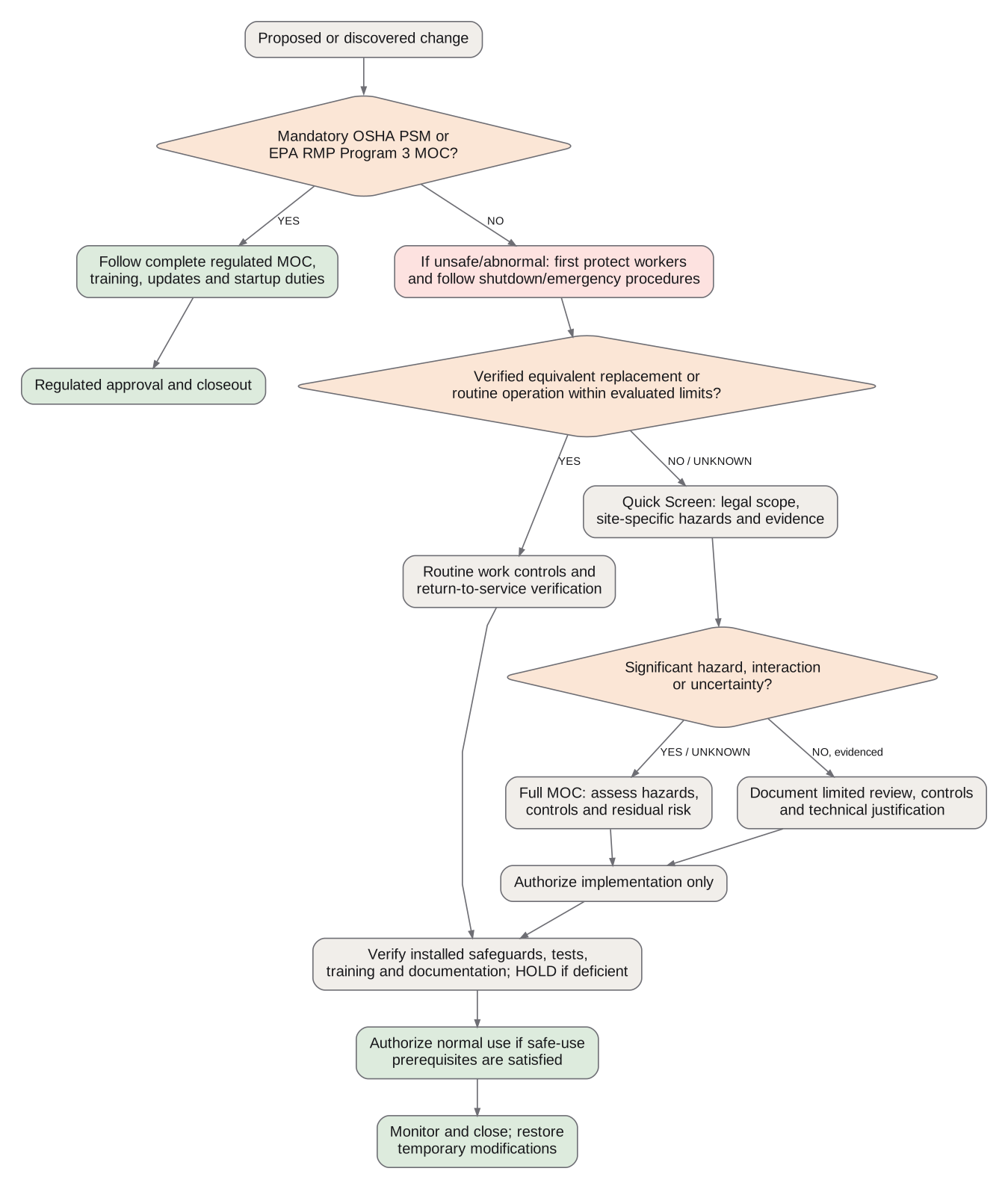
Text alternative to the flowchart (also suitable for screen readers and text-only pages):
- Does OSHA PSM or EPA RMP Program 3 MOC apply? If yes, follow the entire applicable regulated procedure, including its separate startup and information duties; do not substitute this voluntary workflow.
- Is an unsafe or abnormal condition present? Protect workers, use applicable shutdown/emergency procedures, then screen any proposed operating deviation.
- Is this a verified equivalent replacement or an ordinary adjustment within evaluated limits? If yes, follow the normal safe-work and return-to-service process, documenting the basis when appropriate.
- Could hazards, exposure, safety functions, operating limits, affected people or site-specific critical hazards change, or is that uncertain? Complete a Quick Screen and escalate material issues to Full MOC.
- Are the hazard analysis, controls, implementation conditions and residual-risk decision supported? If no, hold, redesign, investigate or reject. If yes, authorize implementation.
- Did the installed configuration pass all applicable checks, tests, documentation and training prerequisites? If no, hold normal use. If yes, explicitly authorize release for the defined conditions.
- Are temporary arrangements restored and closeout evidence complete? Monitor as needed and close the documented change.
Official sources and further reading
- OSHA, 29 CFR 1910.119, especially (a), (b), (i), (l).
- OSHA, 1910.119 Appendix C (nonmandatory), Section 11.
- EPA, 40 CFR 68.75, Management of Change.
- OSHA Recommended Practices, Hazard Identification and Assessment; NIOSH Hierarchy of Controls.
- OSHA, 29 CFR 1910.1200, Hazard Communication.
- OSHA, 29 CFR 1910.147, Hazardous Energy.
- OSHA, 29 CFR 1910.212, Machine Guarding.
- OSHA, 29 CFR 1910.303, Electrical Equipment.
- OSHA, 29 CFR 1910.1000, Air Contaminants; 1910.94, Ventilation.
- OSHA, 29 CFR 1910.1053, Respirable Crystalline Silica; Appendix A, Analytical Methods.
- OSHA, 29 CFR 1910.134, Respiratory Protection.
- OSHA Technical Manual, Industrial Robot Systems.
- U.S. Chemical Safety Board, Didion Milling investigation report (Dec. 2023) and full investigation PDF.
This guide distinguishes selected enforceable federal obligations from voluntary safety-management practices. Applicability depends on actual processes, substances, employment setting and jurisdiction. A completed MOC record is not a regulatory compliance certificate or a guarantee of safe operation.
Frequently Asked Questions
Does every U.S. employer have to use a formal MOC procedure?
No. OSHA's 1910.119(l) formal MOC rule covers applicable PSM processes; EPA RMP Program 3 may impose a separate MOC requirement. Other employers can voluntarily use MOC while complying with applicable hazard-specific duties.
Can a small company use a one-page MOC form?
Yes for a proportionate voluntary screening, if the hazards and regulatory scope are understood. A short form cannot replace binding PSM/RMP requirements, such as 1910.119(l), or necessary engineering evaluation. Unknowns that could affect serious hazards should escalate.
Is a replacement in kind exempt from all safety checks?
No. Under PSM, a replacement satisfying the design specification is excepted from the MOC provision of 1910.119(l)(1), not from all applicable guarding, hazardous-energy, electrical or other safety duties.
Do temporary changes and emergency workarounds need review?
Temporary changes covered by a regulatory MOC provision, such as 1910.119(l)(2)(iv), remain subject to it. Outside PSM, employers should document limits, controls, expiry and restoration. First stabilize an abnormal condition using appropriate safe-work and emergency procedures; do not assume urgency approves an unassessed bypass.
Does OSHA mandate a pre-startup safety review after every equipment change?
No. The PSM PSSR requirement in 1910.119(i) has specific coverage and triggers. Other inspections/testing obligations may still apply. A voluntary non-PSM pre-use check is distinct from a regulated PSSR.
Is an airflow measurement sufficient after moving an exhaust hood?
Not necessarily. Effective control depends on contaminant release, capture geometry, operating conditions and actual exposure. Applicable standards, such as 1910.1000(e), may call for engineering review or personal monitoring. A fan can run while capture is inadequate.
Site-wide regulatory figures such as compliance dates and penalty amounts come from our regulatory source-of-truth modules, last checked against the eCFR, OSHA.gov, and the Federal Register on October 19, 2026. Last reviewed November 14, 2026.
About This Article
Published by: HazComFast
Published: November 14, 2026
Last Updated: November 14, 2026
- https://www.cdc.gov/niosh/hierarchy-of-controls/about/index.html
- https://www.csb.gov/assets/1/6/didion_milling_report_for_public_release.pdf
- https://www.csb.gov/didion-milling-company-explosion-and-fire-/
- https://www.ecfr.gov/current/title-40/chapter-I/subchapter-C/part-68/subpart-D/section-68.75
- https://www.osha.gov/laws-regs/regulations/standardnumber/1910/1910.1000
- https://www.osha.gov/laws-regs/regulations/standardnumber/1910/1910.1053
- https://www.osha.gov/laws-regs/regulations/standardnumber/1910/1910.1053AppA
- https://www.osha.gov/laws-regs/regulations/standardnumber/1910/1910.119
- https://www.osha.gov/laws-regs/regulations/standardnumber/1910/1910.119AppC
- https://www.osha.gov/laws-regs/regulations/standardnumber/1910/1910.1200
- https://www.osha.gov/laws-regs/regulations/standardnumber/1910/1910.134
- https://www.osha.gov/laws-regs/regulations/standardnumber/1910/1910.147
- https://www.osha.gov/laws-regs/regulations/standardnumber/1910/1910.212
- https://www.osha.gov/laws-regs/regulations/standardnumber/1910/1910.303
- https://www.osha.gov/laws-regs/regulations/standardnumber/1910/1910.94
- https://www.osha.gov/otm/section-4-safety-hazards/chapter-4
- https://www.osha.gov/safety-management/hazard-identification
This content is for informational purposes only and does not constitute legal advice.