Mostly no — OSHA has no general rule ordering you to separate incompatible chemicals, and the segregation chart taped to your storage conex almost certainly comes from fire code, not from OSHA. The Hazard Communication Standard, 29 CFR 1910.1200, imposes no storage segregation duty anywhere in its text. But the answer cannot stop there, because two other things are true at once: a handful of narrow federal sentences do command separation, and the General Duty Clause gives an inspector a road to the acid stored over the cyanide even though no specific standard names it. Knowing exactly which rulebook says what is the difference between a defensible storage plan and an argument at the closing conference.
OSHA's Hazard Communication Standard contains no chemical segregation requirement; its Appendix D instead forces every safety data sheet to disclose incompatibilities in Sections 7 and 10. The explicit federal separation rules are narrow, such as the prohibition on storing water-reactive materials in the same room as flammable liquids and the 20-foot separation of oxygen cylinders from fuel-gas cylinders in storage, and broader segregation practice comes from NFPA fire codes, enforced by OSHA only through the General Duty Clause when incompatible storage is a recognized hazard.
The conex at the back of the laydown yard
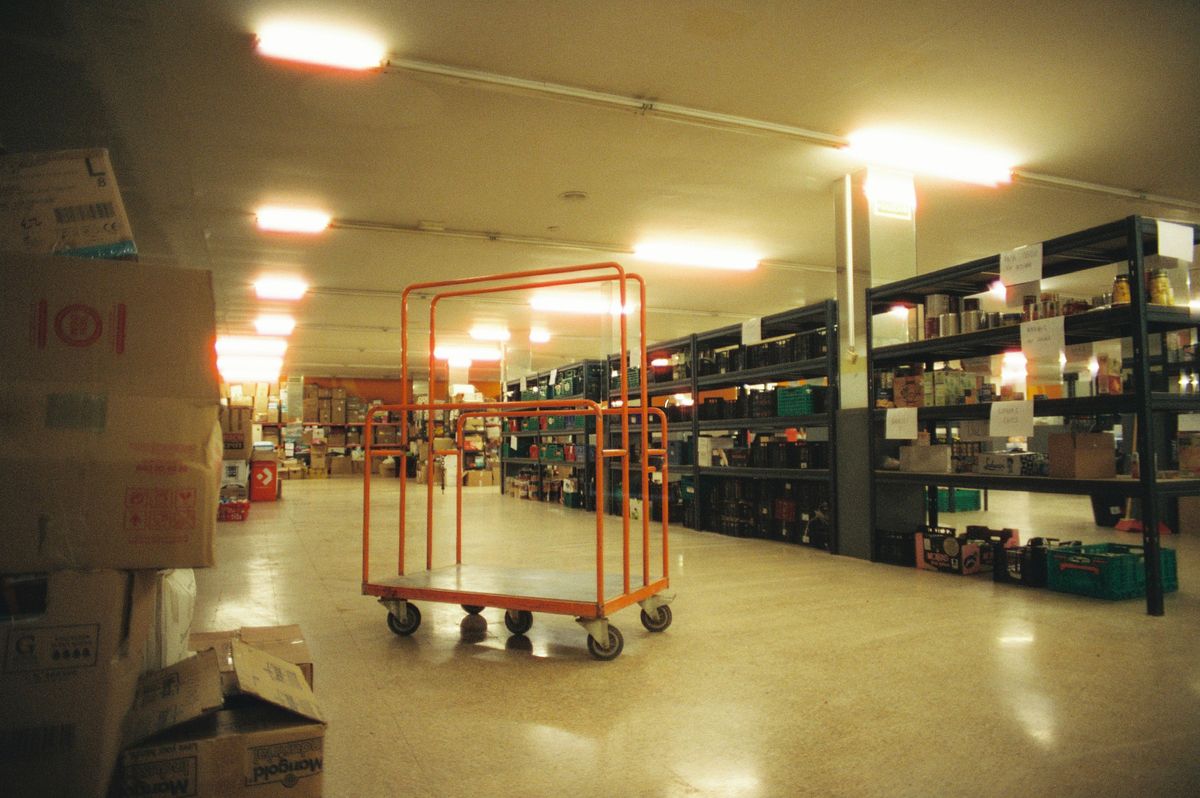
A subcontractor's storage container holds what every jobsite container holds: solvents and form oil on one rack, bagged pool-shock chlorine from a leftover task on the next, a case of acetone against the wall, muriatic acid for the masons on the floor. The safety manager who asks for it to be reorganized gets the question this article answers: "Show me where OSHA says that." And the honest answer — that no general OSHA sentence says it — usually ends the conversation exactly where it should begin.
What the OSHA text actually says
Lay the federal sentences out and the pattern is visible: they are few, and they are narrow.
| Provision | What it commands | How far it reaches |
|---|---|---|
| 1910.106(d)(7)(iv) | "Materials which will react with water shall not be stored in the same room with flammable liquids" | General industry; same-room prohibition, one incompatibility pair |
| 1926.152(b)(4)(iii) | "Materials which will react with water and create a fire hazard shall not be stored in the same room with flammable liquids" | The construction version of the same sentence |
| 1926.350(a)(10) / 1910.253(b)(4)(iii) | "Oxygen cylinders in storage shall be separated from fuel-gas cylinders or combustible materials (especially oil or grease), a minimum distance of 20 feet (6.1 m) or by a noncombustible barrier at least 5 feet (1.5 m) high having a fire-resistance rating of at least one-half hour" | Compressed gas cylinders in storage only; construction and general industry say it in the same words |
| 1910.176(b) | "Storage of material shall not create a hazard" | General industry materials handling — broad wording, no specifics |
| 1910.106 / 1926.152 generally | Quantity limits, approved containers, cabinet and storage-room construction for flammable liquids | Flammables housekeeping, not incompatibility pairing |
What is absent is the thing everyone assumes exists: no OSHA standard sets general separation distances between incompatible chemical classes, prescribes a segregation chart, or requires color-coded storage groups. The 12-group segregation schemes and the class-by-class distance tables live in the NFPA fire codes, chiefly NFPA 30 for flammable liquids and NFPA 400 for hazardous materials, and in EPA guidance on incompatible storage. Those become binding locally when a state or municipality adopts the fire code, which is why the fire marshal can lawfully demand what no OSHA paragraph contains.
What HazCom requires instead: that you know
The Hazard Communication Standard stays out of your storage room, but it reaches into it another way. Appendix D to 1910.1200, which makes SDS content mandatory, requires Section 7 of every SDS to state "conditions for safe storage, including any incompatibilities," and Section 10 to list "incompatible materials." HazCom then requires those sheets to be readily accessible to employees during each work shift, under 1910.1200(g)(8).
Put plainly: the standard does not order you to move the oxidizers away from the solvents. It orders the manufacturer to tell you, in writing, in a document you are required to keep at hand, that they should not sit together. Which is precisely what makes the next section work against you.
The road OSHA actually drives: the General Duty Clause
Section 5(a)(1) of the OSH Act requires each employer to furnish employment and a place of employment "free from recognized hazards that are causing or are likely to cause death or serious physical harm" (29 U.S.C. 654(a)(1)). A violent chemical reaction in a storage room qualifies on the harm side without argument. The contested element in any General Duty case is recognition — did the employer know, or should the industry have known, that the condition was hazardous?
This is where the two halves of the answer connect. The incompatibility warning in Section 7 and Section 10 of the SDS sitting in your own binder is about as clean a proof of a recognized hazard as an inspector could ask for, and the consensus standards that describe standard segregation practice help establish what the industry recognizes. So the precise legal position is narrow but real: OSHA cannot cite you for violating a segregation chart it never wrote, and it can cite the recognized hazard the mixed shelf creates. Contractors who hear only the first half of that sentence reorganize their storage the expensive way.
Who enforces what, on the same shelf
| Rulebook | Enforcer | What it can demand |
|---|---|---|
| 1910.106 / 1926.152, 1910.176(b), 1926.350(a)(10) / 1910.253(b)(4)(iii) | OSHA | The specific sentences above: water-reactives out of the flammables room, oxygen cylinders 20 feet from fuel-gas cylinders or behind a rated barrier, safe storage, flammables housekeeping |
| General Duty Clause, 5(a)(1) | OSHA | Abatement of a recognized incompatibility hazard the SDSs themselves document |
| 1910.1200 + Appendix D | OSHA | That SDSs exist, disclose incompatibilities, and are accessible to the crew |
| NFPA 30 / NFPA 400, as adopted | State or local fire authority | The actual segregation architecture: distances, barriers, hazard-class groups, dedicated rooms |
The practical consequence for a jobsite is undramatic: read Sections 7 and 10 of the SDS for what is actually on site, honor the few hard federal sentences, and treat the fire-code segregation groups as the working method — they are how our own chemical compatibility guide organizes the problem, twelve groups and the pairs that must never meet, and the chemical storage guide covers the flammables-specific rules in depth.
The SDS tells you; the assignment screen refuses
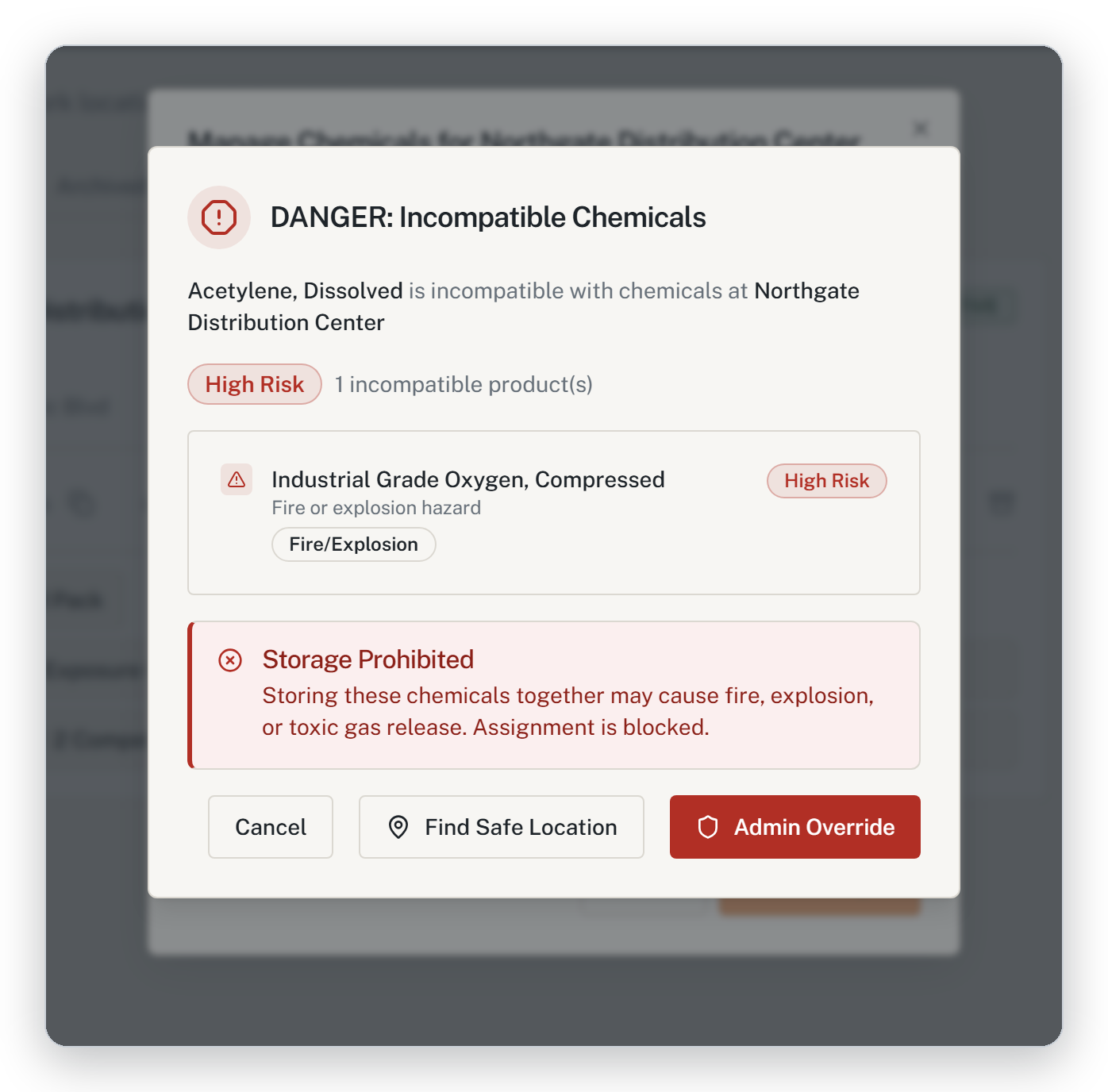
Reading Section 10 is the requirement. Acting on it at the moment a product ships to a site is where paper programs fail. When a chemical is assigned to a jobsite in HazComFast, the products already stored there are screened for high-risk pairs: a dangerous combination is blocked — not flagged after the fact — with the conflicting product, the reaction type and the verdict named on screen. An administrator can override deliberately; a site manager gets the same block with no override offered. The rule set is maintained centrally, so a newly identified pair takes effect without an app update. Screening supports the SDS; it never replaces reading Section 10.
The bottom line
| Question | Answer |
|---|---|
| General OSHA segregation rule | None — 1910.1200 contains no storage separation duty |
| Explicit federal separation sentences | Water-reactives out of the flammables room — 1910.106(d)(7)(iv) / 1926.152(b)(4)(iii); storage must not create a hazard — 1910.176(b) |
| Separation distances in the CFR | None for incompatible chemical classes. The one everyone meets is for cylinders: oxygen 20 feet from fuel gas in storage, or a rated 5-foot barrier (1926.350(a)(10) / 1910.253(b)(4)(iii)). Everything else comes from fire code |
| What HazCom does require | SDSs disclosing incompatibilities (App D, Sections 7 and 10), accessible to the crew |
| How OSHA reaches mixed storage anyway | General Duty Clause, 5(a)(1) — the SDS makes the hazard recognized |
| Who enforces the segregation charts | Your state or local fire authority, via adopted NFPA codes |
Related reading
- The working method: Chemical compatibility matrix, 12 groups and dangerous pairs
- The flammables rules in depth: OSHA chemical storage requirements
- The document that does the telling: Are digital SDSs legal under OSHA?
- Free tool: Interactive compatibility matrix with printable PDF
Sources and verification (verified 2026-08-27): 29 CFR 1910.1200 and Appendix D (Sections 7 and 10 SDS content, quoted), 1910.106(d)(7)(iv), 1926.152(b)(4)(iii), 1910.176(b)-(c), quoted from the current regulation; 1926.350(a)(10) and 1910.253(b)(4)(iii) (oxygen and fuel-gas cylinder separation), verified on August 27, 2026 against the CFR text on govinfo and the eCFR; 29 U.S.C. 654(a)(1); EPA, "Incompatible Chemical Storage" guidance. NFPA 30 and NFPA 400 are consensus standards enforceable as adopted locally. General guidance, not legal advice; State-Plan states may impose additional requirements.
Frequently Asked Questions
Does OSHA require incompatible chemicals to be stored separately?
There is no general OSHA segregation rule. The Hazard Communication Standard, 29 CFR 1910.1200, imposes no storage separation duty at all. The explicit federal separation sentences are narrow: 1910.106(d)(7)(iv) in general industry and 1926.152(b)(4)(iii) in construction both prohibit storing water-reactive materials in the same room as flammable liquids; 1926.350(a)(10) in construction and 1910.253(b)(4)(iii) in general industry keep oxygen cylinders in storage 20 feet from fuel-gas cylinders and combustibles, or behind a rated 5-foot barrier; and 1910.176(b) requires that storage of material shall not create a hazard. Everything more detailed — distances, barriers, hazard-class groups — comes from fire codes and consensus standards, not the OSHA text.
Then why do employers get cited for incompatible chemical storage?
Through Section 5(a)(1) of the OSH Act, the General Duty Clause, which requires employment free from recognized hazards that are causing or are likely to cause death or serious physical harm. A violent reaction between chemicals stored together is exactly such a hazard, and it is hard to argue it was not recognized when the safety data sheet in your own binder lists the incompatibility (29 U.S.C. 654(a)(1); SDS Sections 7 and 10 under Appendix D to 29 CFR 1910.1200).
What does HazCom actually require about incompatibilities?
Knowledge, not shelf placement. Appendix D to 1910.1200 makes SDS content mandatory, and it requires Section 7 to state conditions for safe storage, including any incompatibilities, and Section 10 to list incompatible materials. HazCom's job is to put that information in your hands and keep it accessible to employees; what your storage area does with it is governed by the narrower rules, the General Duty Clause and your local fire code.
Where do the chemical segregation charts come from?
From consensus standards and guidance, chiefly the NFPA fire codes — NFPA 30 for flammable and combustible liquids and NFPA 400 for hazardous materials generally — plus EPA guidance on incompatible chemical storage. These become legally enforceable locally when your state or city adopts the fire code, which is why the fire marshal and the OSHA inspector can walk the same room with different rulebooks. None of them is an OSHA standard: OSHA's own storage rules are the narrow ones in 29 CFR 1910.106, 1910.176 and 1926.152.
What is the water-reactive rule?
The clearest federal segregation sentence there is. In general industry, 1910.106(d)(7)(iv): materials which will react with water shall not be stored in the same room with flammable liquids. Construction repeats it at 1926.152(b)(4)(iii) with the words 'and create a fire hazard' added. It is a same-room prohibition, not a distance table.
Does OSHA set separation distances for chemical storage?
Not a general one. No paragraph of 1910.1200, 1910.106, 1910.176 or 1926.152 sets a distance between incompatible chemical classes. The one federal distance most crews actually meet is for compressed gas cylinders: 1926.350(a)(10) in construction and 1910.253(b)(4)(iii) in general industry keep oxygen cylinders in storage 20 feet from fuel-gas cylinders and combustible materials, or behind a noncombustible barrier at least 5 feet high with a half-hour fire-resistance rating. Every other distance and barrier specification comes from fire codes and manufacturer instructions. A vendor or trainer stretching 'the OSHA 20-foot rule' from the cylinder cage to the whole storeroom is quoting a cylinder rule as if it were a chemical one.
OSHA figures and citations here come from our regulatory source-of-truth modules, last checked against the eCFR, OSHA.gov, and the Federal Register on October 5, 2026. Last reviewed October 5, 2026.
About This Article
Published by: HazComFast
Published: August 27, 2026
Last Updated: October 5, 2026
- https://www.ecfr.gov/current/title-29/section-1910.1200
- https://www.ecfr.gov/current/title-29/section-1910.106
- https://www.ecfr.gov/current/title-29/section-1926.152
- https://www.ecfr.gov/current/title-29/section-1910.176
- https://uscode.house.gov/view.xhtml?req=granuleid:USC-prelim-title29-section654&num=0&edition=prelim
- https://www.osha.gov/laws-regs/regulations/standardnumber/1910/1910.1200AppD
This content is for informational purposes only and does not constitute legal advice.