
Store the wrong two chemicals side by side and you don't need a spark — the reaction is the ignition. Mixing an oxidizer with a flammable, an acid with a base, or bleach with an acid can produce fire, a toxic-gas cloud, or a ruptured drum on its own. OSHA has no general "chemical segregation" standard. What binds you is narrower: water-reactive materials may not share a room with flammable liquids (29 CFR 1926.152(b)(4)(iii); 1910.106(d)(7)(iv) in general industry), oxygen cylinders stay 20 feet from fuel gas or behind a rated barrier (1926.350(a)(10)), the Hazard Communication Standard (1910.1200) puts incompatibilities in SDS Section 10, and the fire codes your jurisdiction adopted (NFPA 30/400) set the rest. The tool that makes that practical is a compatibility matrix — and the authoritative answer for any specific pair is always SDS Section 10. For exactly where the OSHA requirement ends and the fire code begins, see does OSHA require separating incompatible chemicals?
To prevent jobsite chemical reactions, keep oxidizers away from flammables, acids away from bases and bleach, and water-reactive materials away from water and acids, and check every specific pair against Section 10 of each product's safety data sheet.
The invisible hazard
On a congested jobsite, storage space is at a premium, and it's tempting to shove every drum into the same conex or cabinet. But "incompatible storage" is how a quiet chemical shelf becomes an incident. The danger isn't only fire: incompatible pairs can generate toxic gas, boil over, or build pressure until a container fails — no external ignition required.
The category compatibility matrix
Start every storage and delivery decision with a category-level screen. Read a row against a column: where two categories meet, the cell tells you whether they can share a space.
Category compatibility matrix (screening tool)
| Flammables | Oxidizers | Acids | Bases | Water-reactive | |
|---|---|---|---|---|---|
| Flammables | — | ✗ never | ! separate | ! separate | ! separate |
| Oxidizers | ✗ never | — | ✗ never | ! separate | ✗ never |
| Acids | ! separate | ✗ never | — | ✗ never | ✗ never |
| Bases | ! separate | ! separate | ✗ never | — | ! separate |
| Water-reactive | ! separate | ✗ never | ✗ never | ! separate | — |
✗ never = do not store together · ! separate = separate cabinet, barrier, or the distance your fire code sets · — = like-with-like generally acceptable. A screening tool only — the specific product's SDS Section 10 governs.
The segregation rules that drive the matrix
1. Flammables vs. oxidizers — the fire pair
Oxidizers provide the oxygen a fire needs, so storing them next to flammable liquids or fuels is building a fire that only needs heat. This is the single most important separation on most jobsites: gasoline, diesel, solvents, and aerosols on one side; pool-shock, nitrates, peroxides, and oxygen cylinders on the other. For oxygen cylinders the gap is federal law: 20 feet, or a noncombustible barrier at least 5 feet high with a half-hour fire rating (29 CFR 1926.350(a)(10)); for other oxidizers, follow your fire code.
2. Acids vs. bases — violent neutralization
Never store concentrated acids (muriatic/hydrochloric, sulfuric) with strong bases (ammonia, caustic concrete cleaners, lime). When they meet, the neutralization is strongly exothermic — enough to boil, splatter, and rupture containers. Keep acid and base cabinets physically apart with their own secondary containment.
3. The toxic-gas pairs — the ones that kill quietly
Some incompatibilities don't burn — they gas you:
- Acid + hypochlorite bleach → chlorine gas. A jobsite classic: muriatic acid near a bleach-based cleaner.
- Bleach + ammonia → chloramine vapors. Two "cleaners" that must never share a shelf.
- Acid + cyanide or sulfide salts → hydrogen cyanide / hydrogen sulfide. Rare on construction sites but lethal where present.
4. Water-reactives vs. anything aqueous
Water-reactive materials (some concrete additives, calcium carbide, certain metal powders) react — sometimes violently, sometimes evolving flammable gas — with water, aqueous solutions, and acids. Keep them dry, sealed, and well away from acids and oxidizers. OSHA puts one pairing in writing: materials that react with water and create a fire hazard may not be stored in the same room with flammable liquids (29 CFR 1926.152(b)(4)(iii)).
Reading the matrix on a real delivery
- Gasoline (flammable) + oxygen cylinders (oxidizer) → ✗ never — 20 ft, or a 5-ft barrier with a half-hour rating, for the cylinders (1926.350(a)(10)).
- Muriatic acid (acid) + ammonia cleaner (base) → ✗ never — separate cabinets; also a toxic-gas risk.
- Spray paint (aerosol) + thinner (flammable) → ! separate/conditional — both are fire-load, but aerosols are their own HCS 2024 class (App B.3), not the same class as flammable liquids; observe aggregate-quantity limits and keep total fire load low.
Storage solutions that make segregation automatic
- Cabinets by class. Yellow cabinets for flammables, blue for corrosives — the color code does half your training for you. On a construction site, a flammable-liquid cabinet holds no more than 60 gallons of Category 1, 2, or 3 liquids, and a storage area takes no more than three cabinets (29 CFR 1926.152(b)(3)).
- Secondary containment. Spill pallets keep a leak from two drums from ever reaching a shared floor and mixing.
- Distance and barriers. Where cabinets aren't practical, use the distances and barriers in the fire code your jurisdiction adopted, such as NFPA 400; for oxygen cylinders, 1926.350(a)(10) sets 20 feet or a rated 5-foot barrier.
- Label the zones. Mark storage areas by hazard class so a driver unloading a delivery can "consult the matrix" before setting a drum down.
The matrix is a screen — the SDS is the verdict
A category matrix is exactly the right tool for fast training and delivery decisions, but it is a screening tool. Two products can both be "acids" and still be incompatible with each other, or a product can carry a secondary hazard the category label hides. For any specific pair, the authoritative source is the SDS Section 10 (Stability and Reactivity), required by 29 CFR 1910.1200(g)(2)(x), which lists incompatible materials and conditions to avoid — backed by Section 7 (Handling and Storage). NOAA's free CAMEO Chemicals database is a good independent cross-check for reactive groups.
What to do next
- Build your matrix from your actual inventory. Sort every on-site chemical into flammable, oxidizer, acid, base, and water-reactive using its SDS, then apply the grid above.
- Fix the never-together pairs first. Physically separate any red cell you find today — that's your highest-risk exposure.
- Assign cabinets and containment. Rated cabinets by class plus spill pallets turn segregation into a default, not a daily decision.
- Train the people who unload trucks. The reaction usually starts at delivery — make "consult the matrix" a receiving step.
- Verify each pair against SDS Section 10 before you finalize a shared storage zone.
Matrix, cabinets and SDS Section 10, working together
Incompatible storage is a reaction waiting for proximity. A category compatibility matrix gives your crew a fast, visual screen; rated cabinets and secondary containment make the right choice automatic; and SDS Section 10 settles every specific case. Get those three working together and you remove one of the few jobsite hazards that can escalate with no one in the room.
When the printed matrix isn't standing at the gate
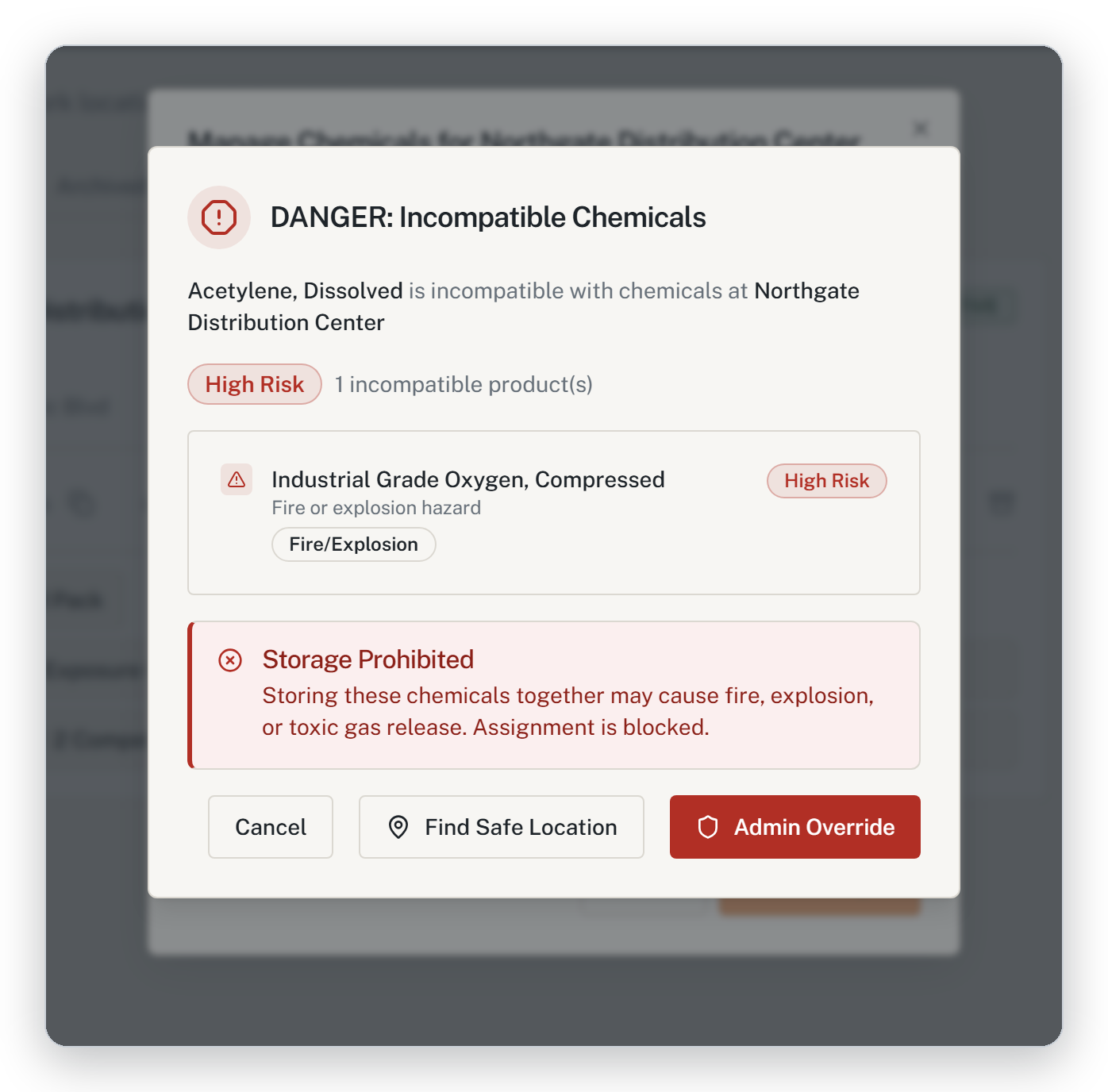
Everything above works in the storage room. It stops working the moment a delivery lands on the wrong site, or someone assigns a product to a jobsite from the office without walking the cage first. That is the gap HazComFast closes: when a chemical is assigned to a jobsite, it is checked against what is already stored there, and a high-risk pair is stopped right there, before anything is saved — you are not finding out from a report the next morning. The block names the product already on site, the reaction type, and the verdict; an administrator can override it deliberately, while a site manager gets the same block with no override offered. The rule set is maintained centrally, not compiled into the app — a corrected segregation rule reaches every jobsite on the next screen it opens.
Group-level screening remains a screen here as anywhere: it does not replace SDS Section 10, and it does not choose cabinets or distances for you. Use the free toolsLog in or try the free Chemical Compatibility Matrix tool first.
Related: Chemical Compatibility Matrix (tool) · OSHA Chemical Storage Requirements · Flammable Liquid Categories & Flash Points · Chemical Inventory & Tier II · SDS Section 10 (glossary) · Oxidizer (glossary)
Sources & verification (read on the eCFR, October 5, 2026): flammable-liquid storage, 29 CFR 1926.152(b)(3) and (b)(4)(iii) and 1910.106(d)(7)(iv); oxygen cylinder separation, 29 CFR 1926.350(a)(10) and 1910.253(b)(4)(iii); Hazard Communication, 29 CFR 1910.1200(g)(2)(vii) and (x) (SDS Sections 7 and 10); NFPA 30 (Flammable and Combustible Liquids Code) and NFPA 400 (Hazardous Materials Code) as adopted by your fire authority; reactive-group data cross-checked against NOAA CAMEO Chemicals. This is a category-level screening guide, not product-specific advice — confirm every pair against the actual SDS Section 10. Not legal advice.
Frequently Asked Questions
Can I store oxidizers next to flammables?
No. Oxidizers supply the oxygen that feeds a fire, so storing them next to solvents or fuels is one of the most dangerous mistakes on a jobsite. For oxygen cylinders OSHA sets the distance itself: 20 feet from fuel-gas cylinders or combustible materials, or a noncombustible barrier at least 5 feet high with a half-hour fire rating (29 CFR 1926.350(a)(10); 1910.253(b)(4)(iii) in general industry). For other oxidizers, the fire code your jurisdiction adopted, such as NFPA 400, sets the separation.
What chemicals should never be stored together?
The classic never-together pairs are: oxidizers with flammables/combustibles (fire); acids with bases (violent, exothermic neutralization and splatter); acids or bases with hypochlorite bleach (releases chlorine gas — bleach plus ammonia releases toxic chloramine vapor); acids with cyanide or sulfide salts (releases hydrogen cyanide or hydrogen sulfide gas); and water-reactive materials with anything aqueous or acidic. Always confirm against each product's SDS Section 10, which 29 CFR 1910.1200(g)(2)(x) requires on every SDS.
Where is the authoritative compatibility answer for a specific product?
In the Safety Data Sheet. Section 10 (Stability and Reactivity) lists incompatible materials and conditions to avoid, and Section 7 (Handling and Storage) gives storage requirements for that exact product. A category-level matrix is a fast screening tool for training and delivery decisions, but the SDS — not the grid — governs any specific pair. NOAA's free CAMEO Chemicals database is a good cross-check for reactive groups. Both sections are required SDS content under 29 CFR 1910.1200(g)(2)(vii) and (x).
How does GHS Rev 7 affect storage?
HCS 2024 aligns primarily with GHS Rev 7 and added new physical-hazard classes such as Chemicals Under Pressure (App B.3.2), which should be stored away from heat. But storage segregation itself is driven by OSHA 1910.106 (flammable liquids) and the fire codes NFPA 30/400 — not by the GHS revision. Update your compatibility matrix and cabinet layout accordingly, and re-check SDS Section 7 when a supplier reclassifies a product.
How far apart must incompatible chemicals be stored?
OSHA has no general segregation distance between incompatible chemical classes. The federal distance most crews meet is for cylinders: oxygen 20 feet from fuel gas or combustibles in storage, or behind a 5-foot noncombustible barrier with a half-hour rating (29 CFR 1926.350(a)(10)). Beyond that, the fire code your jurisdiction adopted, such as NFPA 400, sets distances and barriers, and flammable-liquid storage follows 29 CFR 1926.152 on construction sites (1910.106 in general industry). Many contractors simplify by using dedicated cabinets (yellow for flammables, blue for corrosives).
OSHA figures and citations here come from our regulatory source-of-truth modules, last checked against the eCFR, OSHA.gov, and the Federal Register on October 5, 2026. Last reviewed October 5, 2026.
About This Article
Published by: HazComFast
Published: February 11, 2026
Last Updated: October 5, 2026
- https://www.osha.gov/laws-regs/regulations/standardnumber/1910/1910.106
- https://www.osha.gov/laws-regs/regulations/standardnumber/1910/1910.1200
- https://cameochemicals.noaa.gov/
- https://www.osha.gov/laws-regs/regulations/standardnumber/1926/1926.152
- https://www.osha.gov/laws-regs/regulations/standardnumber/1926/1926.350
This content is for informational purposes only and does not constitute legal advice.