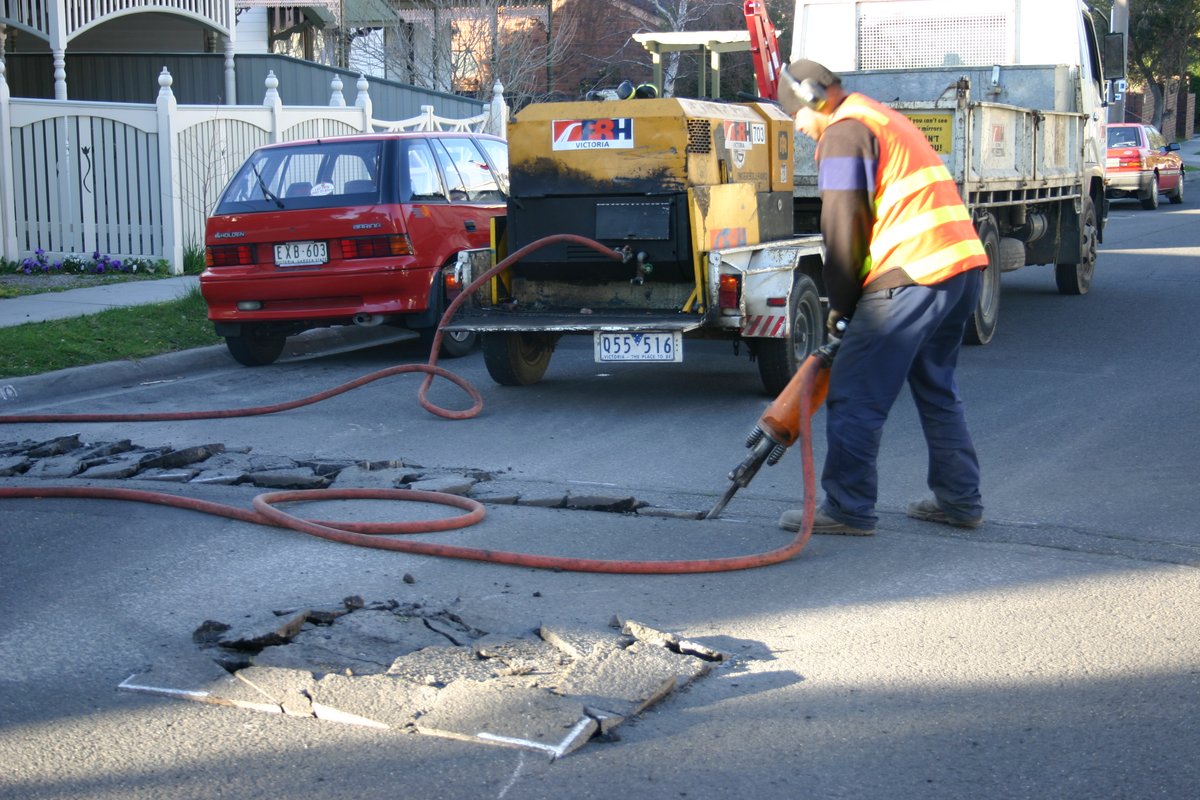
The chart below gives historical construction-equipment sound levels measured 50 feet from the equipment. Use it to compare published reference measurements and plan a noise assessment. To determine a worker's exposure, measure the noise where that person works and account for time spent on each task.
OSHA's construction exposure limits appear in a separate table. An equipment sound level and a daily employee exposure describe different things.
Construction equipment noise at 50 feet
These values come from the actual-measurement column of Table 9.1 in the Federal Highway Administration's Construction Noise Handbook. The 2006 handbook reports averaged maximum A-weighted sound levels, measured with slow response, from the Central Artery/Tunnel project. The sample count is the number of measurements behind each entry.
| Equipment | Average measured maximum at 50 feet, dBA | Samples |
|---|---|---|
| Dump truck | 76 | 31 |
| Backhoe | 78 | 372 |
| Air compressor | 78 | 18 |
| Concrete mixer truck | 79 | 40 |
| Front-end loader | 79 | 96 |
| Generator | 81 | 19 |
| Excavator | 81 | 170 |
| Dozer | 82 | 55 |
| Chain saw | 84 | 46 |
| Jackhammer | 89 | 133 |
| Concrete saw | 90 | 55 |
| Impact pile driver | 101 | 11 |
The handbook separates specification limits from measurements; this chart uses the measured values. The chart lists twelve of the measured entries.
These historical averages help establish a reference. A current machine's model, condition, workload and surroundings may produce a different result. Keep the source, distance and measurement description with the chart when sharing it.
What the decibel number describes
Distance, barriers, reflections and equipment operation affect sound at the worker's position. Several machines operating together also change the exposure. Check the descriptor before comparing two numbers.
| Descriptor | Meaning |
|---|---|
| Lmax | Maximum sound level during the measurement, using a stated instrument response. |
| Leq | Energy-equivalent sound level over a stated period. |
| TWA | Time-weighted exposure calculated using a stated criterion. |
| Sound power level | A source-emission quantity, distinct from sound pressure at a particular location. |
| Peak sound pressure | A peak measurement used for hazards such as impulse noise. |
FHWA's RCNM calculation guidance explains how its environmental-noise model uses reference emissions, distance and equipment usage. Occupational assessment needs employee locations, task durations and the measurement settings appropriate to the exposure criterion.
OSHA construction noise exposure limits
29 CFR 1926.52, Table D-2 gives these daily durations for A-weighted sound levels measured with slow response.
| Sound level, dBA | Daily duration in Table D-2 |
|---|---|
| 90 | 8 hours |
| 92 | 6 hours |
| 95 | 4 hours |
| 97 | 3 hours |
| 100 | 2 hours |
| 102 | 1.5 hours |
| 105 | 1 hour |
| 110 | 30 minutes |
| 115 | 15 minutes or less |
For exposure above the table's limits, 1926.52(b) requires feasible engineering or administrative controls. Where those measures are insufficient, provide hearing protection that reduces exposure within the table's limits. Paragraph (d)(1) requires a continuing, effective hearing conservation program where exposure exceeds the table.
Paragraph (e) states that impulsive or impact noise should not exceed 140 dB peak sound pressure. Assess that peak separately from slow-response dBA and daily dose. The duration table supplies no additional rows above 115 dBA.
Combine exposure periods across the shift
For mixed exposures, 1926.52(d)(2)(ii) combines fractions of actual duration divided by the permitted duration. A total greater than one exceeds the permissible exposure.
OSHA publishes this example:
| Measured level | Actual duration | Permitted duration | Fraction |
|---|---|---|---|
| 110 dBA | 0.25 hour | 0.5 hour | 0.500 |
| 100 dBA | 0.5 hour | 2 hours | 0.250 |
| 90 dBA | 1.5 hours | 8 hours | 0.1875 |
The total is 0.9375, rounded to 0.938 in the regulation, equivalent to 93.75% of the allowable combined-exposure factor. These three periods cover 2.25 hours. Include the rest of the day's relevant exposure before making a full-day determination.
The noise exposure calculator can organize levels, durations and arithmetic. Its preset equipment levels are estimates; replace them with measurements representative of the employee's work. Check the calculation criterion and assess peak noise separately.
OSHA construction, general industry and NIOSH
| Source | Eight-hour basis | How to use it |
|---|---|---|
| Federal OSHA construction, 1926.52 | 90 dBA in Table D-2 | Apply the construction table and its control and hearing conservation provisions. |
| Federal OSHA general industry, 1910.95(b)(1) and (c)(1) | 90 dBA permissible exposure; 85 dBA hearing conservation action level | Apply the general-industry requirements to covered work. |
| NIOSH recommendation | 85 dBA recommended limit, with a 3-dB exchange rate | Use the NIOSH criterion consistently when assessing exposure against its recommendation. |
NIOSH's noise guidance and 1910.95 explain their respective criteria. HazComFast's construction noise guide discusses the difference between construction requirements and the general-industry action level.
Keep the criterion consistent throughout a calculation. Combining a NIOSH duration with an OSHA table entry produces a result that cannot be assessed against either source as written.
Reduce exposure at the source
Compare quieter processes and equipment using data with the same measurement basis. Maintenance, enclosures, barriers and separation can reduce the sound reaching employees.
Document which sources run together, where people work and how long each activity lasts. Reassess when equipment, layout, production or controls change.
Select hearing protection for the exposure and the way it will be worn. Check fit, correct use and communication needs. A package rating describes a test result; achieved attenuation also depends on the individual fit and use.
Noise assessment record
| Item | Information to keep |
|---|---|
| Work and equipment | Task, equipment identity, operating state and simultaneous sources. |
| Employee location | Position, movement and time at each activity. |
| Measurement | Instrument, settings, calibration checks, sampling method and date. |
| Result | Descriptor, sound level, duration and criterion. |
| Controls | Existing measures, planned changes and hearing protection selection. |
| Follow-up | Responsible person, completion check and reasons for reassessment. |
Frequently Asked Questions
Can a phone reading establish compliance?
A phone reading can help identify a noisy task. A compliance assessment also needs a suitable microphone, instrument settings, calibration and a sampling method representative of the work. Check those features before relying on the reading, particularly for a full-shift exposure or high-level impulse noise.
Why do charts disagree about the same equipment?
They may report different distances, models, workloads, descriptors or datasets. Compare the source notes first. A sound-power value, a maximum measured at 50 feet and a worker's TWA are not interchangeable measurements.
Site-wide regulatory figures such as compliance dates and penalty amounts come from our regulatory source-of-truth modules, last checked against the eCFR, OSHA.gov, and the Federal Register on October 19, 2026. Last reviewed November 16, 2026.
About This Article
Published by: HazComFast
Published: November 16, 2026
Last Updated: November 16, 2026
- https://www.fhwa.dot.gov/environment/noise/construction_noise/handbook/handbook09.cfm
- https://www.fhwa.dot.gov/environment/noise/construction_noise/rcnm/rcnm09.cfm
- https://www.osha.gov/laws-regs/regulations/standardnumber/1926/1926.52
- https://www.cdc.gov/niosh/noise/about/noise.html
- https://www.osha.gov/laws-regs/regulations/standardnumber/1910/1910.95
This content is for informational purposes only and does not constitute legal advice.