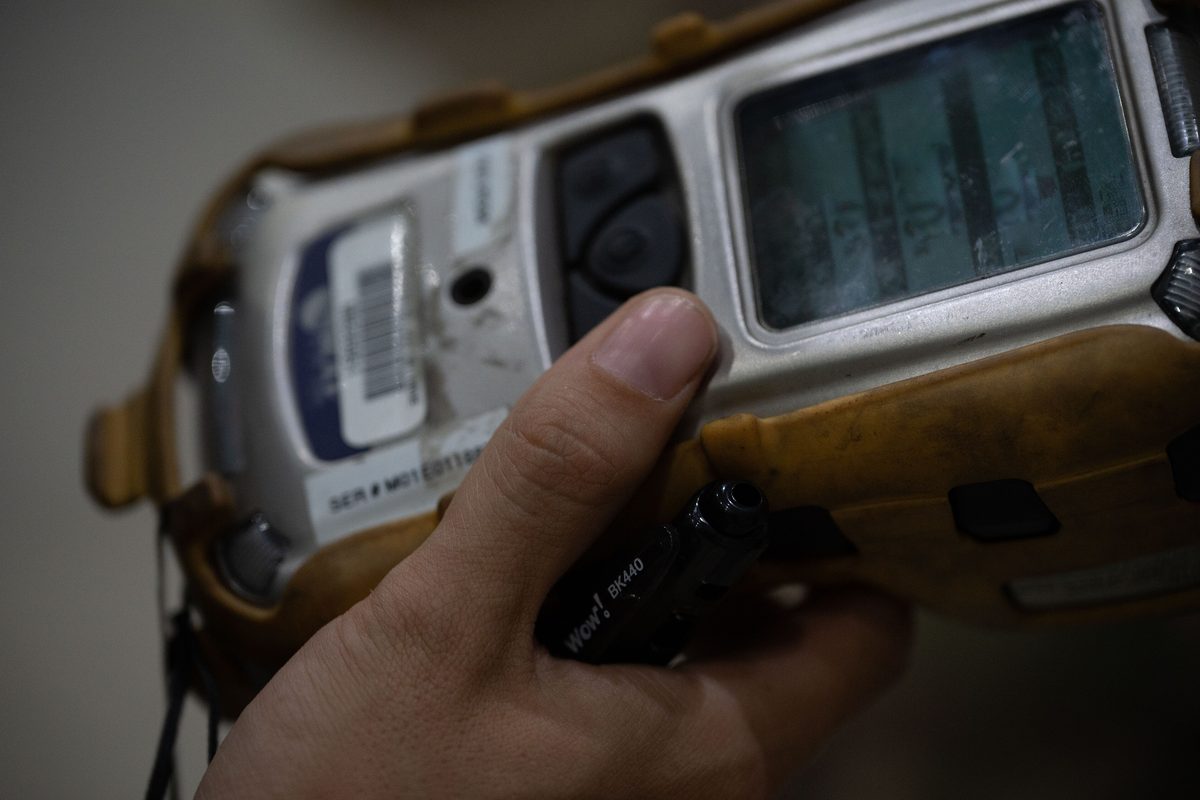
Yes. In general industry, 29 CFR 1910.146(d)(5)(v) requires the employer to re-evaluate a permit space in the presence of any authorized entrant, or that employee's authorized representative, who asks because they have "reason to believe" the evaluation may not have been adequate. In construction, 29 CFR 1926.1204(e)(5) sets the same duty when there is "some indication" of it, and neither standard sets a deadline or makes the request alone a reason to stop entry.
At a lift station rehabilitation job, an entrant asks for a 22-foot wet well to be tested again before returning after a break. The initial readings were taken three feet below the manway. The blower hose has since come loose twice. The readings near the opening do not resolve the entrant’s concern about the atmosphere throughout the descent.
The entrant can request a re-evaluation. Subpart AA covers "employees engaged in construction activities at a worksite with one or more confined spaces" (1926.1201(a)), and the Note to that paragraph lists lift stations among the places where confined spaces may occur. The request falls under 1926.1204(e)(5), and its trigger is "some indication" that the evaluation may not have been adequate. One of the indications OSHA gave in 2015 is "measurements taken in improper locations." The shallow sampling location and the hose failures give concrete reasons to question the evaluation. With an indication like that, the employer has to re-evaluate the well with her there. OSHA has described the options under that paragraph: "the employer may repeat the test, alter the test to assess additional aspects of the space, or assess whether a change occurred in the use or configuration of the space after testing."
What does OSHA require when an entrant asks for a re-evaluation?
The duty sits in 1910.146(d)(5), the paragraph on how the employer evaluates permit space conditions "when entry operations are conducted." Its last three items are written for the entrant:
(iv) Provide each authorized entrant or that employee's authorized representative an opportunity to observe the pre-entry and any subsequent testing or monitoring of permit spaces;
(v) Reevaluate the permit space in the presence of any authorized entrant or that employee's authorized representative who requests that the employer conduct such reevaluation because the entrant or representative has reason to believe that the evaluation of that space may not have been adequate;
(vi) Immediately provide each authorized entrant or that employee's authorized representative with the results of any testing conducted in accord with paragraph (d) of this section. (29 CFR 1910.146(d)(5)(iv) to (vi))
The construction standard repeats them as 1926.1204(e)(4), (e)(5) and (e)(6). The one change of wording that matters is in (e)(5), and the next section covers it. Both standards also build observation into the program itself. The employer's program has to provide "each authorized entrant or that employee's authorized representative with the opportunity to observe any monitoring or testing of permit spaces" (1910.146(d)(3)(ii) and 1926.1204(c)(2)).
Who counts as an entrant differs slightly. In general industry, an authorized entrant is "an employee who is authorized by the employer to enter a permit space" (1910.146(b)). In construction, the employee is "authorized by the entry supervisor to enter a permit space" (1926.1202). In both, the right belongs to the people cleared to go in, and to their authorized representative. What each role is trained on is covered in confined space training for entrants, attendants and supervisors.
Watching the test is an option the entrant can take or leave. The 2015 preamble says 1926.1204(c)(2) "does not require employees and their authorized representatives to observe the specified activities," and it gives the history: "OSHA added this requirement to Sec. 1910.146 in 1998, along with several other employee participation requirements."
As that preamble recounts, OSHA explained in 1998 that those requirements would "function to provide a 'check' on human error in those cases where monitoring was improperly performed," and it "pointed to data demonstrating that human error in monitoring of a hazardous atmosphere was a critical element in many deaths in confined spaces." It also noted that its record "indicated that many entrants would not choose to request to observe the monitoring," but stated that "it is reasonable to assume that allowing authorized entrants or their designated representatives to observe the testing of spaces will prevent a substantial portion of the accidents attributed . . . to human error." In 2015, OSHA wrote that it "believes that this will also be the case under the final rule."
Is the trigger the same in construction and general industry?
The duty is worded the same way in both standards, apart from the trigger. In general industry, (d)(5)(v) covers a request made because "the entrant or representative has reason to believe that the evaluation of that space may not have been adequate." In construction, 1926.1204(e)(5) covers a request made because "there is some indication that the evaluation of that space may not have been adequate." The change was deliberate, and the 2015 preamble lists what OSHA counts as an indication:
Examples of indications that the evaluation of the permit space was inadequate include: improper use of monitoring equipment (e.g., monitoring devices have low battery life or noticeable damage; monitoring devices improperly calibrated; measurements taken in improper locations); employees noting physical hazards not identified in the evaluation; and inconsistent monitor readings without adequate explanation. (80 FR 25365, 25427)
In the same discussion, OSHA took up a commenter who wasn't sure who would make the final decision when an employee offers a basis for believing a hazard determination is inadequate and the employer "finds that the basis is not reasonable." OSHA answered with the options under 1926.1204(e)(5) quoted above, and added: "If such a change occurred, then the employer must reevaluate the space." Then it explained the new wording:
Therefore, compared to the more subjective language in the general industry standard (i.e., "has reason to believe"), the reevaluation requirement in this final provision (i.e., "some indication") is more objective and based on the observable conditions, thereby reducing ambiguity. (80 FR 25365, 25427)
On where to measure, Appendix B to 1910.146 describes a method for a well like the one at the lift station. The appendixes to that general industry standard, in OSHA's words, "serve to provide information and non-mandatory guidelines." For a descent into a space that may be stratified, Appendix B says "the atmospheric envelope should be tested a distance of approximately 4 feet (1.22 m) in the direction of travel and to each side." A reading taken only near the manway doesn't test the descent the way it describes.
The construction standard uses "some indication" in a second place. Under 1926.1203(f): "When there are changes in the use or configuration of a non-permit confined space that might increase the hazards to entrants, or some indication that the initial evaluation of the space may not have been adequate, each entry employer must have a competent person reevaluate that space and, if necessary, reclassify it as a permit-required confined space." The general industry counterpart, 1910.146(c)(6), covers only changes in use or configuration.
| Point | General industry, 29 CFR 1910.146 | Construction, 29 CFR 1926 Subpart AA |
|---|---|---|
| Who authorizes an entrant | The employer, (b) | The entry supervisor, 1926.1202 |
| Opportunity to observe testing | (d)(3)(ii) and (d)(5)(iv) | 1926.1204(c)(2) and (e)(4) |
| Re-evaluation on request | (d)(5)(v) | 1926.1204(e)(5) |
| Trigger for the request | "has reason to believe" | "there is some indication" |
| Test results to entrants | "Immediately," (d)(5)(vi) | "Immediately," 1926.1204(e)(6) |
| Results on the permit, with testers' names or initials and the time | (f)(10) | 1926.1206(k) |
| A condition the permit doesn't allow | Terminate entry and cancel the permit, (e)(5)(ii) | Terminate entry. Suspend or cancel the permit and fully reassess before reentry when the condition is temporary, doesn't change the space's configuration and creates no new hazard, 1926.1205(e)(2). Cancel it otherwise, (e)(3) |
| Re-evaluating a non-permit space | Changes in use or configuration, (c)(6) | Changes in use or configuration, or "some indication" the initial evaluation may not have been adequate, 1926.1203(f) |
| Review of entry operations | When "the employer has reason to believe" the measures may not protect employees, (d)(13) | When the measures may not protect employees, 1926.1204(m) |
| Employee consultation and access to information | (l)(1) and (l)(2) | 1926.1212(a) and (b) |
The two standards differ on more than the entrant's rights. Confined spaces in construction vs. general industry covers the other differences.
Can the employer refuse the request?
In general industry, only in a narrow case, and the answer comes from a letter. The American Petroleum Institute challenged OSHA's 1998 amendment to the confined space rule (API v. OSHA, No. 99-1032), and in settlement discussions it raised four questions. One was about the re-evaluation wording: "API is concerned that this wording requires employers to reevaluate for any reason, and that entrants or their representatives could request reevaluation as a result of labor management issues." OSHA answered on December 9, 2003, in a letter signed by John L. Henshaw, Assistant Secretary for Occupational Safety and Health:
OSHA promulgated the reevaluation requirement to accord entrants a meaningful role in assessing the hazards present in spaces in which they will be working. These employees, whose safety and health is at risk from an inadequate or incomplete evaluation, have the strongest incentive to ensure that the evaluation is performed properly. Accordingly, entrants or their authorized representatives may request reevaluation for any reason related to health or safety, even in the absence of an apparent objectively reasonable basis to conclude that the initial evaluation was inadequate. At the same time, the standard necessarily is limited to promoting legitimate employee health and safety concerns, and an employer may refuse a request if it is clear that it is not related to safety or health. (OSHA letter to API, December 9, 2003)
The bar for asking is any reason related to health or safety, even without an apparent objective basis. The bar for refusing is that it's clear the request isn't related to safety or health. A request about the air in a wet well, or about a blower hose that came off at the manway, is about safety.
The letter addresses the general industry rule. For construction, the 2015 rulemaking discussion explains the different trigger in 1926.1204(e)(5): observable indications that the evaluation may have been inadequate.
Does entry have to stop while a re-evaluation is pending?
Neither standard says so. 1910.146(d)(5)(v) and 1926.1204(e)(5) require the re-evaluation in the requester's presence. They set no deadline and say nothing about the permit while the request waits. The entry supervisor ends an entry when the work is done or when a condition the permit doesn't allow arises. In general industry:
(5) The entry supervisor shall terminate entry and cancel the entry permit when: (i) The entry operations covered by the entry permit have been completed; or (ii) A condition that is not allowed under the entry permit arises in or near the permit space. (29 CFR 1910.146(e)(5))
Construction adds a middle step. Under 1926.1205(e), the entry supervisor "must terminate entry" and, when the prohibited condition is temporary and "does not change the configuration of the space or create any new hazards within it," suspend or cancel the permit and "fully reassess the space before allowing reentry." Any other prohibited condition means the permit is canceled, under (e)(3). OSHA's construction FAQ, answering someone who has been following the general industry rule, lists this among the construction rule's five new requirements: "Allowing for the suspension of a permit, instead of cancellation, in the event of changes from the entry conditions list on the permit or an unexpected event requiring evacuation of the space. The space must be returned to the entry conditions listed on the permit before re-entry."
The entrants' own duty to exit is tied to listed events too. 1910.146(h)(5) and 1926.1208(e) have them exit "as quickly as possible" when the attendant or the entry supervisor orders an evacuation, on a warning sign or symptom of exposure to a dangerous situation, when the entrant detects a prohibited condition, or when an evacuation alarm is activated. A pending request isn't on that list.
A disconnected blower hose can also require an entry to end independently of a re-evaluation request. A construction permit has to identify "the measures used to isolate the permit space and to eliminate or control permit space hazards before entry," and the Note to 1926.1206(i) names ventilating among those measures. The permit also lists "the acceptable entry conditions" (1926.1206(j)). If continuous ventilation is one of those measures or conditions, a blower hose lying loose at the manway can be a condition the permit doesn't allow, and in that case 1926.1205(e) applies on its own, request or no request.
Holding entry while a request is open is left to the employer. The construction preamble says the re-evaluation duty is there so that entrants, or their representatives, "can provide a check on potential human error in the monitoring process before they are potentially exposed to harm." That purpose argues for deciding the request before anyone goes back in, though the text sets no timing.
How fast does an entrant get the test results?
"Immediately," and the text stops there. 1910.146(d)(5)(vi) and 1926.1204(e)(6) both require the employer to "immediately provide each authorized entrant or that employee's authorized representative with the results" of the testing. Neither standard defines the word.
The 2015 preamble gives the purpose. OSHA called (e)(6) "identical to Sec. 1910.146(d)(5)(vi) except for non-substantive clarifications and grammatical changes," and said it gives employees and their representatives "the information necessary to identify potential inadequacies in the testing and take action under paragraph (e)(5) of this section to avoid unsafe entries." It also gave a case: "if an employee knows that he or she has a particular sensitivity to even low levels of a substance that would not otherwise result in a hazardous atmosphere, the employee could review the test results and alert the employer if that substance is detected so that the employer can provide appropriate measures to protect the employee."
The results also go on the permit. 1910.146(f)(10) and 1926.1206(k) require the permit to carry them, "accompanied by the names or initials of the testers and by an indication of when the tests were performed." The completed permit is "made available at the time of entry to all authorized entrants or their authorized representatives, by posting it at the entry portal or by any other equally effective means, so that the entrants can confirm that pre-entry preparations have been completed" (1910.146(e)(3), 1926.1205(c)). An entrant who reads it and finds a single set of readings for a 22-foot well has something concrete to point to.
If the number in question is the LEL reading, is exactly 10% LEL safe? walks through that limit.
Do employees get a say in the permit space program?
Yes, through consultation. 1910.146(l)(1) reads: "Employers shall consult with affected employees and their authorized representatives on the development and implementation of all aspects of the permit space program required by paragraph (c) of this section." 1926.1212(a) says the same of the construction program required by 1926.1203. Under 1910.146(l)(2) and 1926.1212(b), employers also make available "all information required to be developed" by the standard. In 2015, OSHA called the construction provisions "nearly identical to the provisions in the general industry confined spaces rule at Sec. 1910.146(l)." It said the construction text refers to "each affected employee" rather than "affected employees" to stress that the duty runs to each employee, and that "the employer's obligation remains unchanged."
The rulemaking record gives the reasons. The 2015 preamble recalls that commenters on the 1998 amendments that added 1910.146(l) "noted that employees who work in confined spaces and their representatives are particularly well qualified to contribute to the task analysis that is a necessary step in developing a confined space program." One commenter described a time when he, as an employee representative, "was able to identify dangerous adhesive fumes in a confined space that could have otherwise harmed the two employees in that space who did not identify the danger." OSHA added that these employees "are most familiar with the practices used during confined space entries" and "may know of hazards within the space that non-entrants are not taking into consideration."
The preamble also sets the limits. The consultation provision "leaves the final contents of the confined space program up to the employer." On information, 1926.1212(b) "does not require employees or their authorized representatives to request or review this information," and OSHA wrote: "Employers need not provide separate copies of the information to each employee; employers have flexibility in determining how to distribute the information so long as each employee can access it."
Complaints from employees also count when the program is reviewed. 1910.146(d)(13) has the employer review entry operations "when the employer has reason to believe that the measures taken under the permit space program may not protect employees" and revise the program before later entries. Its Note lists "employee complaints about the effectiveness of the program" among the circumstances requiring review, with "the detection of a permit space hazard not covered by the permit" and "the occurrence of an injury or near-miss during entry." 1926.1204(m) has the same review and the same examples, without the words "the employer has reason to believe."
What if the job is in a State Plan state?
Everything above is federal text. OSHA's FAQ on confined spaces in construction says: "State Plans have and enforce their own occupational safety and health standards that are required to be at least as effective as OSHA's. Many State Plans adopt OSHA's standards identically, but some State Plans may have different or more stringent requirements." The comparison above covers the federal rules. On a job in a State Plan state, read the state's confined space rule for its re-evaluation, test result and consultation provisions before relying on the federal wording.
How do you record a re-evaluation request and its outcome?
Both standards require problems to be noted on the permit. 1910.146(e)(6) says "Any problems encountered during an entry operation shall be noted on the pertinent permit so that appropriate revisions to the permit space program can be made," and has the employer keep each canceled permit for at least 1 year. 1926.1205(f) says the same in construction. What prompted a re-evaluation request during an entry, and what came of it, can be one of those problems.
HazComFast keeps that note on the permit itself. A confined space permit has a section titled Re-evaluation of the space. An entrant, the attendant or the entry supervisor named on the permit can choose "Request a re-evaluation," and so can a manager of the jobsite, with a written reason under "Why the evaluation may not have been adequate." The entry supervisor and the attendant are notified right away, and the permit shows the request as "Waiting for a decision," with who asked and when. On an active construction permit, HazComFast goes a step further and suspends entry while the request waits.
The entry supervisor named on the permit, or a manager, records the decision: "Evaluation found adequate" or "Evaluation revised," with what was re-evaluated and why. It saves once the box confirming that the space was re-evaluated with the requester, or their authorized representative, present is checked. The requester is notified of the outcome. Every request stays listed on the permit with its reason, its outcome, who asked, who decided and when.
The rest of what the entrant is owed has its place too. Each atmospheric reading records who tested, the instrument's serial or asset number and its last calibration, with a box for whether an authorized entrant or their representative observed the test. Consultation with employees and their representatives goes into its own register, "Employee consultation on the program," with the date, the subject and who took part, kept as written. On a phone, each worker sees the active permits of their own jobsites, read-only, with the countdown and the latest reading.
Before the next entry
The Confined Space Permit Generator builds a construction entry permit under 29 CFR 1926 Subpart AA, with the entry supervisor, the attendant and the authorized entrants, O2, LEL, CO and H2S readings with the tester's name or initials and the time, and a rescue method. It downloads as a PDF in English or Spanish. Check every line against the space before anyone goes in. The tool is free.
Related reading: Confined space entry permits under OSHA · Subpart AA vs. 1910.146 · Entrant, attendant and supervisor training · Is exactly 10% LEL safe?
Frequently Asked Questions
Can a confined space entrant ask for the space to be re-evaluated?
Yes. 29 CFR 1910.146(d)(5)(v) has the employer re-evaluate a permit space in the presence of any authorized entrant or that employee's authorized representative who asks because they have “reason to believe that the evaluation of that space may not have been adequate.” In construction, 29 CFR 1926.1204(e)(5) gives the same right when “there is some indication that the evaluation of that space may not have been adequate.” The re-evaluation is done with the person who asked, or their representative, present.
Does entry have to stop while a re-evaluation request is pending?
Neither standard says so. 29 CFR 1910.146(d)(5)(v) and 1926.1204(e)(5) require the re-evaluation in the requester's presence and set no deadline and no permit status while the request waits. The entry supervisor ends an entry when a condition the permit doesn't allow arises: under 1910.146(e)(5)(ii) by terminating entry and canceling the permit, and under 1926.1205(e)(2) and (e)(3) by terminating entry and suspending or canceling it. An employer can still choose to hold entry until the request is decided.
Can an employer refuse an entrant's request for a re-evaluation?
Only in a narrow case. In a letter to the American Petroleum Institute dated December 9, 2003, OSHA wrote that under 29 CFR 1910.146(d)(5)(v) entrants or their authorized representatives “may request reevaluation for any reason related to health or safety, even in the absence of an apparent objectively reasonable basis to conclude that the initial evaluation was inadequate,” and that “an employer may refuse a request if it is clear that it is not related to safety or health.” The letter addresses the general industry rule. The construction rule, 1926.1204(e)(5), came in 2015 with its own trigger, “some indication.”
What's the difference between “reason to believe” and “some indication” in OSHA's confined space rules?
“Reason to believe” is the trigger in general industry, 29 CFR 1910.146(d)(5)(v). “Some indication” is the trigger in construction, 29 CFR 1926.1204(e)(5). In the preamble to the construction rule (80 FR 25365, May 4, 2015, page 25427), OSHA called its wording “more objective and based on the observable conditions” and gave examples: monitors with low battery life, noticeable damage or improper calibration, measurements taken in improper locations, physical hazards the evaluation didn't identify, and inconsistent monitor readings without adequate explanation.
How quickly must an entrant get the atmospheric test results?
“Immediately.” 29 CFR 1910.146(d)(5)(vi) and 1926.1204(e)(6) require the employer to “immediately provide” each authorized entrant or that employee's authorized representative with the results of the testing. Neither standard defines the word or gives a number of minutes. The permit also has to carry the results, “accompanied by the names or initials of the testers and by an indication of when the tests were performed,” under 1910.146(f)(10) and 1926.1206(k).
Does OSHA require employers to consult employees on the confined space program?
Yes. 29 CFR 1910.146(l)(1) and 1926.1212(a) require employers to consult with affected employees and their authorized representatives on the development and implementation of all aspects of the permit space program, and 1910.146(l)(2) and 1926.1212(b) require the information the standard has employers develop to be made available to them. In the 2015 preamble, page 25454, OSHA wrote: “Employers need not provide separate copies of the information to each employee,” as long as each employee can access it.
Site-wide regulatory figures such as compliance dates and penalty amounts come from our regulatory source-of-truth modules, last checked against the eCFR, OSHA.gov, and the Federal Register on October 19, 2026. Last reviewed November 14, 2026.
About This Article
Published by: HazComFast
Published: November 13, 2026
Last Updated: November 14, 2026
- https://www.ecfr.gov/current/title-29/section-1910.146
- https://www.ecfr.gov/current/title-29/section-1926.1201
- https://www.ecfr.gov/current/title-29/section-1926.1202
- https://www.ecfr.gov/current/title-29/section-1926.1203
- https://www.ecfr.gov/current/title-29/section-1926.1204
- https://www.ecfr.gov/current/title-29/section-1926.1205
- https://www.ecfr.gov/current/title-29/section-1926.1206
- https://www.ecfr.gov/current/title-29/section-1926.1208
- https://www.ecfr.gov/current/title-29/section-1926.1212
- https://www.govinfo.gov/content/pkg/FR-2015-05-04/html/2015-08843.htm
- https://www.osha.gov/laws-regs/isa/american-petroleum-institute-12092003
- https://www.osha.gov/confined-spaces-construction/faq
This content is for informational purposes only and does not constitute legal advice.