At a glance
- Construction: signals in 29 CFR 1926.1419 to 1926.1422, the chart in Appendix A to Subpart CC, signal person qualification in 29 CFR 1926.1428.
- About 5 minutes to read the script out loud, then the three questions. The drill and the tables below add time if you use them.
- FY2025 citations: 29 CFR 1926.1428, 17 (17 at construction sites); 29 CFR 1926.1419, 1 (1 at construction sites); 29 CFR 1926.1417, 16 (16 at construction sites).
- Free PDF and Word file: the script, the questions, the rule and a 20-line sign-in sheet. No account, no email.
Read this to your crew
Today is about crane hand signals. When the operator cannot see the load or the people around it, the operator works from what one person shows them. If that person and the operator do not mean the same thing by the same gesture, a load moves the wrong way over somebody's head.
Before a lift that needs signals, we settle three things: who the signal person is, what kind of signals we use, hand, voice or radio, and how they reach the operator. The signals have to suit the site. A gesture the operator cannot see in the glare, or a radio channel shared with another crew, does not work. On this job, hand signals follow the standard chart, the one posted at the crane.
Only one person gives signals to the crane at a time. That is the signal person named for this lift, and that person has been evaluated for the job. Knowing every signal on the chart does not make you the signal person, and neither does this talk.
There is one signal everybody here can give: the stop. Anyone who sees a problem gives the stop or the emergency stop, and the operator stops, whoever gave it. The stop is one arm out to the side, palm down, swung back and forth. The emergency stop is both arms out, palms down, swung back and forth. After a stop, the lift starts again only on the signal person's next signal, once the problem is fixed.
If the operator loses sight of the signal person, or the radio goes quiet, the crane stops until the signal is back and understood. It works the other way too: if you lose sight of the operator while you are signaling, stop and get back in view before you go on.
Last point: where you stand. Stay out of the fall zone unless you are hooking, guiding or receiving the load, and never walk under it. If the load path crosses your work, tell the signal person before the lift, not during it.
Three questions for the crew
- Who is the signal person for today's lift, and how will the signals reach the operator?
Listen for: A name, and a method that suits the site: hand signals in clear view of the operator, or a radio channel tested before the lift. - What do you do if you see a problem while the load is moving?
Listen for: Give the stop or the emergency stop right away. The operator stops whoever gives it, and the lift resumes only on the signal person's next signal once the problem is fixed. - What happens if the operator loses sight of the signal person?
Listen for: The crane stops until communication is back and a proper signal is given and understood.
What do OSHA's crane signal rules say?
In construction, a signal person must be provided when the point of operation is not in full view of the operator, when the view in the direction of travel is obstructed, or when the operator or the person handling the load decides one is needed (29 CFR 1926.1419(a)). When hand signals are used, the Standard Method of Appendix A to Subpart CC must be used, with a narrow exception for operations the Standard Method does not cover (29 CFR 1926.1419(c)(1)).
The signals and the means of transmitting them must be appropriate for the site conditions (29 CFR 1926.1419(e)). If the ability to transmit signals is interrupted, the operator must safely stop operations requiring signals until it is reestablished and a proper signal is given and understood (29 CFR 1926.1419(f)). Only one person may give signals at a time (29 CFR 1926.1419(h)), and anyone who becomes aware of a safety problem must give the stop or emergency stop signal (29 CFR 1926.1419(j)), which the operator must obey (29 CFR 1926.1417(y)).
Hand signal charts must be posted on the equipment or conspicuously near the hoisting operation (29 CFR 1926.1422). The employer of the signal person must ensure that the signal person meets the qualification requirements before giving any signals, through a third-party qualified evaluator or the employer's own qualified evaluator, with documentation (29 CFR 1926.1428(a)). The requirements include an oral or written test and a practical test (29 CFR 1926.1428(c)).
The paragraphs, word for word:
“(f) During operations requiring signals, the ability to transmit signals between the operator and signal person must be maintained. If that ability is interrupted at any time, the operator must safely stop operations requiring signals until it is reestablished and a proper signal is given and understood.”
“(j) Anyone who becomes aware of a safety problem must alert the operator or signal person by giving the stop or emergency stop signal. (Note: § 1926.1417(y) requires the operator to obey a stop or emergency stop signal).”
“Hand signal charts must be either posted on the equipment or conspicuously posted in the vicinity of the hoisting operations.”
How often did OSHA cite these rules in FY2025?
| Standard | Construction sites | Other industries | All FY2025 citations |
|---|---|---|---|
| 29 CFR 1926.1428Signal person qualificationsParagraph 1926.1428(a): 13 of these | 17 | 0 | 17 |
| 29 CFR 1926.1419Signals, general requirements | 1 | 0 | 1 |
| 29 CFR 1926.1417Operation of cranes, including the duty to obey a stop signal, paragraph (y) | 16 | 0 | 16 |
Citation items under 29 CFR issued Oct 1, 2024 to Sep 30, 2025, at federal and State Plan inspections, counted by HazComFast on U.S. Department of Labor enforcement data (extracted Oct 13, 2026). Construction means an inspection whose NAICS code starts with 23. The counts describe inspected establishments, not every employer.
Who does what during a lift that needs signals?
| Role | What they do | What stays off limits |
|---|---|---|
| Signal person | Gives every signal to the operator for this lift, from the operator's point of view, by the agreed method | Handing the signals to someone who has not been evaluated |
| Operator | Follows the designated signal person and obeys a stop from anyone | Keeping the crane moving when the signal is lost or unclear |
| Riggers | Hook, guide and receive the load, and tell the signal person about problems | Signaling the operator directly, except for the stop |
| Everyone else | Stays out of the fall zone and gives the stop when they see a problem | Walking under the load or through the barricade |
Roles follow 29 CFR 1926.1419 and 1926.1425. A lift plan can add roles, such as a lift director.
The 19 standard hand signals
Each drawing is OSHA's own figure from Appendix A to Subpart CC of Part 1926, with the name and the description printed under it in the appendix. The printable chart holds the two official sheets.
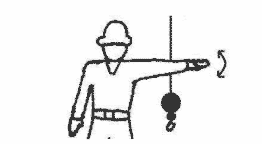
Stop
With arm extended horizontally to the side, palm down, arm is swung back and forth.
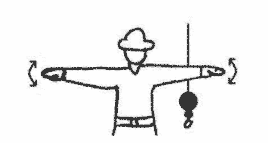
Emergency stop
With both arms extended horizontally to the side, palms down, arms are swung back and forth.
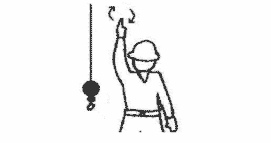
Hoist
With upper arm extended to the side, forearm and index finger pointing straight up, hand and finger make small circles.
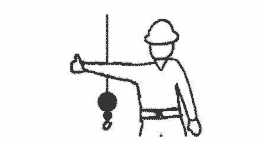
Raise boom
With arm extended horizontally to the side, thumb points up with other fingers closed.
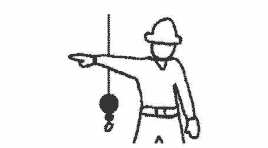
Swing
With arm extended horizontally, index finger points in direction that boom is to swing.
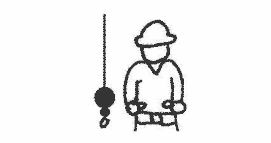
Retract telescoping boom
With hands to the front at waist level, thumbs point at each other with other fingers closed.
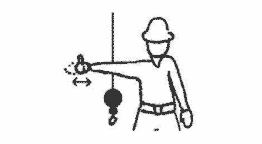
Raise the boom and lower the load
With arm extended horizontally to the side and thumb pointing up, fingers open and close while load movement is desired.
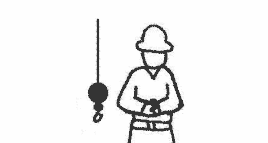
Dog everything
Hands held together at waist level.
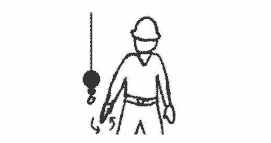
Lower
With arm and index finger pointing down, hand and finger make small circles.
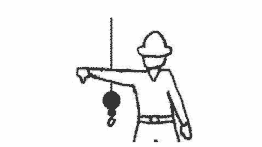
Lower boom
With arm extended horizontally to the side, thumb points down with other fingers closed.
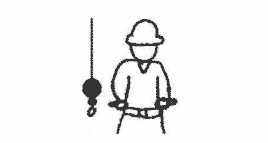
Extend telescoping boom
With hands to the front at waist level, thumbs point outward with other fingers closed.
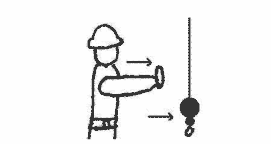
Travel/tower travel
With all fingers pointing up, arm is extended horizontally out and back to make a pushing motion in the direction of travel.
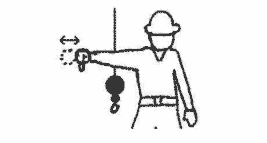
Lower the boom and raise the load
With arm extended horizontally to the side and thumb pointing down, fingers open and close while load movement is desired.
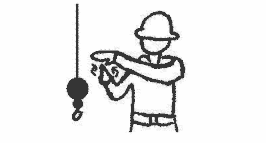
Move slowly
A hand is placed in front of the hand that is giving the action signal.
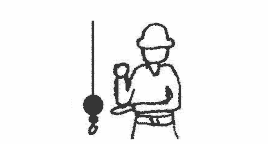
Use auxiliary hoist (whipline)
With arm bent at elbow and forearm vertical, elbow is tapped with other hand. Then regular signal is used to indicate desired action.
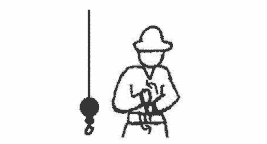
Crawler crane travel, both tracks
Rotate fists around each other in front of body; direction of rotation away from body indicates travel forward; rotation towards body indicates travel backward.
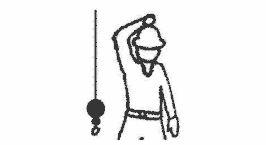
Use main hoist
A hand taps on top of the head. Then regular signal is given to indicate desired action.
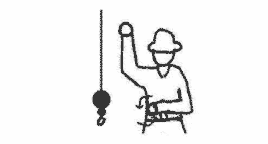
Crawler crane travel, one track
Indicate track to be locked by raising fist on that side. Rotate other fist in front of body in direction that other track is to travel.
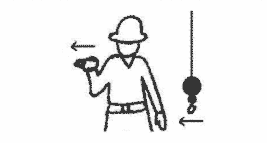
Trolley travel
With palm up, fingers closed and thumb pointing in direction of motion, hand is jerked horizontally in direction trolley is to travel.
Figures: Appendix A to Subpart CC of Part 1926, Standard Hand Signals, as published in the Federal Register on August 9, 2010. The chart helps the crew recognize the signals; it qualifies no one.
Drill: name the signals with the crane parked
About five minutes, before the first lift, with the crane parked or nothing on the hook. Nobody operates the crane during the drill.
- The signal person shows six signals from the chart: stop, emergency stop, hoist, lower, swing and dog everything. The crew names each one.
- The crew shows them back, one person at a time, while the signal person checks each arm position against the chart.
- Ask: the radio goes quiet in the middle of a lift; what does the operator do, and what does the signal person do? Listen for: the operator stops, the signal person gets back in contact, and the lift resumes only after a proper signal is given and understood.
- Ask: who on this crew may give signals to the operator today, and who may give a stop? Listen for: only the designated signal person gives signals; anyone gives a stop.
- Close by pointing to the posted chart and naming the signal person for the day. Recognizing the signals is not the signal person qualification of 29 CFR 1926.1428, which takes an evaluation with an oral or written test and a practical test.