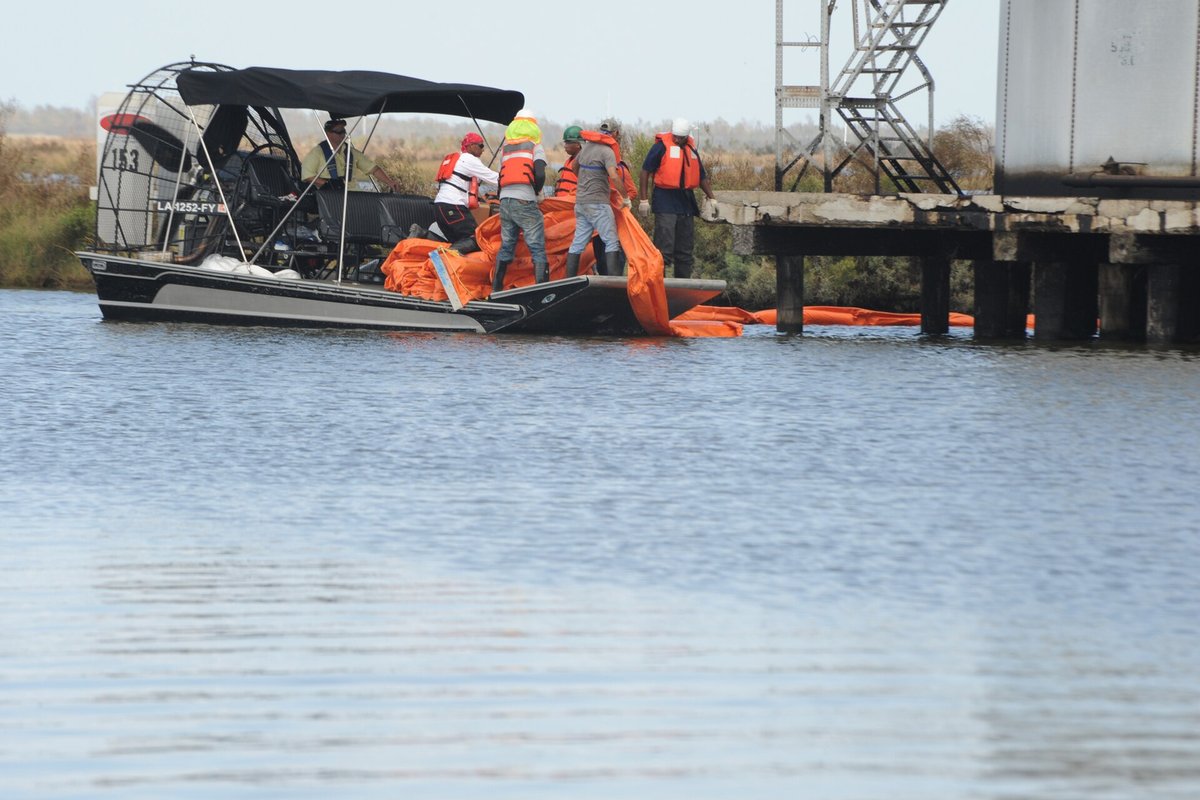
A contractor's yard has a 1,000-gallon diesel tank, two 275-gallon totes of lubricating oil, and a row of 55-gallon drums. No single tank looks especially large. Taken together, however, their rated capacities may put the yard under EPA's Spill Prevention, Control, and Countermeasure (SPCC) rule. The decision then turns on the facility's activities, possible oil-discharge routes, regulatory exclusions, and discharge history, not on how many gallons the tanks happen to contain today.
The opposite result is possible at a fueling station whose completely buried tanks meet the federal UST exclusion. Counting gallons without classifying the tanks can lead to the wrong conclusion.
This guide is principally for U.S. contractors, maintenance yards, warehouses, manufacturers, service garages, utilities, and other onshore, non-transportation-related facilities other than oil production facilities. Farms have special statutory rules. Oil production, offshore facilities, certain animal/vegetable-oil facilities, and facilities requiring a separate Facility Response Plan (FRP) call for further provisions beyond this main screening route.
Downloadable resources
Use the workbook for capacity screening and planning records. It is not a certified SPCC Plan or an engineered containment design.
SPCC requirements in 60 seconds
- Applicability: For an ordinary non-farm facility, confirm EPA's non-transportation jurisdiction, a reasonable expectation of harmful oil discharge to covered waters or shorelines, and nonexempt storage exceeding 1,320 gallons aboveground or 42,000 gallons completely buried. All three issues matter.
- Tier I or Tier II: A federally qualified facility generally has 10,000 gallons or less of counted aboveground capacity and a qualifying discharge history. It is Tier I if no individual counted aboveground container exceeds 5,000 gallons; otherwise it is Tier II.
- Certification: A qualified owner/operator may generally self-certify federally, but certain Tier II technical departures, disqualifying history, higher capacity, or state engineering law can call for PE certification.
- Documents: EPA's Appendix G is the Tier I template. Tier II needs the broader applicable Plan; an unsigned worksheet is neither a completed nor a certified SPCC Plan.
Primary rules: 40 CFR 40 CFR 112.1, 40 CFR 112.3(g), and 40 CFR 112.6.
For your own facility: (1) record its operating scope and physical boundary; (2) inspect every oil container and independently reconcile the field count; (3) assess jurisdiction, drainage, counted capacity, discharge history, and state rules; (4) choose the proper federal Plan route and complete the needed site-specific documentation. Do not select Tier I from a capacity subtotal alone.
Navigate this guide: Applicability and thresholds · Eligibility decision tree · Tier I vs. Tier II · [Plan contents](#what-a-credible-spcc-plan-needs to-actually-address) · Planning worksheets · Inspection checklist.
What is an SPCC Plan: and what does the rule regulate?
The SPCC rule, in 40 CFR Part 112, implements federal oil-spill-prevention requirements under the Clean Water Act. Its purpose is to prevent oil at covered facilities from reaching waters and shorelines identified in 40 CFR 112.1. An SPCC Plan is not just a binder: it needs to describe the facility's actual oil systems, likely discharge paths, prevention and containment measures, inspection and testing program, personnel training, and procedures to prevent and respond to discharges. The owner or operator needs to implement it.
The rule can apply to oil storage, processing, use, consumption, transfer, distribution, and production. 'Oil' is not limited to crude oil or fuel. Diesel, gasoline, hydraulic and lubricating oil, synthetic oil, animal fats, and vegetable oils may be relevant. Oil-filled transformers, switches, hydraulic power units, and gearboxes can also contribute to the oil-capacity screen. See 40 CFR 112.2 definitions and EPA's explanation of regulated oils.
An SPCC Plan is generally kept at the facility, not sent to EPA for advance approval. It is not itself a federal tank permit or a substitute for fire-code compliance, state tank programs, stormwater permits, emergency notifications, or an FRP when one is independently needed. 40 CFR 40 CFR 112.3(e).
Does the SPCC rule apply? Test jurisdiction, discharge potential, and capacity
All three issues matter. Do not start and stop at a gallon figure.
1. Is the activity within EPA's SPCC jurisdiction?
The ordinary rule addresses non-transportation-related oil facilities. Truck deliveries do not automatically convert a fixed storage yard into a transportation-only operation. At a mixed operation, identify the fixed tanks, equipment, transfers, transportation-related components, and applicable jurisdictional boundary. Some mobile or portable oil-handling operations become subject while in a fixed, non-transportation operating mode. 40 CFR 112.1(a)–(b), 112.3(a)(1).
2. Could oil reasonably reach covered waters or adjoining shorelines?
Inspect site topography, drainage ditches, surface flow, nearby waterways, storm drains, paved slopes, and the possibility that a release can travel off-site. A waterway need not be visible from the tank. An off-site ditch or storm-sewer connection can be an important route.
Do not take credit for a dike, berm, wall, or other manmade containment structure when deciding whether a discharge is reasonably expected at this applicability stage. Those controls may reduce actual risk, but they do not erase the underlying discharge potential for this test. Whether a particular water is within federal jurisdiction is a separate site-specific legal question; do not assume every roadside depression is federally covered. 40 CFR 112.1(d)(1)(i).
3. Does the nonexempt oil capacity exceed a threshold?
Use rated shell capacity, not oil on hand, expected fill level, annual purchases, or the amount usually delivered. An 800-gallon container normally filled to 500 gallons contributes 800 gallons if it is otherwise counted. Track aboveground and completely buried capacity in separate totals. 40 CFR 112.1(d)(2), 112.2.
SPCC thresholds at a glance
| Figure | Regulatory use | Exact distinction |
|---|---|---|
| 55 U.S. gallons | Container-counting floor | A nonexempt container with capacity 55 gallons or more counts; a container below 55 gallons generally does not. |
| More than 1,320 gallons | Aboveground applicability test | The sum of counted aboveground capacities need to be greater than 1,320. Exactly 1,320 does not pass this federal capacity test. |
| More than 42,000 gallons | Completely buried applicability test | Nonexempt completely buried capacities have their own trigger. Do not add buried capacity to aboveground capacity for the 1,320-gallon test. |
| 10,000 gallons or less | Federal qualified-facility ceiling | Aggregate counted aboveground oil capacity needs to meet this ceiling and discharge history needs to qualify. |
| No container greater than 5,000 gallons | Tier I versus Tier II | Tier I has no counted individual aboveground oil container over 5,000 gallons; otherwise a qualified facility is Tier II. |
| More than 1,000 gallons once; or more than 42 gallons twice in 12 months | Qualified-facility history disqualifier | Applies to relevant discharges to covered waters/shorelines in the preceding three years, or the shorter period since becoming subject. See the rule's excluded causes. |
Sources: 40 CFR 112.1(d); 40 CFR 112.3(g); EPA qualified-facility guidance.
A narrow federal override: Even where an ordinary exclusion in 40 CFR 112.1(d) would otherwise apply, 40 CFR 112.1(f) allows the EPA Regional Administrator, through a written determination and specified procedures, to call for an SPCC Plan or relevant part for a facility within EPA's Clean Water Act jurisdiction. This is not the normal outcome for a site below the thresholds; it is why a capacity-only screening result should not be stated as an absolute legal guarantee.
Count these containers: unless a specific exclusion applies
- Aboveground tanks, 55-gallon drums, totes/IBCs, and containers used for standby, seasonal, or temporary oil storage.
- Bunkered tanks, partially buried tanks, and tanks in vaults; the SPCC rule generally treats these as aboveground, not as completely buried tanks.
- Relevant non-transportation-related mobile refuelers and other portable oil systems.
- Oil-filled operational or manufacturing equipment with qualifying capacity, including transformers and hydraulic equipment. These systems count in the aboveground screen even though some technical requirements differ from those for bulk storage containers.
- Nonexempt completely buried tanks, in their separate buried-capacity category.
Do not count an item merely because it exists on a property. Verify the applicable definitions and exclusions in 40 CFR 112.1(d), including provisions for containers under 55 gallons; permanently closed containers as specifically defined; motive-power containers on vehicles; certain hot-mix asphalt containers; certain single-family residential heating-oil containers; pesticide application equipment and related mix containers; milk and milk-product containers; and equipment used exclusively for wastewater treatment. A tank simply described as “empty” is not necessarily permanently closed.
Important for garages and contractor fueling: A vehicle's own motive-power fuel tank can be excluded from the storage-capacity count, but 40 CFR 112.1(d)(7) expressly does not exempt the act of transferring fuel into that tank at a facility already subject to SPCC. Fuel dispensers and transfer areas associated with otherwise excluded USTs may therefore call for general secondary containment at an otherwise regulated facility. Do not conclude that a fueling operation is exempt just because the vehicle tank or supplying UST is excluded. EPA clarification on UST transfer areas.
Completely buried underground storage tank systems that are subject to all applicable technical requirements of 40 CFR Part 280, or an approved Part 281 state program, have a specific SPCC exclusion. Verify the legal status of each system; “underground” is not a blanket exemption. An exempt UST at an otherwise covered facility may still have to appear on its SPCC diagram marked exempt. 40 CFR 112.1(d)(4); 40 CFR 112.7(a)(3); EPA UST guidance.
Calculate capacity in a reproducible way
Make an inventory by container ID, not just by product name. Confirm the facility boundary with the 40 CFR 112.2 definition: multiple parcels, units, and operations sometimes call for combined treatment, and a boundary cannot be defined arbitrarily to avoid the threshold.
| Example inventory item | Shell capacity | Count? | Reason |
|---|---|---|---|
| AST-01: diesel tank | 1,000 gal | Yes | Nonexempt aboveground oil tank. |
| IBC-01 and IBC-02: lubricating oil | 2 × 275 = 550 gal | Yes | Two nonexempt aboveground containers. |
| Four 55-gallon oil drums | 4 × 55 = 220 gal | Yes | Each meets the 55-gallon floor. |
| Gasoline vehicle fuel tank | n/a | Generally excluded | Vehicle motive-power exclusion needs to be confirmed. |
| Qualifying completely buried UST | 12,000 gal | Excluded if criteria verified | Part 280/281 exemption basis documented separately. |
For this hypothetical inventory, counted aboveground capacity is 1,000 + 550 + 220 = 1,770 gallons. If the other applicability tests are satisfied, the ordinary federal aboveground threshold is crossed. The buried UST does not make the aboveground subtotal 13,770 gallons.
SPCC eligibility decision tree
Use this sequence for a typical onshore, non-transportation-related, non-farm facility. Document each decision in order: Tier I and Tier II are plan-certification categories, not alternative applicability thresholds.
| Question, in order | If yes | If no |
|---|---|---|
| 1. Is the facility/activity within SPCC's non-transportation jurisdiction? | Continue to 2. | Ordinarily outside federal SPCC for that activity; check other programs. |
| 2. Is a harmful oil discharge to covered waters or adjoining shorelines reasonably expected, disregarding manmade containment for this threshold inquiry? | Continue to 3. | Ordinarily outside SPCC; retain documented site evaluation. |
| 3. Does nonexempt aboveground capacity exceed 1,320 gal, or nonexempt completely buried capacity exceed 42,000 gal? | SPCC is potentially applicable; continue to 4. | Ordinarily outside federal SPCC; check state rules and special cases. |
| 4. Is counted aggregate aboveground capacity 10,000 gal or less, with qualifying discharge history? | Qualified-facility route potentially available; continue to 5. | General SPCC Plan, ordinarily PE-certified. |
| 5. Does every counted individual aboveground oil container have capacity 5,000 gal or less? | Tier I: Appendix G, qualifying Tier II-style Plan, or PE Plan. | Tier II: full applicable, self-certified Plan, or PE Plan. |
Before acting on the result: review the specific exclusions, production/offshore provisions, farm statutes, state engineering law, and any 40 CFR 112.6 technical alternatives. This screening table does not establish whether a water is jurisdictional or whether a buried tank qualifies for the UST exclusion. See 40 CFR 40 CFR 112.1, 40 CFR 112.3(g), and 40 CFR 112.6.
Tier I vs. Tier II vs. PE-certified SPCC plans
Tier I: limited individual-container size
Tier I qualified facilities have 10,000 gallons or less of counted aggregate aboveground oil capacity, no individual counted aboveground oil container over 5,000 gallons, and qualifying discharge history. They can complete, sign, and implement EPA's Appendix G template. They may also elect a qualifying Tier II-style self-certified Plan or a PE-certified Plan. 40 CFR 112.6(a).
EPA provides the official Tier I template, instructions, and completed examples. Its statutory and regulatory route is Appendix G to Part 112. The template is not a permit issued by EPA and is not effective merely because someone downloads it.
The owner/operator's self-certification includes familiarity with the rule, a personal visit and examination of the facility, procedures for needed inspections and testing, commitment to implement the Plan, qualification, and management approval and resources. EPA's interpretation is explicit: an agent's site visit does not replace the certifying owner's or operator's own visit. EPA self-certification site-visit explanation.
Tier I uses a specifically enumerated regulatory package, not every clause of the general Plan rule. Section 112.6(a)(3) incorporates selected provisions of 40 CFR 112.7 and the applicable facility subparts, then substitutes its own limited failure-prediction, sized bulk-container containment, and overfill rules. For example, 40 CFR 112.7(h) (loading/unloading racks) and 40 CFR 112.7(i) (brittle fracture) are not listed in 40 CFR 112.6(a)(3). Do not impose those clauses on a Tier I Appendix G user solely because a rack or tank exists. An owner who elects a 40 CFR 112.6(b) Tier II-style Plan or a general PE-certified Plan uses the requirements of that selected route instead.
Important limitation: A self-certified Tier I Appendix G Plan cannot use environmental-equivalence substitutions under 40 CFR 112.7(a)(2) or secondary-containment impracticability determinations under 40 CFR 112.7(d) to depart from its applicable requirements. If the facility needs such a departure, reassess the valid Plan route and the relevant PE-certification requirements before proceeding; do not insert a purported exception into Appendix G. EPA Tier I checklist and guidance; 40 CFR 112.6(a).
For the Tier I route, the incorporated 40 CFR 112.7(c) general containment still applies where relevant. Its substituted bulk-storage rule calls for a means of containment for the entire capacity of the largest single container plus additional precipitation capacity; there is no automatic 110% rule. Each applicable container needs to have an overfill-prevention system or documented procedure, described in the Plan and regularly tested for operation or efficacy. Appendix G remains a site-specific, signed and implemented Plan, not a fill-in-the-blanks guarantee. 40 CFR 40 CFR 112.6(a)(1)–(3); EPA explanation of the streamlined Tier I requirements.
Tier II: a qualified facility with a container over 5,000 gallons
Tier II shares the 10,000-gallon aggregate ceiling and clean-history requirement, but has one or more aboveground oil container with a capacity greater than 5,000 gallons. It may use a site-specific, self-certified Plan meeting all applicable requirements of 40 CFR 112.7 and Subparts B/C, within 40 CFR 112.6(b). The Tier I Appendix G route does not become a valid Tier II Plan by changing its heading.
Federal Tier II self-certification does not cover every engineering departure. Under 40 CFR 112.6(b)(3)–(4), a PE needs to review and certify the affected portions when a Tier II Plan relies on specified environmental-equivalence methods, secondary-containment impracticability determinations and alternate measures, or certain produced-water options. Thus, some plans are owner/operator self-certified overall but PE-certified in particular sections. 40 CFR 112.6(b).
When the full plan calls for a professional engineer
For the ordinary facility route, a Plan normally needs certification under 40 CFR 112.3(d) if the site is SPCC-covered but fails the qualified-facility criteria, for example, its counted aboveground capacity exceeds 10,000 gallons or its relevant discharge history is disqualifying. A qualified owner/operator may choose PE certification voluntarily; a state may also call for it.
PE certification assesses the regulatory and engineering matters prescribed in 40 CFR 112.3(d). It does not transfer implementation, employee training, inspections, or repairs away from the owner/operator. The engineer needs to be appropriately licensed under applicable state professional-practice requirements.
| Document or route | Eligible use | What is still needed |
|---|---|---|
| Blank outline or example | Planning and internal data collection | It is not a completed or certified SPCC Plan. |
| Completed EPA Appendix G | Eligible Tier I, if state law permits | Site-specific content, certifications, management resources, implementation, relevant supporting records. |
| Self-certified Tier II Plan | Eligible Tier II, subject to state rules | Full applicable 40 CFR 112.7/Subparts B/C measures, signed owner/operator certification, implementation, and any necessary PE-certified portions. |
| PE-certified Plan | Nonqualified facilities and other facilities choosing/needed to use this route | Appropriate engineering certification and continuing owner/operator implementation and review. |
Terminology warning: Here, Tier II means an SPCC qualified-facility classification. It does not mean the EPCRA §312 hazardous-chemical Tier II report discussed later.
Deadlines: new operations, amendments, reviews, and changes of tier
There is no single SPCC deadline that answers every facility's situation. The triggers below should be assessed separately.
| Event | Federal rule for the ordinary site or stated category | Authority |
|---|---|---|
| New nonproduction facility begins operations after November 10, 2011 | Prepare and implement the Plan before operations begin; some special 40 CFR 112.3 categories have different historical dates. | 40 CFR 112.3(a)(1) |
| Certain new oil-production facilities | Under the applicable 40 CFR 112.3(b) category, prepare and implement within six months after operations begin. Do not extend this to ordinary warehouses and contractor yards. | 40 CFR 112.3(b) |
| Material facility change affecting discharge potential | Prepare a technical amendment within six months of the change; implement as soon as possible and by six months after preparation, subject to special provisions. | 40 CFR 112.5(a) |
| Tier I loses qualification because an individual aboveground container exceeds 5,000 gal or aggregate capacity exceeds 10,000 gal | After the qualifying amendment, use the specific Tier I transition in 40 CFR 112.6(a)(2): within six months following preparation of the amendment, prepare and implement an appropriate Tier II Plan (if still eligible) or PE-certified general Plan. | 40 CFR 112.6(a)(2) |
| Tier II loses qualification because aggregate aboveground capacity exceeds 10,000 gal | Prepare and implement a PE-certified general Plan no more than six months after the change. Do not assume the general amendment sequence allows a full year. | 40 CFR 112.6(b)(2)(ii) |
| Periodic review | Review and evaluate the Plan no less than once every five years, document the determination, and implement applicable qualifying amendments in the regulatory timeframe. | 40 CFR 112.5(b) |
For mobile or portable operations, 40 CFR 112.3 allows a general Plan in relevant circumstances, but the equipment needs to be positioned and operated in accordance with that Plan at each fixed operating location. For an actual modification or newly covered facility, examine the complete text and any applicable federal extension provision rather than improvising a deadline.
The five-year review also calls for a signed statement saying whether the Plan will be amended. Where field-proven prevention or control technology would significantly reduce discharge likelihood, 40 CFR 112.5(b) calls for amendment no more than six months after that review, followed by implementation as soon as possible and by six months after amendment preparation. Keep the statement in the Plan, a log, or an appendix. 40 CFR 40 CFR 112.5(b).
If a discharge changes the facility's qualified-facility history, reassess the eligibility and certification route promptly. Do not simply assume that the transition language written for a capacity increase supplies the deadline for every possible loss of qualification.
What a credible SPCC Plan needs to actually address
The Plan's provisions depend on the facility and its applicable sections. The following is the practical starting point for ordinary onshore, nonproduction facilities. It is not a claim that every subparagraph applies to every oil system.
Facility diagram, oil inventory, and failure scenarios
Define the regulated facility boundary and operations. Show fixed oil containers with their contents, areas where portable containers are kept, relevant exempt USTs marked as exempt, oil-transfer points, surface flow directions, drainage systems, nearby receiving waters, response equipment, and access routes. 40 CFR 112.7(a)(3).
Identify credible overfills, hose failures, tank leaks, ruptures, valve failures, and piping discharges. Where 40 CFR 112.7(b) applies, predict the direction, rate, and total quantity of oil that could be discharged from each major type of equipment failure, based on actual site facts. Tier I has a specific adjusted failure-analysis provision. Base discharge predictions on the equipment, operating conditions, and credible failure modes at the site. 40 CFR 112.7(b); 40 CFR 112.6(a)(3)(i).
Containment: one phrase, different regulatory tests
General secondary containment under 40 CFR 112.7(c) addresses foreseeable oil discharges from handling and transfer areas, oil-filled equipment, and other applicable sources. Curbs, sumps, diversion, spill pallets, drain covers, sorbents, and appropriately organized active response measures may be relevant, depending on the likely failure and demonstrated response capability.
Specifically sized secondary containment is a separate requirement for applicable bulk storage tank installations under 40 CFR 112.8(c)(2): retain the entire capacity of the largest single container plus sufficient freeboard for precipitation, with specified exceptions and alternatives. Diked areas need to be sufficiently impervious. The federal rule does not prescribe a universal 110% figure. For an open containment area, document the actual displacement from other tanks/equipment, available containment volume, rainfall/freeboard basis, drainage-valve condition, and the responsible design evaluation.
For mobile refuelers and other specified non-transportation-related tank trucks, the sized requirement has an exception; general containment remains applicable. For other portable containers, confirm the applicable specifically sized provisions rather than automatically treating all mobile equipment alike. EPA mobile-refueler explanation.
For a Plan subject to 40 CFR 112.7(h), an actual tank-truck or tank-car loading/unloading rack has a separate requirement: the system needs to hold no less than the largest single truck/rail compartment handled there, along with specified drainage and premature-departure protections. A hose connection alone does not establish that the area is a regulated rack. Do not automatically apply 40 CFR 112.7(h) to the streamlined Tier I Appendix G route, which follows 40 CFR 112.6(a)(3)'s enumerated provisions. Non-rack transfers still need the containment and procedures applicable under the chosen plan route. 40 CFR 112.7(h); 40 CFR 112.6(a)(3).
Drainage, transfers, and overfill prevention
Describe diked-area drainage controls, how accumulated stormwater is examined before release, who authorizes discharge, and how drainage valves or pumps are secured. For ordinary onshore facilities, 40 CFR 112.8(b) contains specific drainage design and handling requirements. Check the special Tier I requirements where that alternative is used.
At transfer points, specify verification of the receiving tank's spare capacity, connection inspection, operator attendance, pump shutoff, emergency isolation, valve positions, and response to a failed transfer. Use site-specific operating procedures; “avoid spills” is not a procedure.
At an applicable bulk storage tank, 40 CFR 112.8(c)(8) calls for one or more specified overfill-prevention methods; the chosen method and actions after alerts need to be described in the Plan. An eligible Tier I Plan can use the 40 CFR 112.6(a)(3)(iii) documented-system/procedure route with regular testing of effectiveness. Do not substitute a generic verbal reminder for a method the applicable provision does not allow.
Inspections, integrity tests, corrective actions, and retention
The inspection and testing program needs to address each type of oil equipment, its material, configuration, operating conditions, maintenance history, and recognized industry standards or recommended practices. For relevant aboveground bulk storage containers, 40 CFR 112.8(c)(6) calls for a regular testing/inspection schedule and evaluation after material repairs. Record the chosen frequency and technical basis.
There is no universal EPA instruction to inspect every SPCC tank once per month. A plan may legitimately use monthly visual rounds for some equipment and a different periodic integrity test for a particular tank, if the actual regulation, condition, and applicable standards are satisfied. EPA inspection-frequency guidance.
Under 40 CFR 112.7(e), records of inspections and tests need to be signed by the appropriate supervisor or inspector and kept with the Plan for three years. A defect log should link an observation to a container, temporary control, repair order, responsible person, and verification of closure. That is an operational suggestion for effective recordkeeping, not a separate federal three-year deadline for every kind of document.
Tank condition, corrosion, and piping: checks a generic checklist misses
A site-specific Plan needs to address the particular tank and piping controls that apply to its route. For ordinary onshore nonproduction facilities using the general or Tier II route, 40 CFR 112.8(c)–(d) provides important detail:
- Tank suitability (40 CFR 112.8(c)(1)): Confirm that container material, design, and construction are compatible with stored oil and operating temperature/pressure. That duty also appears in the Tier I incorporated list.
- Completely buried metallic tanks (40 CFR 112.8(c)(4)): For nonexempt systems installed on or after January 10, 1974, provide corrosion protection as specified and perform regular leak tests. A UST properly excluded under 40 CFR 112.1(d)(4) is not subject merely because this subsection exists. This clause is part of the Tier I incorporated list for relevant systems.
- Partially buried or bunkered metallic tanks (40 CFR 112.8(c)(5)): Protect buried metal portions from corrosion with protection appropriate to soil conditions; the provision is also listed for Tier I.
- Aboveground bulk-container integrity (40 CFR 112.8(c)(6)): Select regular tests or inspections using relevant industry standards and the container's size, construction, supports, foundations, and configuration. Reassess after material repairs and retain comparison records. A signed visual round alone may be insufficient for some tanks; not every tank needs the same nondestructive-testing method.
- Leaks and oil accumulation (40 CFR 112.8(c)(10)): Promptly correct visible discharges involving seams, gaskets, valves, pumps, and other components and remove accumulated oil from diked areas. This paragraph applies on the Tier I list as well.
- Buried and aboveground piping (40 CFR 112.8(d)(1)–(4)): The general/Tier II route includes protection of qualifying newly installed or replaced buried piping, inspection when exposed, proper support, regular examination of visible piping, and integrity/leak testing of buried pipe at installation or specified changes. The streamlined Tier I list specifically incorporates 40 CFR 112.8(d)(4), not every requirement in 40 CFR 112.8(d)(1)–(3).
Record the actual container ID, corrosion-protection evidence, chosen inspection standard, method and frequency, date, finding, defect control, repair, and verification. If deterioration could allow oil to leave containment, address the release potential without waiting for the next routine inspection. Use the applicable regulation and the documented inspection program to set intervals.
Training and management accountability
40 CFR 112.7(f) calls for training for oil-handling personnel on equipment operation and maintenance for discharge prevention, discharge procedures, applicable rules, facility operations, and the Plan. Designate a discharge-prevention contact accountable to management. Conduct discharge-prevention briefings no less than once a year, including known discharges, equipment failures or malfunctions, and new precautionary measures. Keep a dated briefing record identifying the personnel, subjects, and follow-up actions as evidence of implementation. The annual briefing does not replace initial or task-specific training; 40 CFR 112.7(f) itself does not prescribe a universal briefing-record form or retention period.
Security, rack precautions, and specialized equipment
Under 40 CFR 112.7(g), the applicable Plan for a nonproduction facility addresses access control, security of valves and pump controls, idle pipeline connections, and appropriate security lighting. This provision is also included in the Tier I list under 40 CFR 112.6(a)(3).
Where the general or Tier II Plan route makes them applicable, 40 CFR 112.7(h)(2)–(3) calls for rack measures to prevent a truck or railcar from leaving while connected, plus checks of low-level outlets. Likewise, 40 CFR 112.7(i) addresses brittle-fracture or other catastrophic-failure risks in qualifying field-constructed aboveground containers following specified changes or failures. These are not automatic Appendix G Tier I requirements or a blanket test mandate for every small tank. 40 CFR 112.6(a)(3).
For qualified oil-filled operational equipment (for example, certain transformers or hydraulic systems), 40 CFR 112.7(k) offers an alternative to the general containment requirement if the equipment meets its separate discharge-history test. An operator choosing that route needs to establish and document an inspection or monitoring program. Unless the facility has submitted a response plan under 40 CFR 112.20, the Plan needs to also include an oil spill contingency plan consistent with 40 CFR Part 109 and a written commitment of manpower, equipment, and materials for prompt response. The alternative is not a blanket exemption for transformers and does not automatically remove other SPCC duties. EPA explanation.
Spill response, NRC notification, and additional EPA reporting
Describe safe shutdown, source isolation, drain protection, evacuation/contractor escalation, internal calls, and legally needed external reporting. Only appropriately trained and equipped personnel should perform cleanup within their role. HazComFast's spill-response toolbox talk may support worker instruction, but it is not an SPCC Plan.
Do not confuse three different sets of numbers:
- A harmful oil discharge to covered waters can trigger immediate notice to the National Response Center, including under the sheen standards, even when the spill is below 42 gallons. 40 CFR Part 110; EPA reporting guidance.
- 40 CFR 112.4 separately calls for specified written information to the EPA Regional Administrator no more than 60 days after a qualifying discharge occurrence, more than 1,000 gallons once or more than 42 gallons in each of two discharges in any 12-month period, with the needed state-agency copy.
- The relevant past-three-year discharge history also affects whether a covered facility can self-certify under 40 CFR 112.3(g). It is not an exemption from immediate spill notification.
Keeping the Plan available: Under 40 CFR 112.3(e), keep the complete Plan at a facility that is normally attended no less than four hours per day; otherwise keep it at the nearest field office. Make it available to EPA for review during normal working hours. The Plan's physical or electronic access arrangements need to actually work during an inspection.
State rules can change the certification answer
Federal SPCC eligibility does not override state engineering-practice law or additional state petroleum-storage obligations. 40 CFR 112.7(j) specifically calls for consideration of applicable more stringent state measures.
- Kentucky: The Kentucky Board of Engineers and Land Surveyors states that SPCC Plan certification is the practice of engineering in Kentucky and calls for a Kentucky-licensed PE. An otherwise federally eligible Tier I or Tier II operator should not assume owner/operator self-certification is permitted there.
- New York: The New York State Education Department's professional engineering FAQ expressly recognizes the federal qualified-facility self-certification exception for Tier I and Tier II. Other state petroleum programs may create additional obligations.
- California: The Office of the State Fire Marshal's APSA guidance explains that state Aboveground Petroleum Storage Act coverage includes, subject to its definitions and exemptions, facilities federally subject to SPCC; facilities with 1,320 gallons or more of aboveground petroleum capacity; and certain facilities with qualifying tanks in an underground area, even below that petroleum threshold. That California screen is not the federal more than 1,320 gallons of oil test. APSA's distinct reporting, exemption, and plan provisions call for their own determination.
California construction-site exception to examine: APSA identifies a conditionally exempt category that can include an eligible construction site, farm, nursery, or logging site when no individual aboveground storage tank exceeds 20,000 gallons and the facility's cumulative petroleum storage capacity does not exceed 100,000 gallons, subject to the other statutory criteria. Such a facility may be excused from preparing an SPCC Plan under APSA, but needs to still perform the specified visual inspections, allow periodic Unified Program Agency (UPA) inspections, and install secondary containment if the UPA determines it necessary. For this conditional exemption, California law defines “daily” tank inspection as each day petroleum is added or withdrawn, no less than five days per week, subject to specified holiday adjustments; a UPA may authorize a lower frequency, not less often than every three days, for an irregularly staffed facility if inspections occur on every staffed day. Do not assume that “daily” always means seven days per week or that the exceptions apply without the statutory conditions. Regulated facilities also have applicable CERS tank-facility-statement or hazardous-materials-business-plan reporting duties. This state exception does not cancel an independently applicable federal SPCC Plan duty. A California contractor should verify the category and inspection schedule with its local UPA before relying on it. California HSC §25270.4.5(b), as amended by SB 612; CAL FIRE–OSFM APSA instructions.
These are examples, not a complete 50-state matrix. Before signing, check the state environmental/fire agency, professional engineering board, and any applicable tank program. A state qualification can neither enlarge nor reduce a federal exemption by assumption.
Special provisions for farms: do not use the ordinary chart unmodified
Section 1049 of the Water Resources Reform and Development Act of 2014 (WRRDA) changes federal SPCC applicability and certification for certain farms, as defined for this program. EPA's current agriculture page continues to identify WRRDA as operative and notes that implementing rulemaking is anticipated. EPA agriculture page; statutory text, as amended.
For the WRRDA farm-specific aggregate aboveground capacity calculation, §1049(c)(1), as amended, excludes containers on separate parcels with individual capacity of 1,000 gallons or less and containers holding FDA-approved livestock-feed ingredients. A related but distinct container-specific exemption in §1049(c)(2) applies to containers on a separate parcel only if each has capacity no greater than 1,000 gallons and their aggregate on that parcel is no greater than 2,500 gallons; it also covers the specified feed-ingredient containers. Do not treat the aggregate-capacity calculation and container-specific exemption as identical rules, and do not carry either farm provision over to a contractor's industrial yard. Amended statutory note to 33 U.S.C. §1361.
| Farm circumstance under WRRDA | Federal direction, assuming other jurisdictional conditions are met |
|---|---|
| Aggregate aboveground oil capacity less than 2,500 gallons | Exempt from SPCC under the WRRDA farm provision. |
| Aggregate capacity greater than 2,500 but less than 6,000 gallons, without reportable discharge history | Statutory interim exemption, subject to any later effective EPA adjustment. |
| Aggregate capacity greater than 6,000 but less than 20,000 gallons, no individual tank over 10,000 gallons, and no reportable discharge history | WRRDA permits farm owner/operator self-certification, subject to the exact applicable plan requirements. |
| Individual aboveground tank over 10,000 gallons, aggregate capacity 20,000 gallons or more, or reportable discharge history | WRRDA identifies conditions requiring PE certification when a Plan is needed. |
Boundary cases call for special care. The statutory wording uses less than 2,500, greater than 2,500 and less than 6,000, and greater than 6,000 in distinct provisions. Those precise endpoints are not expressly resolved by the simplified bands reproduced here. EPA's 2015 WRRDA fact sheet illustrates the interim approach but should not be treated as a substitute for the law or as proof that no later adjustment exists. A farm at exactly 2,500 or 6,000 gallons, or with mixed parcels, should check the current statute, current EPA interpretation, and relevant discharge history before claiming an exemption or self-certification. The facility-specific decision can also depend on the separate-parcel and animal-feed exclusions. Public Law 113-121 §1049; EPA WRRDA farm fact sheet.
Example: A hypothetical farm with 3,500 gallons of qualifying aboveground storage and no reportable oil discharge history should be evaluated against the farm exemption, not automatically classed as Tier I using the 1,320-gallon industrial trigger. With a different discharge history, its conclusion could change.
Six hypothetical facility examples
The following hypothetical examples illustrate capacity and certification decisions. Except where noted, assume ordinary onshore, nontransportation facility operation, a reasonable discharge route to covered waters, no other applicable exclusions, and no state restriction on certification.
- Service garage, potential Tier I: Two 550-gallon lubricant tanks and five 55-gallon drums total 1,375 gallons. This exceeds the federal 1,320-gallon aboveground screen. If its relevant history qualifies and all other conditions are met, the Tier I route is available.
- Equipment yard, potential Tier II: One 6,200-gallon diesel tank and one 1,500-gallon oil tank total 7,700 gallons. The aggregate is at most 10,000, but one tank exceeds 5,000: Tier II if the discharge-history and other tests qualify.
- Manufacturer, general Plan: Two 6,000-gallon oil tanks total 12,000 gallons. That exceeds the ordinary qualified-facility ceiling. If SPCC-covered, the general Plan ordinarily calls for PE certification.
- Fuel station with excluded USTs and one small AST, capacity screen not crossed: Two 12,000-gallon completely buried USTs meeting the specific Part 280/281 exemption and one 330-gallon nonexempt aboveground tank. The excluded UST capacity does not trigger federal SPCC, and the counted aboveground subtotal is below 1,320. State UST and other rules remain applicable.
- Transformer site, potential Tier I: Four transformers each holding 400 gallons of qualifying oil total 1,600 gallons. Oil-filled equipment can trigger SPCC, though 40 CFR 112.7(k) may offer a conditional alternative to general containment for individual qualifying equipment.
- Farm, separate WRRDA screen: A farm with 3,500 qualifying aboveground gallons and no reportable discharge history falls within a special farm-specific statutory capacity band. The ordinary Tier I decision tree alone is not sufficient.
Worked Tier I example: capacity, containment, and actual Plan decisions
Consider Contractor Yard A, a hypothetical onshore maintenance yard, with one defined operating area and the following assumed oil inventory: a 1,000-gallon diesel AST, two 275-gallon lubricant IBCs, and four 55-gallon oil drums. None of the containers is exempt. The rated aboveground capacity is 1,000 + (2 × 275) + (4 × 55) = 1,770 gallons. There is no nonexempt buried storage. Assume, strictly for this example, that a documented paved-slope/storm-drain route could carry a harmful discharge to covered waters, the operation is non-transportation-related, and the past-three-year record contains no disqualifying discharges.
| Decision or Plan entry | Worked entry | What needs to be verified on a real site |
|---|---|---|
| Federal applicability | Potentially covered: 1,770 gal exceeds 1,320 gal, with other assumed jurisdiction and discharge-path tests met. | Actual facility boundary, oil inventory, water jurisdiction, site drainage, and exclusions. |
| Federal certification route | Potential Tier I: 1,770 gal is at most 10,000 gal; largest container is 1,000 gal, at most 5,000 gal; discharge history assumed clear. | State PE requirements and qualifying discharge records. |
| Starting document | EPA Appendix G, completed and personally certified by an eligible owner/operator, then implemented. | Physical visit, actual procedures, management resources, correct signatures and current state law. |
| Discharge pathway shown on map | Hypothetical AST area → paved grade → storm drain → potentially covered water. | Measured topography and actual receiving-water determination; disregard manmade containment for the applicability screen. |
| Overfill prevention | A documented fill-capacity check, operator attendance and site-specific stop sequence are proposed under the eligible Tier I route. | Tested procedure/system, tank gauges, personnel, supplier handoff and actual operating safeguards. |
| Inspection program | Tank/IBC/drum inspections plus applicable tank integrity checks are to be specified. | Accepted standard, real tank condition, tested frequencies, inspection responsibilities, and recorded results. Use the site’s applicable inspection and testing schedule. |
Illustrative containment arithmetic, not an engineered design: Assume all listed containers are in one applicable diked bulk-storage installation, with a hypothetical gross measured containment volume of 1,500 gal, 150 gal of displaced volume from equipment/other structures, and an independently justified precipitation allowance of 125 gal. The illustrated usable volume is 1,500 − 150 = 1,350 gal. The illustrated requirement is 1,000 gal (largest single container) + 125 gal (assumed rain allowance) = 1,125 gal, leaving a mathematical difference of 225 gal. That positive arithmetic result does not establish compliance: the rainfall design basis, actual geometry, tank displacement, imperviousness, valve and drainage controls, applicable 40 CFR 112.6(a)(3)(ii) conditions, state requirements, and installed configuration needs to all be checked. EPA supplies secondary-containment calculation worksheets for real calculations.
What the yard would actually keep: Its site-specific, signed Appendix G Plan; dated oil inventory and map; containment calculation/drawing; documented transfer and inspection procedures; training and annual briefing records; spill contacts; and five-year review and amendment records as needed. A PDF containing only this example would not be a valid Plan for any actual facility.
SPCC Tier II is not EPCRA Section 312 Tier II
These programs happen to share the words Tier II. They do not share eligibility criteria or compliance documents.
| SPCC Tier II | EPCRA Tier II | |
|---|---|---|
| Authority | Clean Water Act; 40 CFR Part 112 | EPCRA §312; 40 CFR Part 370 |
| Purpose | Determine an eligible facility's SPCC Plan preparation/certification pathway | Hazardous-chemical inventory disclosure to emergency-planning and fire authorities |
| Screening basis | Qualifying oil capacity in gallons and relevant discharge history | Chemical-specific amounts, ordinarily in pounds, and regulatory exceptions |
| Core document | Site-specific, implemented SPCC Plan | Annual hazardous-chemical inventory report |
| Certification/filing | Owner/operator self-certification may be available under federal SPCC; state PE rules matter | Federal minimum is annual Tier I inventory reporting; Tier II is needed on request, and states commonly call for annual Tier II submission directly |
See 40 CFR Part 370 and EPA EPCRA guidance. For the separate inventory program, HazComFast has an existing EPCRA Tier II construction guide and EPCRA Tier II threshold screener. Neither tool determines SPCC Tier II status.
Practical SPCC planning worksheet: a usable starting point
Download the editable companion: SPCC working calculator (.xlsx). Use it for field inventory, preliminary capacity and containment calculations, inspection entries, and change records. Keep the official Plan and its certification separate.
First choose the valid plan route. The official EPA Tier I Appendix G template is the regulatory template for eligible Tier I facilities. EPA provides versions that may be completed electronically or by hand. An eligible owner/operator can also develop an equivalent Plan meeting 40 CFR 112.6(a)(3), with the needed regulatory cross-reference if the EPA template is modified. Tier II facilities need a Plan meeting the broader applicable requirements of 40 CFR 112.6(b), 40 CFR 112.7, and relevant subparts. A blank worksheet cannot confer self-certification status or replace needed PE certification. EPA's template guidance.
Use the blank worksheets below to assemble the facility facts and operating procedures before preparing the final Plan. They support the selected regulatory route and are not certification pages.
The companion workbook starts with blank operational inputs and a separate WORKED EXAMPLE. Its inventory accommodates 499 container groups. Enter each group’s physical position, unit count, rated shell capacity and capacity-evidence reference; document any exclusion and its approval. Classify partially buried, bunkered, and vaulted tanks as Aboveground. A qualifying completely buried Part 280/281 UST can be excluded from counted capacity, while still needing identification on the facility diagram. 40 CFR 40 CFR 112.1–112.2.
Identify the facility and boundary in START HERE B7. In Oil inventory, complete the survey reference (B4), surveyor/date (D4), verification (F4), and independent field counts of container groups (B5) and individual units (H5). Reconcile these counts to the inventory; do not derive the “independent” field counts by copying spreadsheet totals. Follow the workbook’s instructions for supporting evidence and exclusions. Matching counts alone cannot establish that the field survey found every container.
The workbook withholds capacity totals for missing or invalid inventory evidence and unresolved exclusions. Correct every review flag before using a result, keep entries within the marked input area, and use a separately checked expanded ledger if more rows are needed. The containment sheet calls for measurements and a precipitation basis for the specific containment area. A positive arithmetic margin does not establish an adequate installed design.
Choose the working document
| Screening outcome | Appropriate next document or action |
|---|---|
| Ordinary site does not meet SPCC applicability tests | Preserve dated inventory, facility boundary, drainage determination and exclusion support; check rare 40 CFR 112.1(f) override and state law. |
| Eligible Tier I; state law permits self-certification | Complete and implement the official EPA Appendix G template, or choose one of the other valid 40 CFR 112.6(a) routes. |
| Eligible Tier II; state law permits self-certification | Prepare a complete site-specific 40 CFR 112.6(b) Plan; obtain PE certification for specified technical alternatives. Do not use Appendix G as a Tier II shortcut. |
| SPCC-covered and not qualified | Prepare the applicable general Plan with needed PE certification. |
| Farm, oil production, offshore, FRP facility, or unusual jurisdictional case | Use the relevant specialized statutory and regulatory route before selecting a template. |
HazComFast's companion SPCC working workbook is for oil inventory, preliminary capacity screening, containment arithmetic and inspection/response records. Its calculated figures are working evidence, not an automated regulatory determination, certification, engineering design, or substitute for the official EPA Plan.
SPCC Plan outline: twelve sections to build and verify
Use this as an organizational outline, not a claim that 40 CFR Part 112 prescribes these exact headings for every facility. Match the final document to the chosen Tier I, Tier II, or PE-certified route; omit a section only with a documented, applicable reason.
- Facility identification and scope: Legal operator, locations, boundary, operating activities, plan version, and applicable facility category.
- Signed certification and management commitment: The actual certification prescribed for the selected route; PE certification or PE-certified portions where needed.
- Capacity inventory and exemptions: Container IDs, oil types, rated shell capacities, aboveground and buried totals, and evidence supporting each exclusion.
- Site map and drainage assessment: Oil locations, transfers, berms, drains, flow directions, possible receiving waters, and response equipment.
- Failure scenarios and discharge predictions: Direction, rate, and quantity where needed by the applicable route.
- Containment design and capacity basis: General controls, applicable specifically sized systems, freeboard calculations, rainwater drainage, and any permitted alternative measures.
- Tank and piping controls: Suitability, overfill prevention, corrosion protection, integrity evaluation, repairs, valves, and transfers, as applicable.
- Operating and spill-prevention procedures: Delivery, dispensing, loading, shutdown, abnormal conditions, and written responsibilities.
- Inspection and testing program: Facility-specific frequency, method, standard, record form, defect response, and retention basis.
- Security and personnel training: Relevant security measures, designated accountability, oil-handler instruction, and annual discharge-prevention briefings.
- Spill response and notifications: Safe immediate actions, emergency contacts, NRC/state decision points, contingencies, and follow-up records.
- Review and supporting records: Amendments, five-year evaluations, site drawings, test records, training logs, drainage decisions, and source documentation.
Release check: Before a responsible person signs, reconcile every referenced exhibit with the physical site, confirm that the chosen regulatory route actually allows the proposed self-certification, and check any state PE restrictions. The EPA Tier I Appendix G template remains the official starting document for its eligible users; the outline above does not replace it.
Worksheet A: Facility and applicability record
| Field | Site-specific entry needed |
|---|---|
| Legal facility name, physical address, county/state, owner/operator | [Verify and enter] |
| Defined facility boundary and operations | [Attach drawing and explain] |
| Transportation/non-transportation jurisdiction basis | [Identify relevant activities and limits] |
| Nearest potentially covered waters and drainage path | [Map flow direction, ditch, storm drains, outfall, receiving waters] |
| Basis for reasonable discharge expectation, disregarding manmade containment | [State site facts and supporting evidence] |
| Aboveground counted oil capacity; completely buried counted oil capacity | [Two separate gallon subtotals] |
| Largest individual counted aboveground container | [Tank ID and rated gallons] |
| Exempt units and precise exclusion for each | [Legal citation, technical evidence, drawing ID] |
| Relevant discharge history | [Dates; amount that reached water; reporting documentation] |
| Selected route and state certification review | [Tier I / Tier II / general-PE / special provision; source/date] |
| Management approver, accountable discharge-prevention person | [Actual names/roles; signed authorizations in final Plan] |
| Plan version, effective date, document access location | [Version control; availability under 40 CFR 112.3(e)] |
Worksheet B: Oil inventory and containment sizing
| Container ID, use, and location | Shell capacity (gal) | Aboveground counted? | Buried counted? | Exclusion or containment/inspection reference |
|---|---|---|---|---|
| [AST-01 / product / map cell] | [ ] | [Yes/No] | [Yes/No] | [Citation / control / record] |
| [Drum group / product / map cell] | [Number × size] | [Yes/No] | [Yes/No] | [Citation / control / record] |
| [Oil-filled equipment / ID] | [ ] | [Yes/No] | [Yes/No] | [Applicable equipment rule] |
| TOTAL, aboveground and buried separately | [Σ aboveground] | [Σ buried] |
For each applicable specifically sized containment area, record the controlling provision, largest relevant container or compartment, physical containment volume, displacement, available usable volume, precipitation/freeboard basis, imperviousness assessment, and drain-valve procedure. Do not write “110%” without verifying the actual federal and state design basis. 40 CFR 112.7(c), 40 CFR 112.8(c)(2), and 40 CFR 112.6(a)(3)(ii).
Worksheet C: Operating procedure and inspection register
Each oil transfer or storage system needs a real procedure, identifying who acts and what they do, not merely “prevent spills.” Use one record per equipment type:
- Before receipt/transfer: Verify destination capacity, approved product, valve lineup, hoses/couplings, and containment or drain protection.
- During transfer: Identify who monitors the source and destination, which gauge or alarm is used, and the site-specific stop conditions.
- After transfer: Shut valves/pumps, disconnect securely, check for drips, restore protected drains only under the approved procedure, and complete the log.
- For each tank: Specify a documented visual-inspection and applicable integrity-testing method and schedule based on the rule, its configuration, and industry standards.
- If defects occur: Record container ID, observed damage, temporary safe controls, responsible repair owner, completion and verification date.
- For a spill: Isolate if safe, escalate to trained response personnel, protect drains if within training, assess applicable NRC/EPA/state notifications, and record follow-up.
Blank register headers: Equipment/location | Applicable provision/standard | Test or inspection | Actual planned frequency | Inspector | Date/result | Defect/action | Closure evidence.
Working field inspection checklist
This is a suggested field aid, not a federally needed monthly frequency. Use it against the chosen Plan's actual scope. Record Yes / No / Not applicable (with reason) and the finding's tank or area ID.
- Oil inventory and site diagram still match actual tanks, portable storage, and routes to water.
- No unexplained seepage, oil accumulation, damaged tank wall, weld, gasket, valve, or fitting.
- Container materials and operating conditions remain compatible with stored oil.
- Tank supports, foundations, anchors, and exposed corrosion-prone metal appear serviceable.
- Needed protection of buried/bunkered metal and piping is documented and maintained.
- Needed periodic tank integrity tests and post-material-repair evaluations are current.
- Secondary containment, curbs, liners, joints and berms remain intact and adequate for the relevant test.
- Dike drainage valves are controlled; water-inspection and release records are available.
- Transfer hoses, connections, overfill safeguards and monitoring procedures work as specified.
- Aboveground valves/piping have been inspected; buried piping tests are current when applicable.
- Needed rack safeguards and brittle-fracture evaluations are checked only if the selected plan route makes those clauses applicable.
- Qualified oil-filled-equipment monitoring and any needed contingency commitments are documented.
- Spill-response materials, emergency contacts and accessible Plan sections are current.
- Oil-handling personnel were trained and the annual SPCC discharge-prevention briefing was completed.
- Inspector/supervisor signed the relevant inspection/test records and corrective actions are tracked.
- Material changes triggered Plan amendments; the five-year review is documented.
Checklist closeout: Facility/area: [ ] | Date/time: [ ] | Inspector/signature: [ ] | Plan revision: [ ] | Exceptions and immediate precautions: [ ] | Corrective-action owner and closure date: [ ].
For a full Plan-development process, attach separate site drawings, inspection and testing procedures, contingency instructions, training records, rainwater drainage logs, calculations, and the correct certification pages. EPA's SPCC Guidance for Regional Inspectors includes detailed inspection checklists and sample Plan material, but these needs to still be adapted to actual conditions.
Frequently Asked Questions
Does storing exactly 1,320 gallons of oil mandate a federal SPCC Plan?
Not on the ordinary aboveground-capacity test alone. That test is more than 1,320 gallons of counted aboveground shell capacity. Federal jurisdiction, discharge potential, nonexempt completely buried storage, special facility categories, and state law also matter. In unusual circumstances, EPA may call for a Plan or part of one under §112.1(f) despite an ordinary exclusion.
Can a Tier II qualified facility use EPA's Appendix G template?
Not as the streamlined Tier I route. Appendix G is for eligible Tier I facilities. A Tier II Plan needs to meet the broader applicable requirements of §112.7 and Subparts B/C, with the owner/operator certification and any necessary PE-certified portions under §112.6(b).
Can a qualified SPCC facility ever need a Professional Engineer?
Yes. State engineering law may restrict self-certification; certain Tier II technical alternatives call for PE certification of the affected portions (40 CFR 112.6(b)(3)); and an operator may elect PE certification. Kentucky is a documented example of a state that calls for a licensed PE for SPCC Plan certification.
Does a buried diesel tank count toward the SPCC storage threshold?
It depends. A completely buried system covered by all applicable 40 CFR Part 280 technical requirements or an approved Part 281 program can qualify for an exclusion. A partially buried, bunkered, or vault tank is generally treated as aboveground for SPCC. Verify each system and its status instead of excluding all underground equipment.
Does EPA always mandate 110% secondary containment?
No. Where the specific bulk-tank containment rule applies, the federal standard is capacity for the largest single container plus sufficient precipitation freeboard (40 CFR 112.8(c)(2)), not a universal percentage. General containment and loading-rack requirements are separate tests, and state rules may be more stringent.
Is SPCC Tier II the same as the EPCRA Tier II report due each year?
No. SPCC Tier II is an oil-spill-prevention Plan classification under 40 CFR Part 112. EPCRA Tier II is a hazardous-chemical inventory reporting format under EPCRA §312 and Part 370. Their thresholds, units, recipients, and documents are different.
Site-wide regulatory figures such as compliance dates and penalty amounts come from our regulatory source-of-truth modules, last checked against the eCFR, OSHA.gov, and the Federal Register on October 19, 2026. Last reviewed November 14, 2026.
About This Article
Published by: HazComFast
Published: November 14, 2026
Last Updated: November 14, 2026
- https://www.ecfr.gov/current/title-40/section-112.1
- https://www.ecfr.gov/current/title-40/section-112.3
- https://www.ecfr.gov/current/title-40/section-112.6
- https://www.ecfr.gov/current/title-40/part-112
- https://www.ecfr.gov/current/title-40/section-112.2
- https://www.epa.gov/oil-spills-prevention-and-preparedness-regulations/spcc-rule-regulated-oil-types
- https://www.epa.gov/oil-spills-prevention-and-preparedness-regulations/my-facility-qualified-facility-under-spcc-rule
- https://www.epa.gov/oil-spills-prevention-and-preparedness-regulations/spcc-requirements-transfer-areas-associated
This content is for informational purposes only and does not constitute legal advice.