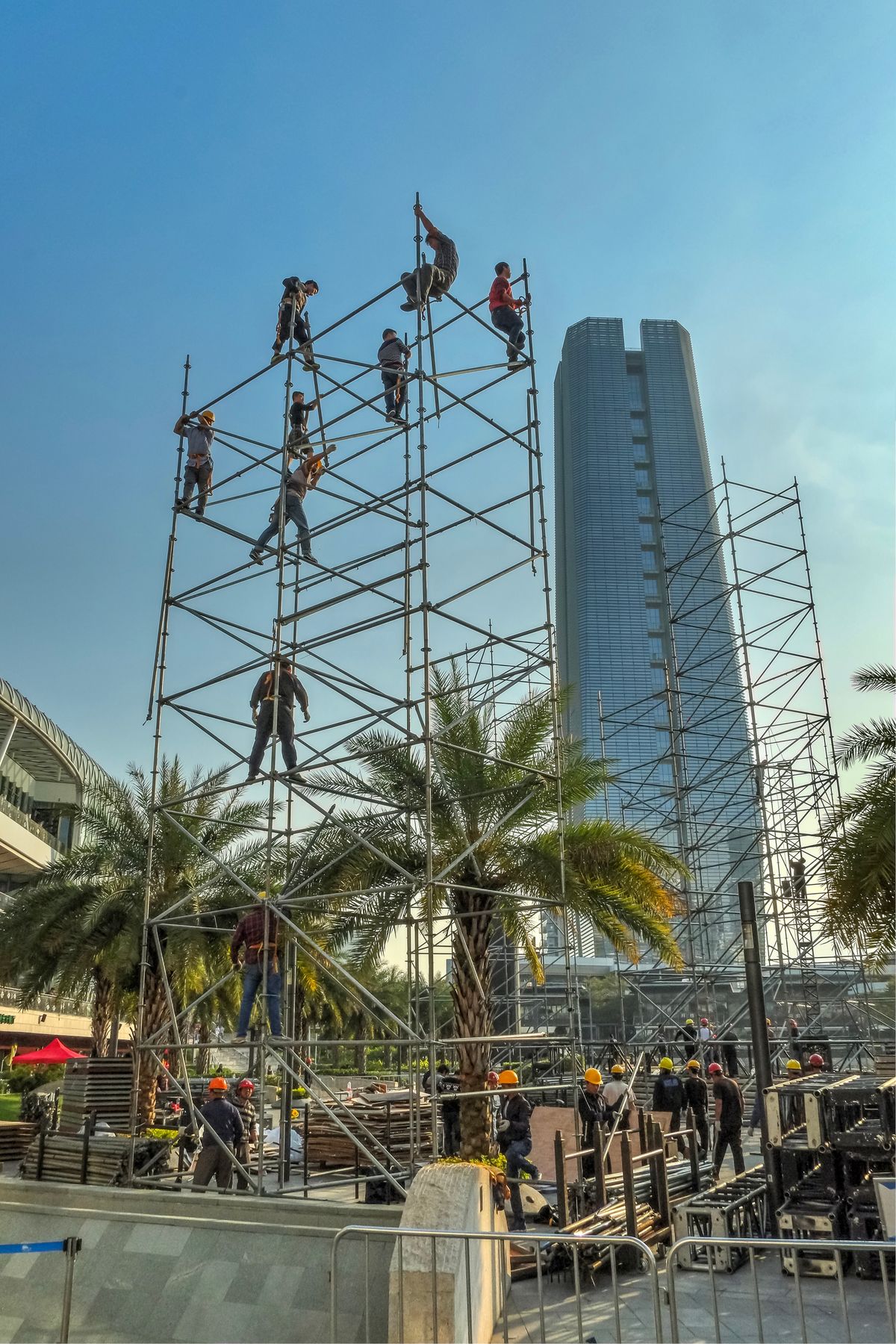
Why Scaffolding Is a Top OSHA Citation
Scaffolding (1926.451) ranked sixth on OSHA's FY2025 list of most-cited standards, behind fall protection (1926.501), which ranked first. Check OSHA's current published Top 10 for the latest year's citation count. Each serious violation carries a penalty of up to $16,550 in 2026 (29 CFR 1903.15(d), unchanged from 2025).
Scaffold falls, collapses, and falling objects injure and kill workers every year, and most of those incidents are preventable with proper setup, inspection, and fall protection.
On construction scaffolds, OSHA's 29 CFR 1926.451 requires fall protection at 10 feet, components that hold their own weight plus 4 times the maximum intended load, platforms at least 18 inches wide, safe access for platforms more than 2 feet above or below the access point, and an inspection by a competent person before each shift.
Related: See our Fall Protection Guide for comprehensive fall prevention requirements.
The 5 Key OSHA Scaffold Requirements
1. Capacity & Structural Integrity (1926.451(a))
Every scaffold and component must support its own weight plus 4× the maximum intended load without failure (1926.451(a)(1)). For suspension scaffolds, the ropes and connecting hardware carry a factor of 6× (1926.451(a)(3)-(4)).
| Scaffold Type | Safety Factor | Max Load Includes |
|---|---|---|
| Supported scaffolds | 4:1 | Workers + materials + equipment |
| Suspension ropes and hardware | 6:1 | Load applied or transmitted to the rope |
| Personal fall arrest anchors | 5,000 lbs per worker | Static load per attachment point |
Common citation trap: Overloading platforms with material stockpiles. Keep only the materials needed for immediate work on the platform.
2. Platform Construction (1926.451(b))
Scaffold platforms must be:
- At least 18 inches wide (with exceptions for narrow areas) (1926.451(b)(2))
- Fully planked as fully as possible, with no more than a 1-inch gap between the platform and the uprights (1926.451(b)(1)(i))
- Secured at each end: cleated or restrained, or extended at least 6 inches over the centerline of the support (1926.451(b)(4)), and overhanging no more than 12 inches on platforms 10 feet or shorter or 18 inches on longer ones, unless the cantilever is designed for it or blocked off (1926.451(b)(5))
⚠️ Inspection tip: Walk every level. The most common finding is missing planks or planks with visible defects (cracks, knots, warping).
3. Access Requirements (1926.451(e))
Workers cannot climb cross-braces to access scaffold platforms (1926.451(e)(1)). OSHA requires proper access when the scaffold platform is more than 2 feet above or below the access point:
- Portable, hook-on, or attachable ladders
- Stair towers, stairway-type ladders, ramps, walkways, or integral prefabricated scaffold access (1926.451(e)(1))
- Direct access from another scaffold or structure, only within 14 inches horizontally and 24 inches vertically (1926.451(e)(8))
4. Fall Protection (1926.451(g))
Fall protection is mandatory at 10 feet (1926.451(g)(1)):
| Scaffold Type | Required Protection |
|---|---|
| Most scaffolds, supported ones included | Guardrails OR personal fall arrest systems (1926.451(g)(1)(vii)) |
| Single-point and two-point adjustable suspension scaffolds | Personal fall arrest AND guardrails (1926.451(g)(1)(ii)) |
| Erecting or dismantling supported scaffolds | Wherever a competent person finds it feasible and not a greater hazard (1926.451(g)(2)) |
Aerial lifts are not scaffolds; they have their own rule, 1926.453.
Guardrail specifications:
- Top rail: 38–45 inches above platform on supported scaffolds placed in service after January 1, 2000 (36–45 inches on older supported scaffolds and where both guardrails and a personal fall arrest system are required) (1926.451(g)(4)(ii))
- Mid rail: Approximately midway between top rail and platform (1926.451(g)(4)(iv))
- Top rail strength: 200 lbs in any downward or horizontal direction, 100 lbs on single- and two-point adjustable suspension scaffolds (1926.451(g)(4)(vii))
- Toeboards: 3.5 inches minimum height (when workers below)
Falling objects are a separate duty (1926.451(h)). Guardrails protect the worker on the scaffold; 1926.451(h) protects the crew below — and OSHA's construction struck-by eTool calls struck-by "another leading cause of construction-related deaths." Beyond hard hats, workers must be shielded from falling hand tools, debris, and small objects by toeboards, screens, or guardrail systems, or by debris nets, catch platforms, or canopy structures (1926.451(h)(1)). Where larger objects could fall, the area below is barricaded and kept clear, or a canopy, net, or catch platform strong enough for the impact is erected over the people below (1926.451(h)(2)). A toeboard used for this must be at least 3½ inches high and take a 50-pound force (1926.451(h)(4)). That makes struck-by part of every scaffold inspection — see the Struck-By Safety hub for the equipment side (forklifts, vehicles, cranes).
5. Competent Person Requirements (1926.451(f))
A competent person must:
- Supervise and direct scaffold erection, moving, dismantling, or alteration (1926.451(f)(7))
- Inspect the scaffold before each shift and after any occurrence that could affect its integrity, such as a storm (1926.451(f)(3))
- Train erectors, dismantlers, and inspectors (1926.454(b)); scaffold users are trained by a person qualified in the subject (1926.454(a))
- Take immediate corrective action when hazards are identified (1926.451(f)(4))
Free Tool: Document your scaffold inspections with our Inspection Action Plan Builder.
Five Common Scaffold Citation Traps
These deficiencies come up again and again on scaffold inspections:
- Missing guardrails on open sides and ends (1926.451(g)(1))
- Improper access / climbing cross-braces (1926.451(e)(1))
- Platform deficiencies — gaps, unsecured planks (1926.451(b))
- No competent person inspection (1926.451(f)(3))
- Capacity violations — overloaded or unsupported scaffolds (1926.451(a))
Scaffold Inspection Checklist
Use this before every shift:
- Foundation is level, stable, on base plates/mudsills
- All bracing and ties installed per manufacturer specs
- Platforms fully planked, no gaps > 1 inch (1926.451(b)(1)(i))
- Guardrails on all open sides at 10+ feet
- Toeboards installed where workers below
- Access ladders or stair towers properly secured
- No overloading — only immediate-use materials on platform
- Power-line clearance per 1926.451(f)(6): 3 feet from insulated lines under 300 volts, 10 feet from other lines up to 50 kV, more above
- Competent person inspected before the shift (1926.451(f)(3)); a written record is good practice, not a Subpart L requirement
Pro tip: Use our HazCom Audit Checklist alongside scaffold inspections for complete jobsite compliance.
Training Requirements
1926.454 supplements the general training duty of 1926.21(b)(2) and splits scaffold training in two.
Everyone who works on a scaffold is trained by a person qualified in the subject (1926.454(a)) in:
- The electrical, fall, and falling-object hazards in the work area
- The correct procedures for dealing with electrical hazards and for the fall protection and falling-object protection systems in use
- Proper use of the scaffold and handling of materials on it
- The maximum intended load and load-carrying capacities
Everyone who erects, disassembles, moves, operates, repairs, maintains, or inspects a scaffold is trained by a competent person (1926.454(b)) in:
- The nature of scaffold hazards
- The correct procedures for that work on the type of scaffold in question
- The scaffold's design criteria, maximum intended load-carrying capacity, and intended use
Retraining is required when an employee lacks the skill or understanding for safe scaffold work, and at least when (1926.454(c)):
- Changes at the worksite present a hazard the employee was not trained on
- Changes in scaffold type, fall protection, falling-object protection, or other equipment do the same
- The employee's work shows the proficiency was not retained
Retraining after a scaffold incident is good practice even where none of these strictly applies.
Free Tool: Generate a Toolbox Talk on scaffold safety in seconds.
Penalty Calculations for 2026
| Violation Type | Per Violation | Example |
|---|---|---|
| Serious | $16,550 | Missing guardrails on one scaffold |
| Willful | $165,514 | Knowingly using defective scaffold |
| Repeat | $165,514 | Substantially similar violation within five years of the prior final order or abatement date (Field Operations Manual, Chapter 4) |
| Failure to Abate | $16,550/day | Not fixing cited hazard by deadline |
Three serious violations at the maximum would total $49,650; actual penalties are set by gravity and adjusted for size, history, and good faith (Field Operations Manual, Chapter 6).
Calculate your risk: Use our OSHA Fine Calculator to estimate penalties.
Key Takeaways
- Scaffolding (1926.451) ranked sixth on OSHA's FY2025 list of most-cited standards — every jobsite with scaffolds gets scrutinized
- Fall protection kicks in at 10 feet, with a feasibility exception only for erectors and dismantlers decided by a competent person (1926.451(g)(2))
- A competent person must inspect before every shift
- Platforms must be fully planked with no gaps over 1 inch
- Proper access (ladders or stairs) is required — no climbing braces
- Document inspections, training, and competent person designations; the rule requires the work, and the records prove it
The standard & related reading
- Scaffolding — 29 CFR 1926.451 (the standard itself)
- The hub: Fall Protection (OSHA 1926.501) — trigger heights, systems, anchorage, rescue
- Fall Protection in Construction (OSHA 2026) · OSHA Ladder Safety — Subpart X & the 4-Foot Rule
- OSHA Top 10 Most-Cited Violations 2026
- 2026 OSHA penalty schedule · penalties by state
Frequently Asked Questions
What OSHA standard covers scaffolding in construction?
29 CFR 1926.451 covers general scaffolding requirements for construction. Subpart L (1926.450–454) addresses capacity, platforms, access, fall protection, and training.
At what height is fall protection required on scaffolds?
Fall protection is required at 10 feet above a lower level on scaffolds in construction (29 CFR 1926.451(g)(1)). Most scaffolds take guardrails or a personal fall arrest system (1926.451(g)(1)(vii)); single-point and two-point adjustable suspension scaffolds need both (1926.451(g)(1)(ii)). For erectors and dismantlers of supported scaffolds, a competent person decides where fall protection is feasible (1926.451(g)(2)).
Who is a competent person for scaffolding?
Under 29 CFR 1926.450(b), a competent person can identify existing and predictable hazards and is authorized to take prompt corrective measures. On scaffolds that person supervises erection, moving, dismantling, and alteration and must be qualified in that work (1926.451(f)(7)), inspects before each shift (1926.451(f)(3)), and trains the erectors and inspectors (1926.454(b)).
How often must scaffolds be inspected?
A competent person inspects scaffolds and components for visible defects before each work shift and after any occurrence that could affect structural integrity (29 CFR 1926.451(f)(3)). A damaged or weakened part is repaired, replaced, braced, or removed from service immediately (1926.451(f)(4)). Subpart L requires the inspection, not a written record, though a dated log is how you prove it.
What is the maximum load capacity requirement for scaffolds?
Each scaffold and component must support, without failure, its own weight and at least 4 times the maximum intended load (29 CFR 1926.451(a)(1)). Suspension ropes and their hardware must hold at least 6 times the maximum intended load (1926.451(a)(3)), and on adjustable suspension scaffolds that load is figured at the hoist's rated load or 2 times its stall load, whichever is greater (1926.451(a)(4)).
OSHA figures and citations here come from our regulatory source-of-truth modules, last checked against the eCFR, OSHA.gov, and the Federal Register on October 5, 2026. Last reviewed October 6, 2026.
About This Article
Published by: HazComFast
Published: March 22, 2026
Last Updated: October 6, 2026
This content is for informational purposes only and does not constitute legal advice.