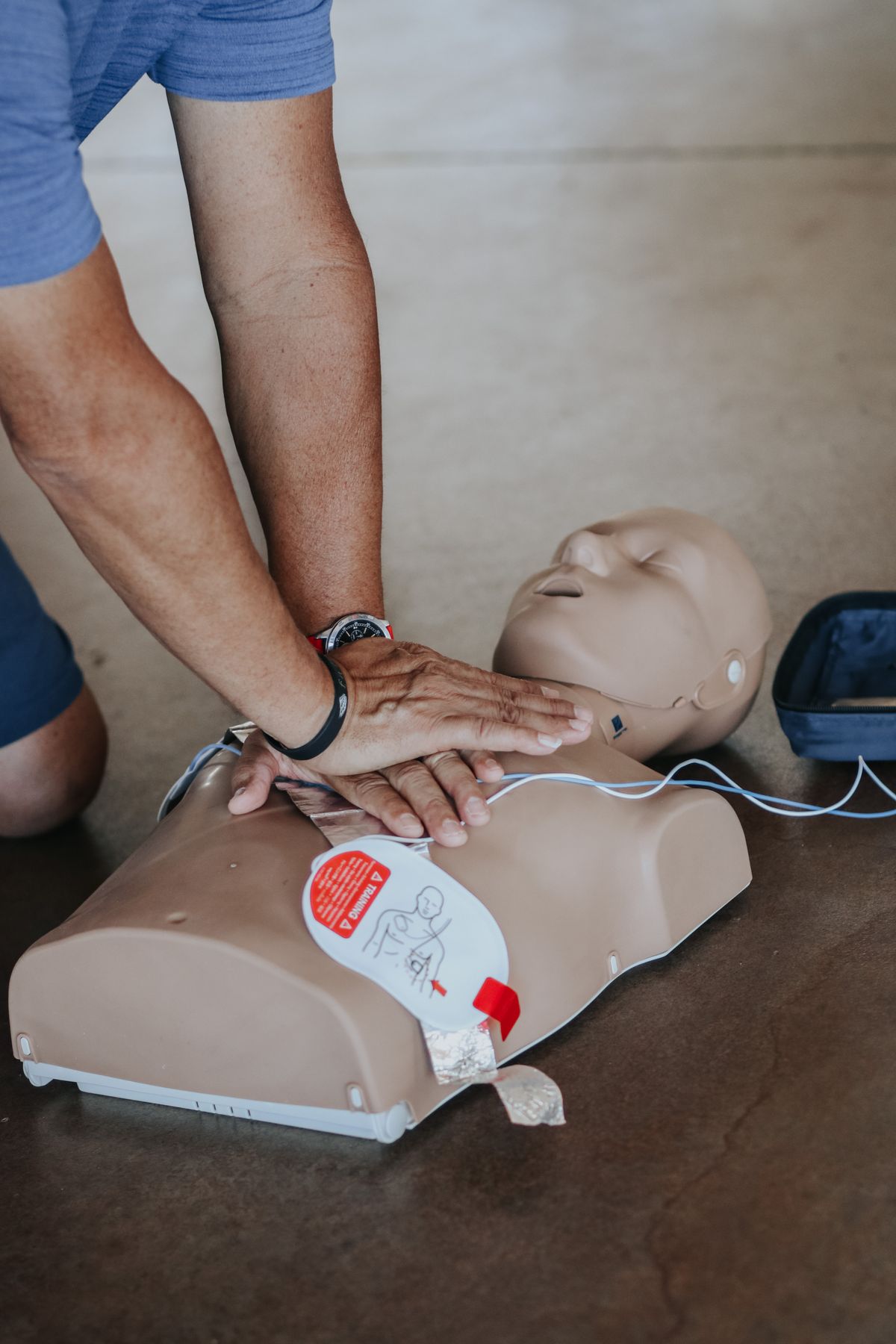
Under 29 CFR 1926.50(c), a construction employer must have a person with a valid first-aid certificate available at the worksite whenever no infirmary, clinic, hospital or physician is reasonably accessible in time and distance. The same section requires prompt medical attention arranged before the project starts, easily accessible first aid supplies, transport or a way to call an ambulance, and drench or flushing facilities where corrosive materials are used.
The rule is short, and it is cited. In fiscal year 2025, federal OSHA cited 1926.50 43 times in inspections of construction employers, most often for the missing trained person (paragraph (c), 17 citations) and the missing eyewash or drench facility (paragraph (g), 14). This guide takes the section paragraph by paragraph, then the questions it leaves open: how "reasonably accessible" is judged, which certificates count, what goes in the kit, and what OSHA's other rules add.
The Regulation: 29 CFR 1926.50 Paragraph by Paragraph
29 CFR 1926.50, Medical services and first aid, is the construction standard. Read on the eCFR (title 29 current as of September 25, 2026), it requires:
| Paragraph | Requirement |
|---|---|
| 1926.50(a) | The employer "shall insure the availability of medical personnel for advice and consultation on matters of occupational health" |
| 1926.50(b) | "Provisions shall be made prior to commencement of the project for prompt medical attention in case of serious injury" |
| 1926.50(c) | Without an infirmary, clinic, hospital or physician "reasonably accessible in terms of time and distance to the worksite," a person with a valid first-aid certificate "shall be available at the worksite to render first aid" |
| 1926.50(d)(1) | "First aid supplies shall be easily accessible when required" |
| 1926.50(d)(2) | Kit contents in a weatherproof container with individual sealed packages, checked before each job and at least weekly on each job |
| 1926.50(e) | Equipment for prompt transportation to a physician or hospital, or a communication system for contacting ambulance service |
| 1926.50(f)(1) | Where 911 dispatch is not available, the numbers of physicians, hospitals or ambulances are conspicuously posted |
| 1926.50(f)(2) | Where 911 is available and the employer relies on a communication system, the system must work, and if it does not send the caller's location, the site posts its latitude and longitude or other location information |
| 1926.50(g) | Where eyes or body may be exposed to injurious corrosive materials, facilities for quick drenching or flushing within the work area for immediate emergency use |
Two rule changes explain wording you may still see quoted. A 1998 rule removed the requirement that a consulting physician approve the first aid supplies and added the non-mandatory Appendix A on kits (63 FR 33450, June 18, 1998). A 2019 rule added the 911 and location provisions of (f)(2) (84 FR 21416, May 14, 2019).
General industry cross-reference: 1910.151
If you also run a shop, yard or office that is not construction work, 29 CFR 1910.151 is the general-industry counterpart. It has three paragraphs: medical personnel for advice ((a)), a person "adequately trained to render first aid" when no infirmary, clinic or hospital is "in near proximity" ((b)), and the same quick drenching or flushing facilities for corrosives ((c)). Neither 1910.151(c) nor 1926.50(g) sets a distance or a number of seconds; the consensus standard for eyewash and shower equipment is ANSI Z358.1, which OSHA's first aid page lists as a reference.
The "Reasonably Accessible" Question
OSHA has not written a time or distance into 1926.50(c). Two OSHA documents show how it reads the question:
- The 1990 letter. Answering a question about work over water under 1926.106(d), OSHA wrote on June 13, 1990 that an employer must also meet "the requirements that an injured employee be treated by medical personnel or an employee certified in first aid within three (3) to four (4) minutes from the time the injury occurred."
- The 2006 best practices guide (OSHA 3317). It advises employers to "obtain estimates of EMS response times for all permanent and temporary locations and for all times of the day and night at which they have workers on duty," and to use them when planning the first aid program.
On a jobsite, the clock runs from the injury to the first care, not to the hospital door. Several site conditions stretch it even when a hospital is close:
- Vertical access: a worker on an upper floor or a roof is several minutes from the street before transport starts.
- Confined spaces and excavations: retrieval comes before treatment.
- Remote work: highway, pipeline and utility projects far from any clinic.
- Traffic and closures: an urban work zone can slow an ambulance.
- Spread-out work fronts: a large site may put a crew far from the trailer.
If the honest answer to "can care start within minutes?" is no, plan for a certified person on site. Where the work involves permit-required confined spaces and the employer provides its own rescue, 1926.1211(b)(3) adds a specific rule: each affected rescue employee is trained in basic first aid and CPR, and at least one member of the rescue team or service holding a current first aid and CPR certification is available.
Who Needs to Be Trained, and in What
1926.50(c) asks for "a valid certificate in first-aid training from the U.S. Bureau of Mines, the American Red Cross, or equivalent training that can be verified by documentary evidence." It does not list course content. OSHA's first aid program page describes what standard courses cover: basic first aid intervention, basic adult CPR, universal precautions, and training for shock, bleeding, poisoning, burns, temperature extremes, musculoskeletal injuries, bites and stings, medical emergencies and confined spaces.
Certifying organizations
The regulation names two: the U.S. Bureau of Mines and the American Red Cross. Everything else is "equivalent training that can be verified by documentary evidence." OSHA's first aid page notes that training is primarily received through the American Heart Association, the American Red Cross, the National Safety Council and private institutions. Keep the certificate or card that documents the training: that is the "documentary evidence" the rule speaks of.
Hands-on practice
OSHA "recommends that CPR training include having trainees develop 'hands-on' skills through the use of mannequins and partner practice," and its 2006 guide lists hands-on skills among the principles of a training program. A course that ends with a skills check is the easiest one to defend as equivalent training.
How many trained people
OSHA sets no ratio. The test in 1926.50(c) is availability: a certified person available at the worksite whenever work is going on and care is not reasonably accessible. Plan around that test:
- Shifts: overtime, weekends and night work need their own coverage.
- Work areas: on a large site, each area needs someone who can reach it within minutes.
- Breaks and absences: one certified person who leaves the site leaves it uncovered.
- Turnover: train replacements before people leave.
- Subcontractors: each employer carries its own 1926.50 duty; agree in writing on who covers which crews.
First Aid Kit Requirements
1926.50(d)(1) requires first aid supplies to be "easily accessible when required." It does not list contents. The non-mandatory Appendix A to 1926.50 points to ANSI Z308.1-1978, "Minimum Requirements for Industrial Unit-Type First-aid Kits," as an example of minimal contents, says those contents "should be adequate for small work sites," and tells employers running larger or multiple operations at one location to determine the need for additional kits, equipment and supplies. In the 1998 rule, OSHA added that supplies beyond Appendix A "may be necessary to address specific work hazards and prevalent injuries."
Practical additions follow the hazards of the site: burn supplies where hot work goes on, eyewash where corrosives are handled (1926.50(g) requires the drench or flushing facility itself), and more kits where crews work far apart.
Kit inspections
1926.50(d)(2) sets two checks: the contents "shall be checked by the employer before being sent out on each job and at least weekly on each job to ensure that the expended items are replaced." A kit checked weekly on site but never before dispatch misses half the rule, and "at least weekly" is a floor. A short log makes the checks provable:
- Date of the check and who did it
- Items used and replaced
- Expiration dates checked
- Items added for site hazards
Free Tool: Track first aid training documentation with our HazCom Training Record generator.
What OSHA Cites Under 1926.50
In fiscal year 2025 (October 1, 2024 to September 30, 2025), federal OSHA issued 43 citations under 1926.50 in inspections of construction employers:
| Paragraph | What it requires | FY2025 citations |
|---|---|---|
| 1926.50(c) | A certified person available to render first aid | 17 |
| 1926.50(g) | Quick drenching or flushing facilities for corrosives | 14 |
| 1926.50(b) | Prompt medical attention arranged before the project | 7 |
| 1926.50(d)(1) | First aid supplies easily accessible | 2 |
| 1926.50(a) | Medical personnel for advice and consultation | 1 |
| 1926.50(e) | Transportation or a communication system for an ambulance | 1 |
| 1926.50(f)(2)(i) | A communication system that reaches emergency medical services | 1 |
Count: HazComFast, from the U.S. Department of Labor enforcement data (citations issued in the fiscal year, deleted citations excluded, federal OSHA inspections of employers classified in NAICS 23, extracted September 26, 2026). State Plan inspections are not included. 1926.23, the general first aid provision of Subpart C, drew no citations in the same data.
What the standard lets an inspector ask
Each paragraph turns into a question on site:
- "Who here is certified in first aid, and where is the certificate?" (1926.50(c))
- "How far, in minutes, is the nearest clinic or hospital, and how would care start before that?" (1926.50(b), (c))
- "Where is the kit, and when was it last checked?" (1926.50(d))
- "How would you get an injured worker to a hospital, or call an ambulance?" (1926.50(e))
- "Does your phone system give 911 your location? If not, where is it posted?" (1926.50(f))
- "Where is the eyewash for the corrosive products on this site?" (1926.50(g))
A serious violation carries a maximum of $16,550, and a willful or repeated one up to $165,514 (29 CFR 1903.15(d)); the classification depends on the facts of each case.
Emergency Response Planning for Medical Emergencies
1926.50(b) asks for the plan before the project starts: who gives first aid, how care is called, and how an injured worker reaches a hospital. Where another standard requires an emergency action plan under 1926.35, the medical response belongs in it; see our guide to emergency action plans in construction for when one is required.
Medical emergency protocol
- Immediate response: the certified person begins care.
- Call for help: 911, or the numbers posted under 1926.50(f)(1) where 911 is not available.
- Scene safety: no added hazards, such as fall edges or energized equipment.
- Guide EMS: someone meets the ambulance and leads it to the patient; the posted location under (f)(2) helps the dispatcher.
- Document: record the case for the 300 log and the investigation, and report a hospitalization, amputation or loss of an eye to OSHA within 24 hours (1904.39(a)(2)).
Medical emergency protocol: the first five moves
It works only if a certified person is already on site, which 1926.50(c) requires whenever care is not reasonably accessible.
AEDs
No Part 1926 standard requires an automated external defibrillator: the word does not appear in the construction standards. OSHA's 2006 best practices guide says "all worksites are potential candidates for AED programs" and that using an AED "within 3-4 minutes" of sudden cardiac arrest "can lead to a 60% survival rate." If you place one, put it where crews can reach it quickly, keep the batteries and pads current, and train the people who will use it.
Multi-Employer Site Coordination
Each employer on a shared site has its own 1926.50 duty for its employees. Coordination keeps that from becoming a gap:
- The general contractor usually sets the site-wide medical response: posted numbers and location, the route to the hospital, kit and eyewash locations, and who covers which areas.
- Each subcontractor confirms that its crews have a certified person available, or puts in writing which other employer's certified person covers them.
- Everyone reports injuries through the agreed channel so that the right employer records and reports them.
Related: Multi-employer worksite citation doctrine · Who records a temp worker's injury
Bloodborne Pathogens on a Construction Site
The bloodborne pathogens standard, 29 CFR 1910.1030, is a general-industry rule, and OSHA has said it does not apply to construction. In its 1993 answers to the most frequently asked questions about the standard, OSHA wrote: "The standard does not apply to agriculture or construction," adding that "the General Duty Clause (Section 5(a)(1) of the OSH Act) will be used, where appropriate, to protect employees from bloodborne hazards in construction." The 1998 rule says the same when it explains why Appendix A to 1926.50 omits the reference to 1910.1030 that the general-industry appendix carries.
The hazard is real for anyone who gives first aid, so the 1910.1030 model is a sound way to protect designated responders: an exposure control plan, gloves and CPR barriers in every kit, a hepatitis B vaccination offer, and a medical follow-up after an exposure. Keep the program's records with the responder's certificate. A shop or yard that is not construction work falls under 1910.1030 itself.
Training Documentation
1926.50(c) speaks of training "that can be verified by documentary evidence." For each certified person, keep:
- A copy of the current certificate or card, front and back
- The certifying organization, the date and the expiration date
- The skills covered (first aid, CPR, AED)
For the site:
- The list of certified people and the areas and shifts they cover
- The kit check log required by 1926.50(d)(2)
- The medical response arranged under 1926.50(b), with the posted numbers or location under (f)
Free Tool: Use our OSHA Deadline Calendar to track certificate expirations alongside other compliance deadlines.
Renewals
1926.50(c) requires a valid certificate, so an expired card leaves the role empty. The regulation sets no renewal period: the certifying organization does. OSHA's first aid program page recommends that "basic adult CPR retesting should occur every year and first aid skills and knowledge should be reviewed every three years." A 90-day reminder before each expiration gives time to schedule the class.
Key Takeaways
- 29 CFR 1926.50(c) requires a person with a valid first-aid certificate at the worksite whenever no infirmary, clinic, hospital or physician is reasonably accessible in time and distance; OSHA has not codified a number, and its 1990 letter speaks of care within three to four minutes.
- The regulation names the U.S. Bureau of Mines and the American Red Cross, or equivalent training verified by documentary evidence; OSHA recommends hands-on CPR practice.
- OSHA sets no ratio: cover every shift, crew and work area.
- Kits must be easily accessible, weatherproof, and checked before each job and at least weekly (1926.50(d)); ANSI Z308.1-1978 is the non-mandatory example in Appendix A.
- 1910.1030 does not apply to construction; OSHA uses the General Duty Clause for bloodborne hazards, and the 1910.1030 model protects responders.
- No Part 1926 standard requires an AED; OSHA's guide recommends considering one.
- In FY2025, OSHA cited 1926.50 43 times in construction, most often (c), (g) and (b).
Related: California First Aid & CPR (Cal/OSHA) · Emergency Action Plans for Construction · Reporting a severe injury to OSHA · HazCom Training Record
Sources: 29 CFR 1926.50 and its Appendix A, 1910.151, 1926.1211(b)(3), 1904.39 and 1903.15(d), read on the eCFR (title 29 current as of September 25, 2026) on October 2, 2026; 63 FR 33450 (June 18, 1998) and 84 FR 21416 (May 14, 2019); OSHA letters of June 13, 1990 and February 1, 1993; OSHA's first aid program page and Best Practices Guide OSHA 3317 (2006); citation counts from U.S. Department of Labor enforcement data, extracted September 26, 2026. Not legal advice; State Plan rules, such as Cal/OSHA's, may be stricter.
Frequently Asked Questions
Does OSHA require CPR and first aid training on construction sites?
First aid, conditionally. Under 29 CFR 1926.50(c), when no infirmary, clinic, hospital or physician is reasonably accessible in terms of time and distance, a person with a valid first-aid certificate (U.S. Bureau of Mines, American Red Cross, or equivalent training verified by documentary evidence) must be available at the worksite. 1926.50 does not mention CPR; other standards do, such as 1926.1211(b)(3) for an employer's own permit-space rescue team.
How many first aid trained employees does OSHA require per construction site?
OSHA sets no ratio. 29 CFR 1926.50(c) requires that a certified person be available at the worksite to render first aid whenever medical care is not reasonably accessible, so the plan has to cover every shift, crew and work area where people are working.
What first aid certifications does OSHA accept?
29 CFR 1926.50(c) names a valid certificate from the U.S. Bureau of Mines or the American Red Cross, or equivalent training that can be verified by documentary evidence. OSHA's first aid page says training is primarily received through the American Heart Association, the American Red Cross, the National Safety Council and private institutions, and OSHA recommends hands-on CPR practice with mannequins and partners.
How often must first aid and CPR certifications be renewed?
29 CFR 1926.50(c) requires a valid certificate, so a lapsed card does not meet it; the regulation sets no renewal period of its own. OSHA's first aid program page recommends retesting basic adult CPR every year and reviewing first aid skills and knowledge every three years.
What first aid supplies are required on a construction site?
29 CFR 1926.50(d)(1) says first aid supplies shall be easily accessible when required, and (d)(2) requires a weatherproof container with individual sealed packages, checked before the kit is sent to each job and at least weekly on each job. The non-mandatory Appendix A to 1926.50 points to ANSI Z308.1-1978 as an example of minimal contents. The physician-approval requirement was removed in 1998 (63 FR 33450). No Part 1926 standard requires an AED.
Can OSHA cite you for not having first aid coverage on site?
Yes. In fiscal year 2025, federal OSHA cited 29 CFR 1926.50 43 times in inspections of construction employers, most often paragraph (c), the trained person (17), paragraph (g), drenching and flushing facilities (14), and paragraph (b), prompt medical attention planned before the project (7). A serious violation carries a maximum of $16,550 (29 CFR 1903.15(d)).
What does 'reasonably accessible' mean under OSHA 1926.50?
OSHA has not codified a time or distance for 29 CFR 1926.50(c). In a June 13, 1990 letter about work over water (1926.106(d)), OSHA wrote that an injured employee must be treated by medical personnel or an employee certified in first aid within three to four minutes of the injury. OSHA's 2006 best practices guide tells employers to estimate EMS response times for each location and for every time of day they have workers on duty.
OSHA figures and citations here come from our regulatory source-of-truth modules, last checked against the eCFR, OSHA.gov, and the Federal Register on October 5, 2026. Last reviewed October 2, 2026.
About This Article
Published by: HazComFast
Published: March 29, 2026
Last Updated: October 2, 2026
- https://www.ecfr.gov/current/title-29/section-1926.50
- https://www.ecfr.gov/current/title-29/section-1910.151
- https://www.federalregister.gov/d/98-15936
- https://www.federalregister.gov/d/2019-07902
- https://www.osha.gov/laws-regs/standardinterpretations/1990-06-13
- https://www.osha.gov/laws-regs/standardinterpretations/1993-02-01-0
- https://www.osha.gov/medical-first-aid/programs
- https://www.osha.gov/sites/default/files/publications/OSHA3317first-aid.pdf
This content is for informational purposes only and does not constitute legal advice.