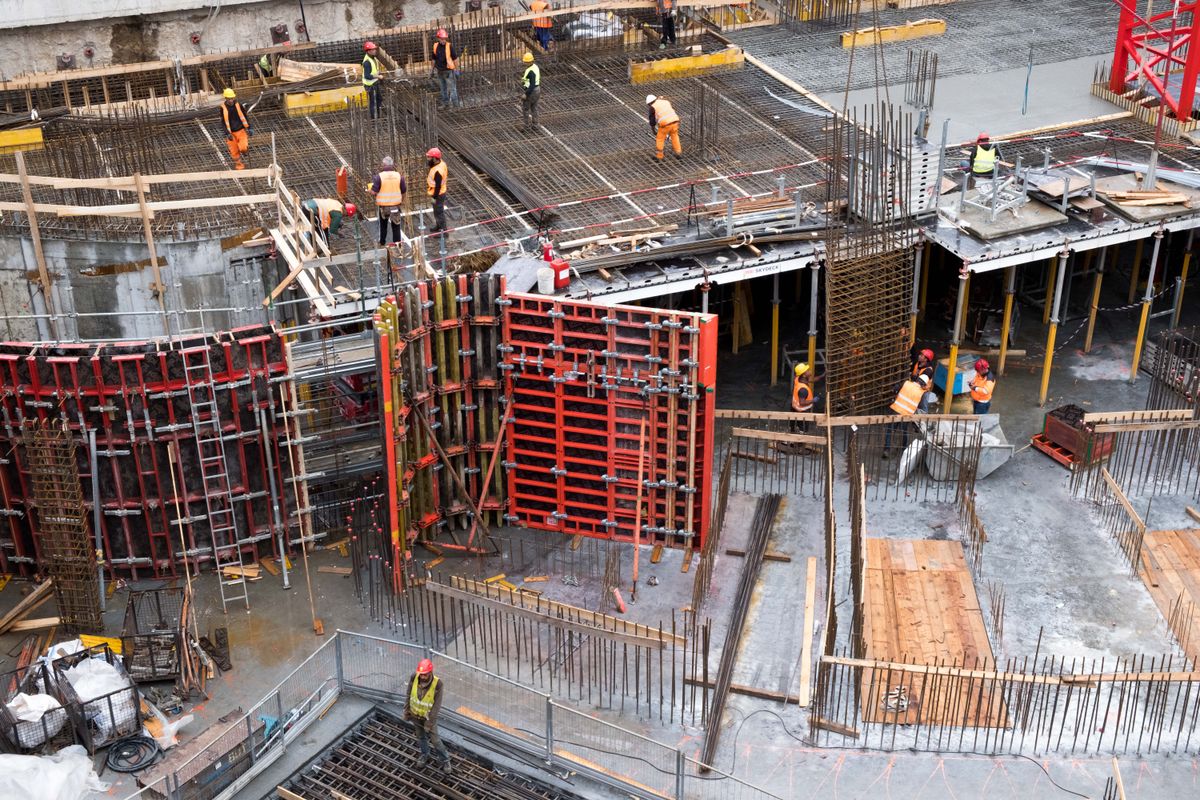
The First-Week Problem
New workers face unfamiliar hazards, unknown site layouts, and team dynamics they haven't learned yet, so OSHA's construction rules put training before exposure: HazCom at initial assignment, fall protection before work at height, and instruction in recognizing and avoiding unsafe conditions for every employee. OSHA's heat data show how concentrated the early risk can be: almost half of heat-related deaths occur on a worker's first day on the job or first day back after an extended absence, and over 70 percent during the first week.
The solution isn't more paperwork — it's a structured orientation that covers the right topics, in the right order, before the new hire picks up a single tool.
The rules put training first. HazCom training happens at initial assignment (29 CFR 1910.1200(h)(1), applied to construction by 29 CFR 1926.59), fall protection training before exposure (29 CFR 1926.503(a)(1)), and every employee gets instruction in recognizing and avoiding unsafe conditions (29 CFR 1926.21(b)(2)).
Why day-one orientation matters
Sources: OSHA, Protecting New Workers (heat); 29 CFR 1910.1200(h)(1) and 1926.503(a)(1). The fix is a structured orientation before the new hire picks up a tool.
What the Rules Require Before Day-One Work
No federal rule prescribes an "orientation," but several construction standards put training before exposure. These are the ones a new hire meets first:
| Topic | Rule | When |
|---|---|---|
| Recognizing and avoiding unsafe conditions | 29 CFR 1926.21(b)(2) | Every employee |
| Hazardous chemicals (HazCom) | 29 CFR 1910.1200(h)(1), applied by 29 CFR 1926.59 | At initial assignment, and whenever a new chemical hazard is introduced into the work area |
| Fall protection | 29 CFR 1926.503(a)(1) | Each employee who might be exposed to fall hazards, with a written certification record (1926.503(b)(1)) |
| Ladders and stairways | 29 CFR 1926.1060(a) | Each employee using ladders and stairways, as necessary |
| Scaffolds | 29 CFR 1926.454(a) | Each employee who performs work while on a scaffold |
| Respirators | 29 CFR 1910.134(k)(3), applied by 29 CFR 1926.103 | Before the employee is required to use a respirator |
| Confined spaces | 29 CFR 1926.1207(b)(2) | Before the employee is first assigned duties under Subpart AA |
| Emergency action plan | 29 CFR 1926.35(e)(2) | When the plan is developed, when the employee's role changes, and when the plan changes |
The orientation below is how those duties land on the first morning, in an order a new worker can follow.
The 8-Step Orientation Framework
Step 1: Company Safety Policy & Culture (15 min)
Before anything technical, set the tone:
- Safety is a core value — not a compliance checkbox
- Stop Work Authority — every worker has the right and duty to stop unsafe work
- No retaliation — reporting hazards is expected, not punished
- Drug and alcohol policy — zero tolerance, testing procedures
- Your company's EMR (Experience Modification Rate) and safety record
Step 2: Site-Specific Hazard Briefing (30 min)
Every jobsite is different. Cover the specific hazards present today:
| Hazard Category | What to Cover |
|---|---|
| Fall hazards | Open edges, floor holes, elevator shafts, roof work |
| Struck-by hazards | Crane zones, material storage, overhead work |
| Electrical hazards | Temporary power, overhead lines, live panels |
| Excavation hazards | Open trenches, spoil piles, traffic near edges |
| Chemical hazards | What chemicals are on site, SDS locations |
| Confined spaces | Permit-required spaces, atmospheric hazards |
Free Tool: Generate a site-specific Toolbox Talk covering the hazards most relevant to today's work.
Step 3: Emergency Procedures (20 min)
New hires must know before they start work:
- Evacuation routes — walk them physically, don't just point at a map
- Muster point — take them there
- Alarm signals — play the alarm so they recognize it
- Emergency contacts — site superintendent, safety officer, 911
- First aid kit locations — every one on site
- Nearest hospital — address, phone number, posted in break area
Step 4: Hazard Communication Training (30 min)
Required under 29 CFR 1926.59 / 1910.1200. Cover:
- What the HazCom standard requires and why
- SDS access — where they are, how to read them (focus on Sections 2, 4, 8)
- GHS labels — pictograms, signal words, hazard statements
- Secondary container labeling — when and how to label
- Chemical-specific hazards — the top 5 chemicals on this site
Free Tool: Use our GHS Label Generator to create secondary container labels before the new hire starts.
Step 5: PPE Requirements (20 min)
Cover what's required site-wide and what's task-specific:
Site-wide minimums (typical):
- Hard hat (ANSI Z89.1 Type I or II)
- Safety glasses (ANSI Z87.1)
- High-visibility vest (ANSI/ISEA 107 Class 2+)
- Work boots (ASTM F2413, steel or composite toe)
- Gloves (task-appropriate)
Task-specific additions:
- Fall protection harness (at 6 feet or more above a lower level, 1926.501(b)(1), when a personal fall arrest system is the protection used)
- Hearing protection (where noise exceeds the construction permissible exposure in 1926.52, 90 dBA over 8 hours; NIOSH's recommended limit is 85 dBA)
- Respiratory protection (dust, fumes, chemicals)
- Face shields (grinding, cutting, chemical splash)
Free Tool: Use our PPE Selector to match PPE to specific GHS pictograms.
Step 6: Fall Protection Overview (20 min)
Falls are the leading cause of death in construction: OSHA's Fall Prevention Campaign reports 389 fatal falls to a lower level out of 1,034 construction fatalities in 2024 (BLS data). Every new hire must understand:
- 6-foot trigger — fall protection required at 6 feet or more above a lower level (1926.501(b)(1))
- Three types: Guardrails, safety nets, personal fall arrest systems
- Harness inspection — how to check for damage before each use
- Anchor points — what qualifies as a valid anchor: 5,000 lbs per employee attached, or designed by a qualified person as part of a complete system with a safety factor of at least two (1926.502(d)(15))
- Controlled access zones — when and where they're used
Step 7: Reporting Requirements (10 min)
Explain exactly how to report:
- Hazards — who to tell, what to document
- Near misses — why they matter (each one is a warning)
- Injuries — first aid procedures, when to call 911
- Equipment deficiencies — tag-out procedures for damaged tools/equipment
- Unsafe conditions — Stop Work Authority in practice
Step 8: Site Walk & Practical Demonstration (30+ min)
The classroom portion is useless without a physical walkthrough:
- Walk every evacuation route
- Show muster points
- Point out chemical storage areas and SDS locations
- Identify fall hazard zones and protection in use
- Show restroom, break area, water stations
- Demonstrate PPE donning/doffing
- Introduce the new hire to their crew lead and safety contact
Documentation
What to Document:
| Field | Example |
|---|---|
| Employee name | John Smith |
| Employee signature | (signed) |
| Date of orientation | March 17, 2026 |
| Topics covered | (checklist with checkmarks) |
| Trainer name & title | Jane Doe, Safety Director |
| Trainer signature | (signed) |
| Site/project name | Highway 101 Bridge Replacement |
| Duration | 3.5 hours |
Retention:
- No general OSHA rule sets a retention period for orientation records; keep them at least through employment. Where a standard requires a written training record, follow it: fall protection training is certified in writing, and the latest certification is kept (1926.503(b)(1) and (b)(2)).
- Digital records are acceptable — use our HazCom Training Record generator
- The four-business-hour rule in 29 CFR 1904.40(a) covers injury and illness records, not training files; still keep orientation records where you can produce them quickly.
Subcontractor Orientation Protocol
On multi-employer sites, OSHA's Multi-Employer Citation Policy (CPL 02-00-124) expects a controlling employer to exercise reasonable care to prevent and detect violations, and 29 CFR 1910.1200(e)(2) requires each employer's HazCom program to cover how it shares SDSs, precautions and labeling with the other employers. Ensure sub employees receive:
- GC site orientation covering evacuation, muster, and site-wide hazards
- Sub-specific orientation covering their trade hazards and PPE
- Daily pre-task planning — brief review of that day's hazards
Free Tool: Use our Subcontractor RFI Writer to request missing safety documentation from subs before they mobilize.
Key Takeaways
- Train before exposure: HazCom at initial assignment, fall protection before work at height
- Cover 8 topics minimum: policy, site hazards, emergencies, HazCom, PPE, falls, reporting, site walk
- Walk the site physically — classroom alone isn't enough
- Document everything — sign-in sheets, topics covered, trainer signature
- Subcontractor employees need GC site orientation too
- Keep orientation records at least through employment, and follow any standard that sets its own rule (1926.503(b))
- Use Stop Work Authority as the cornerstone of your safety culture
Frequently Asked Questions
What safety training does OSHA require for new construction workers?
Federal construction rules require the employer to instruct each employee in recognizing and avoiding unsafe conditions (29 CFR 1926.21(b)(2)), HazCom training at initial assignment (29 CFR 1910.1200(h)(1), applied by 1926.59), and fall protection training for each employee who might be exposed to fall hazards (29 CFR 1926.503(a)(1)). Task standards add their own training, for example ladders (1926.1060), scaffolds (1926.454), respirators (1910.134(k), via 1926.103) and confined spaces (1926.1207).
How long should a construction safety orientation take?
No OSHA rule sets a length; plan it by content. The eight steps in this checklist add up to about three hours (15 + 30 + 20 + 30 + 20 + 20 + 10 + 30 minutes), split between a classroom and a site walk. What is fixed is the timing: HazCom training at initial assignment, before the worker handles the chemicals (29 CFR 1910.1200(h)(1)).
Do subcontractor employees need the GC's safety orientation?
Each subcontractor must train its own employees under the standards that apply to them. OSHA's Multi-Employer Citation Policy (CPL 02-00-124) can also cite a controlling employer, usually the GC, that fails to exercise reasonable care to prevent and detect violations on the site, so many GCs run a site orientation for every worker: evacuation routes, hazard areas and emergency contacts. Where several employers share a site, each one's HazCom program must also cover how it gives the others access to SDSs and informs them of precautions and labels (29 CFR 1910.1200(e)(2)).
How do I document safety orientation for OSHA?
Use a sign-in sheet with the employee's name and signature, the date, the topics, the trainer and the site. Some standards require a written record: fall protection training is certified in writing with the employee's name, the training date(s) and the trainer's or employer's signature, and the latest certification is kept (29 CFR 1926.503(b)). HazCom sets no record form or retention period; keep orientation records at least through employment.
Why are new workers at higher risk?
They meet unfamiliar hazards, an unknown site layout and a crew they do not know yet, and OSHA's heat data show how concentrated the early risk can be: almost half of heat-related deaths occur on a worker's first day on the job, and over 70 percent in the first week. That is why the rules put training before exposure: HazCom at initial assignment (29 CFR 1910.1200(h)(1)) and fall protection training for each employee who might be exposed to fall hazards (29 CFR 1926.503(a)(1)).
OSHA figures and citations here come from our regulatory source-of-truth modules, last checked against the eCFR, OSHA.gov, and the Federal Register on October 5, 2026. Last reviewed October 5, 2026.
About This Article
Published by: HazComFast
Published: March 17, 2026
Last Updated: October 5, 2026
This content is for informational purposes only and does not constitute legal advice.